

WDYM Field Guide · What Time Binds · October 28, 2026
On June 7, 2025, the President signed a memorandum that named no state, no city and no crowd. It called up “at least 2,000 National Guard personnel” under 10 U.S.C. 12406 for “60 days or at the discretion of the Secretary of Defense.” One sentence set the condition:
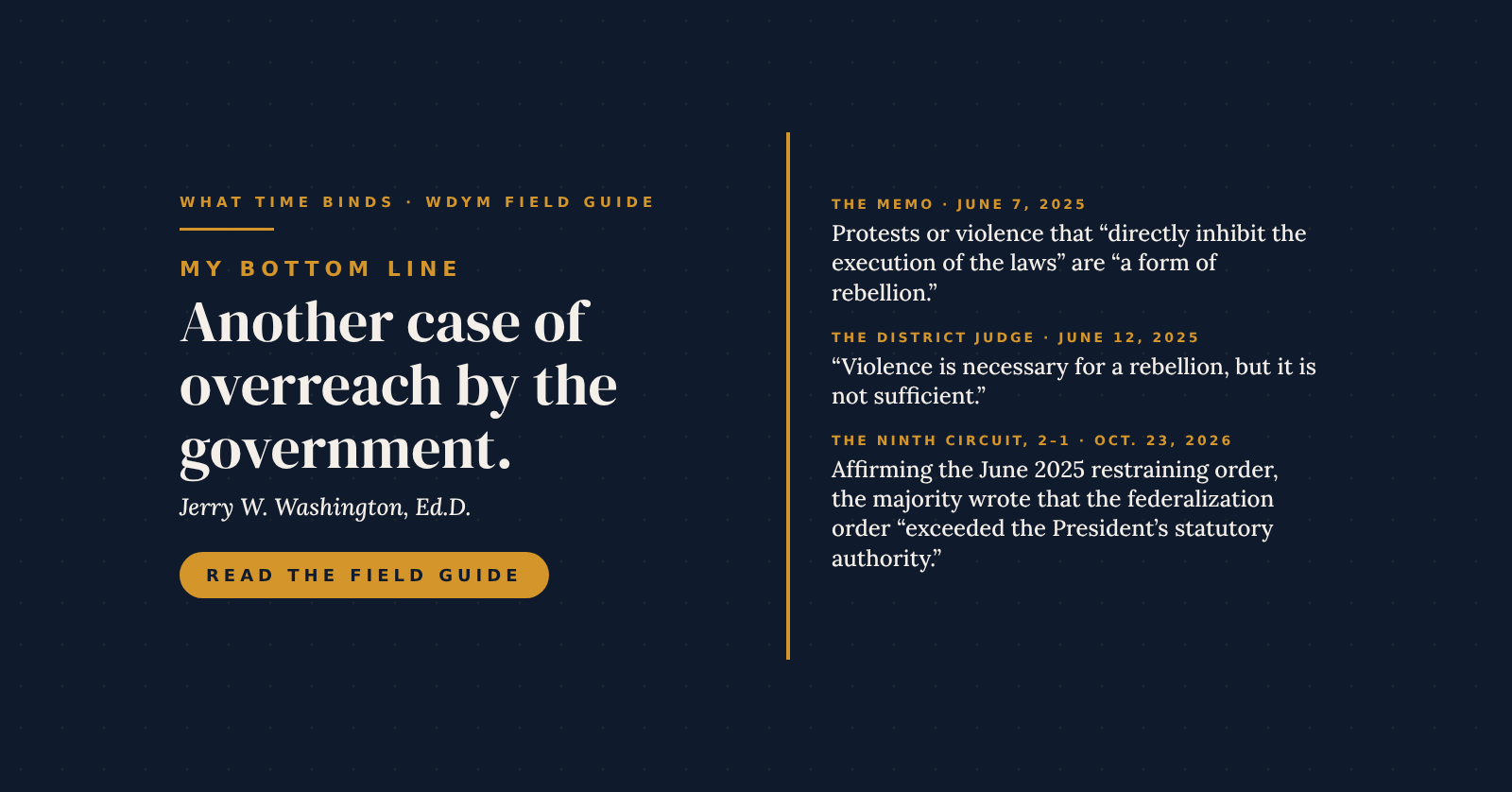
“To the extent that protests or acts of violence directly inhibit the execution of the laws, they constitute a form of rebellion against the authority of the Government of the United States.”
Open the memo and find the sentence that starts “To the extent.” Then look for the name of a state. You will not find one.
The Ninth Circuit supplied the place and the number later. Its opinion begins the story this way: “In early June 2025, federal enforcement of immigration laws gave rise to public demonstrations in Los Angeles.” Then it says: “In response, the President invoked 10 U.S.C. § 12406 to order 4,000 members of California’s National Guard into federal service for 60 days to protect federal property and personnel.”
Guard members went under federal orders the day the memo was signed. Five days later, a district judge defined the word and found the condition likely unmet. On Oct. 23, 2026, 503 days after the memo, the Ninth Circuit agreed.
Two Meanings, One Word
Section 12406 of Title 10 lets the President call the Guard into federal service when “there is a rebellion or danger of a rebellion against the authority of the Government of the United States.” The same section names the job that follows: “repel the invasion, suppress the rebellion, or execute those laws.” The statute asks whether a rebellion, or the danger of one, exists.
The memo answered with a definition. Its rebellion is “protests or acts of violence” that “directly inhibit the execution of the laws.” The memo keeps the statute’s closing phrase, “against the authority of the Government of the United States,” and puts three words in front of the noun: “a form of.” Paragraph (2) of the statute has no such phrase.
By the memo’s sentence, a protest that directly gets in the way of enforcing the laws becomes a form of rebellion. The sentence asks for no weapons, no organization and no aim at the government as a whole. Each of those missing pieces shows up in the definition the courts applied.
Three words, “a form of,” stretched a statute’s trigger to fit a protest, and 503 days passed before the Ninth Circuit read the word against the law in California’s case. Every Wednesday I take one word an institution bent and show the page it bent on. Subscribe and the next one is in your inbox, free.
Look It Up
Five days after the memo, on June 12, 2025, the district court defined the statute’s word. A rebellion, it wrote, is “a violent, armed, organized, open and avowed uprising against the government as a whole.” On Oct. 23, 2026, the Ninth Circuit adopted that reading: “we continue to conclude that a ‘rebellion’ is an unusual and extreme exigency, and we agree with the district court’s interpretation.”
Counting “open and avowed” as one, that definition carries five conditions, and an uprising has to meet all of them. It has to be violent, armed, organized, open and avowed, and aimed at the government as a whole.
The court also quoted the 1903 edition of Webster’s International Dictionary, which defines rebellion as “open and avowed renunciation of the authority of the government to which one owes obedience, and resistance to its officers and laws,” and the quotation runs on from there. Renunciation of the government’s authority comes first, joined to resistance by “and.” Even the June 2025 stay order, which went the President’s way, described rebellions as “unusual and extreme exigencies . . . that threaten the normal operations of civil government,” as the October opinion quotes it. The statute’s tense matters too. “Because the statutory text uses the present tense,” the court read it to require that “the asserted exigency exists at the time the order is issued.”
Open the opinion to page 61 and count the conditions in the district court’s definition. Then go back to the memo’s sentence and count the ones it asks for.
Now look at where else the word appears in the law. The Constitution lets the writ of habeas corpus be suspended only “when in Cases of Rebellion or Invasion the public Safety may require it.” The Fourteenth Amendment bars from office a person who swore “to support the Constitution of the United States” and then “shall have engaged in insurrection or rebellion against the same.” The federal criminal code punishes anyone who “engages in any rebellion or insurrection against the authority of the United States or the laws thereof” with up to ten years in prison, and a person convicted “shall be incapable of holding any office under the United States.” The Insurrection Act lets a President use troops “Whenever the President considers that unlawful obstructions, combinations, or assemblages, or rebellion against the authority of the United States” make it impracticable to enforce the laws “by the ordinary course of judicial proceedings.”
In each of those four places, something grave follows: a suspended writ, a bar from office, a prison term, troops.
Five Days, Then 503
The courts took the word up in this order.
June 7, 2025. The memo calls protests or acts of violence that “directly inhibit the execution of the laws” “a form of rebellion.” In early June, by the Ninth Circuit’s account, the President orders 4,000 California National Guard members into federal service for 60 days.
June 12, 2025. A district judge finds the statute’s conditions likely unmet. The order bars deploying the Guard in Los Angeles and directs the government “to return control of the California National Guard to Governor Newsom.” The Ninth Circuit puts the order on hold the same day.
June 19, 2025. Three appeals judges, Mark J. Bennett, Eric D. Miller and Jennifer Sung, keep it on hold. They find it “likely that the President lawfully exercised his statutory authority under § 12406(3),” the clause about “regular forces.” On the rebellion clause they write, “we do not reach the other condition invoked by the President, § 12406(2).”
Dec. 23, 2025. In a case from Illinois, the Supreme Court says “regular forces” in § 12406(3) “likely refers to the regular forces of the United States military” and denies the government’s application.
Jan. 23, 2026. The government asks the Ninth Circuit to dismiss its own appeal.
Oct. 23, 2026. The same three judges rule 2 to 1 that the plaintiffs are “likely to succeed.” Judge Sung writes the opinion, and Judge Bennett dissents. “Accordingly, § 12406(2) did not authorize the President’s order federalizing the California National Guard.” On the regular-forces clause, the court concludes that “Defendants have not made either of the required threshold showings here.” In a separate order, it refuses to let the government drop this appeal.
Put three dates on one line: June 7, 2025, June 19, 2025, and Oct. 23, 2026. The first is the memo, the second is “we do not reach,” and the third is the ruling. The rebellion question sat unreached at the appeals court for 491 days.
The Strongest Case for the Memo
The memo has a defense, and it deserves its full weight here.
First, the memo hedged. “To the extent that” makes its definition conditional, and the memo named no city. Read that way, it described a category and left the facts on the ground for later.
Second, the same three judges reviewed the same call-up in June 2025 and found the President likely acted lawfully under the regular-forces clause. The October opinion came after the Supreme Court read “regular forces” in the Illinois case.
Third, Judge Bennett would not have decided the appeal at all. He would have let the government drop it. In his dissent from the order that kept the appeal, he wrote that the court had “received scant briefing on several significant issues.” The court’s staff summary, which is not part of the opinion, says his dissent also argues that the majority “disregarded the legal standard that governs statutory ultra vires claims.” The same summary says Judge Miller’s concurrence stresses that the government forfeited one argument: that an ultra vires claim, the kind California brought, “is not available in this case.” The government could raise it in a future case.
Fourth, the October opinion rules on likelihood. The court concluded that the plaintiffs are “likely to succeed” on their claim.
The record answers the first two points. The hedge leaves the definition in place: a protest that directly inhibits enforcement still counts as “a form of rebellion” under the memo’s sentence. And the June order did not reach the rebellion clause; it said so in writing. The last two points stand. The dissent disputes the standard the majority applied, and the ruling is about likelihood. That standard gives the President’s call wide room. It asks only whether the determination falls within a range of honest judgment, and the court concluded the plaintiffs are likely to show that it “does not reflect a colorable assessment within a ‘range of honest judgment.’”
Were the Protests Peaceful?
A reader asked that on Sunday’s card. If they were not, the reader wrote, “that’s a violation of the Constitution.” The question carries the memo’s logic in a reader’s words: find violence, and the word follows.
The record answers both halves. Some protesters were violent. The Ninth Circuit’s June 2025 stay order recounts “concrete chunks, bottles of liquid, and other objects” thrown at federal officers, and “a Molotov Cocktail at deputies.” That same order put the district judge’s ruling on hold without reaching the rebellion clause. The district judge had said so too. In his June 12, 2025 order, Judge Charles R. Breyer wrote that “there can be no debate that most protesters demonstrated peacefully,” and that “it is also beyond debate that some individuals used the protests as an excuse for violence and destruction.”
Then he answered the logic behind the question: “Violence is necessary for a rebellion, but it is not sufficient.” On the same page he also wrote that “a rebellion must be against the government as a whole,” and that “the Court is aware of no evidence in the record of actual firearms.” His conclusion: “The protests in Los Angeles fall far short of ‘rebellion.’”
The Constitution’s part is narrower than the reader’s. The First Amendment protects “the right of the people peaceably to assemble,” so violence gets no cover there, and the criminal law reaches it. On page 21 the judge pointed to a line courts “have repeatedly reaffirmed”: “peaceful protest does not lose its protection merely because some isolated individuals act violently.”
My Bottom Line
My bottom line is that this is another case of overreach by the government. Two of the three judges put this order in the law’s terms when they affirmed the June 2025 restraining order. Because neither clause authorized the President’s initial federalization order, the majority wrote, “the order exceeded the President’s statutory authority and encroached on Congress’s calling forth power, in violation of the constitutional separation of powers.” Judge Bennett dissented.
Why It Matters This Week
The government asked to drop this appeal in January. On Oct. 23 the panel refused, over Judge Bennett’s dissent, and let the government drop a second appeal, No. 25-7781. Among its reasons for keeping this one: “The possibility of such federalization and deployment is not speculative.” The opinion is published, so its reading binds courts in the Ninth Circuit unless the full court or the Supreme Court sets it aside.
The Insurrection Act uses the word too, under a different test. It turns on what the President “considers,” and it lists “unlawful obstructions, combinations, or assemblages” beside rebellion. The five conditions above come from the court’s reading of § 12406. The court did not apply its definition to that Act.
Election Day is Tuesday. If you hear an official call something a rebellion between now and the count, you have the court’s conditions for § 12406 and a date to check them against.
The Pin
Rebellion, as this field guide pins it: a violent, armed, organized uprising that openly renounces the government’s authority as a whole. The pin follows the Ninth Circuit’s Oct. 23, 2026 reading of 10 U.S.C. § 12406(2), which adopted the district court’s definition, and the 1903 Webster’s the court quoted.
What it includes: an uprising that meets all five conditions at once. The same word appears where the Constitution allows habeas corpus to be suspended “in Cases of Rebellion or Invasion,” and where the Fourteenth Amendment bars from office an oath-taker who “engaged in insurrection or rebellion.”
What it cannot be read to say: that a protest becomes a rebellion because it slows the enforcement of a law; that violence by some people in a crowd turns the crowd into an uprising against the government as a whole; that “a form of rebellion” counts as a rebellion.
The habit, in three steps.
When “rebellion” shows up in an order, find the sentence that defines it and write down every condition it asks for.
Set those conditions beside the five in the court’s definition: violent, armed, organized, open and avowed, against the government as a whole.
Check the record for the day the order issued. The court reads the statute to require that “the asserted exigency exists at the time the order is issued.”
The question to carry: Who rose against the government as a whole, with what arms, on the day the order issued?
The script. When someone tells you the Los Angeles protests were a rebellion, say this:
“The appeals court agreed that the word means ‘a violent, armed, organized, open and avowed uprising against the government as a whole.’ Show me the page that puts all five on the ground on June 7, 2025, and we can read it together.”
Fifteen seconds, one page asked for. If the page exists, it takes a minute to bring.
Before the Count
Folks, Election Day is Nov. 3. Every House seat and about a third of the Senate are on the ballot. See every race on your ballot at vote411.org.
How the links work. Every link sits on its source document: the memo, the statutes, the Constitution and the court orders. When you pass one of these facts along, pass the link with it.
Decision / Definition Log
Term pinned: Rebellion (noun), as used in 10 U.S.C. § 12406(2).
Pinned definition: A violent, armed, organized uprising that openly renounces the government’s authority as a whole. Built from the Ninth Circuit’s opinion in Newsom v. Trump (Oct. 23, 2026, p. 61), the district court’s June 12, 2025 definition it adopted, and Webster’s International Dictionary (1903).
Operational definition, as used June 7, 2025: “protests or acts of violence” that “directly inhibit the execution of the laws.”
Not the same as: a protest that slows the enforcement of a law, or “a form of rebellion.”
Test before using the word: Name the violence, the arms, the organization, the open declaration and the government the uprising rejects, as of the day of the order. If any answer is blank, the word does not fit.
Paid subscriptions open at 500 readers, and the paid product is Coded Threads, the codebooks built from these comment sections. A pledge now is a vote for that.
Jerry W. Washington, Ed.D., is a Marine Corps veteran of twenty-three years, a combat engineer by trade, an instructor at UC Irvine’s Division of Continuing Education, and the writer of What Time Binds, a record of how institutions bend words and how the page holds them to account.