

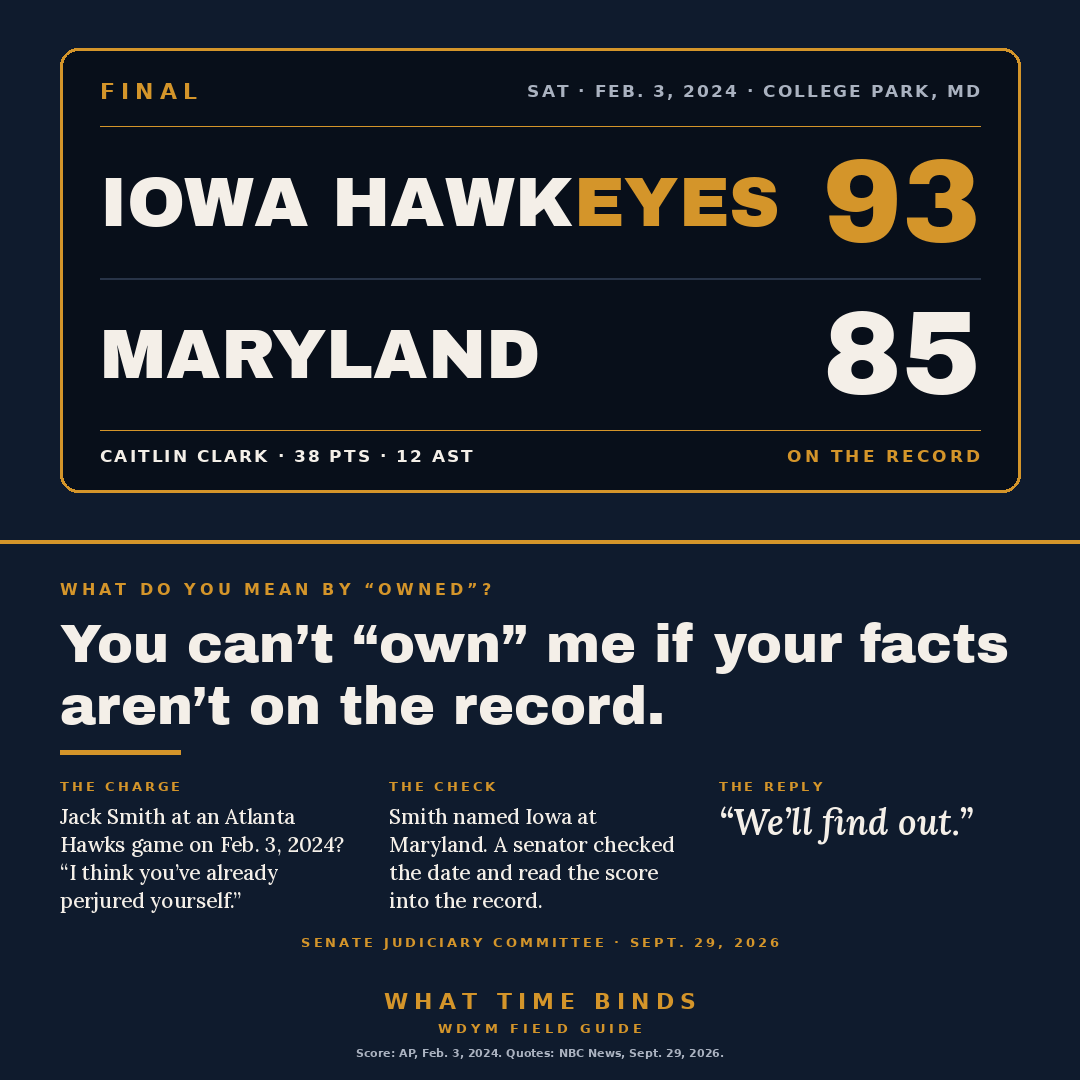
On February 3, 2024, Iowa beat Maryland 93 to 85 in College Park. Caitlin Clark scored 38 points with 12 assists. The box score is still posted.
On September 29, 2026, that box score ended a perjury accusation in the United States Senate.
At a Senate Judiciary Committee hearing with former special counsel Jack Smith as the witness, Sen. Eric Schmitt of Missouri asked a question with a date in it. “Did you go to an NBA game between the Golden State Warriors and the Atlanta Hawks on February 3, 2024?” Smith said no. Schmitt said he had texts from Smith’s team placing him in Atlanta that day, the day after, as Schmitt put it, Georgia prosecutors Fani Willis and Nathan Wade “announced their affair.” A staffer held up a poster board.
“I don’t think you know that we have this stuff, so I’ll give you a second to process it so you don’t perjure yourself,” Schmitt said. Then: “I think you’ve already perjured yourself.” Smith, he added, would go down in history as “a total dirtbag.” (NBC News)
Smith said the one game he remembered from that date was Iowa at Maryland. “The Marshals Service was there with me,” he said. “You could check if that was the exact date.”
Sen. Amy Klobuchar of Minnesota checked. “Iowa, the Iowa Hawkeyes, played Maryland on February 3, 2024,” she told the committee. Schmitt had the right date, the wrong team, and a perjury charge built on the gap. The Missouri Independent noted that the texts on his poster never mentioned Atlanta.
See for yourself. Watch the exchange on C-SPAN. Then open the box score and read the two team names at the top.
What happened after the check
The correction took one sentence. The part we’re pinning came after it.
Asked by NBC News whether he still believed Smith had perjured himself, Schmitt said, “We’ll find out. That’s going to be up to a prosecutor to determine.” Later that day, on The Charlie Kirk Show, he stood by the Atlanta frame: “He claimed later that he was at another game.” The host, Andrew Kolvet, told him, “Gotta give you some flowers for that, sir.” A post from the influencer Benny Johnson announcing that Schmitt had “CAUGHT Jack Smith perjuring himself” and “pulled out the receipts” was gone by late afternoon.
The flowers and the receipts measured one thing. An audience reacted. The fact under the charge had already failed.
The word.
Stated definition: “to humiliate or embarrass (someone) in view of others and especially online.” (Merriam-Webster, own, sense 1c)
Operational definition: a win scored by the other side’s reaction, whether or not the fact holds.
The dictionary writes the audience into the word. That is the tell. An own needs spectators before it needs a page.
A win measured in the other side’s anger lasts until someone opens the box score. Every Monday I take one word an institution bent and show the page it bent on. Subscribe and the next one is in your inbox, free.
I watched it work on my own page
On Sunday, September 27, I posted about the White House’s taxpayer-funded television ad that closes on the words “Paid for by the US Government.” One commenter called it great. I asked him what he liked about it.
“The fact that it spun up the liberals,” he wrote. “I love watching the anti-Trumpers meltdown.” In the same comment he said he believes in respect for the person in the office, “regardless of who it is.”
I took him at his word and applied his standard to the money. If a Democratic president aired a campaign line with “Paid for by the US Government” at the end, would that be great too? He answered with a question about a different video. Then the whole thread came down. I do not know why he deleted it. I know what the page said before he did. The ad’s value to him was the reaction.
A second commenter on that post opened by guessing my party. He ended by agreeing on the rule: taxpayer money should not buy ads like this “regardless of who does it.” Then he named the test: “the real test will be when democrats take control of the house, will they use it to get revenge and block as many things as possible, or do what’s right for the country?”
He is right about the test. It belongs to the people sharing the Klobuchar clip this week.
The test for the next gavel
If November 3 hands Democrats the House, the Senate, or both, they inherit the gavels, the subpoenas, and the temptation that put a poster board on the dais on Tuesday. A chair who wants a clip can always find a witness to call a liar. Oversight survives the box score. An “own” lasts until someone opens it. The difference is one step: name the fact the charge rests on, and check it before the charge leaves your mouth.
The check binds the checker too. Klobuchar told the committee Clark “scored 30 points.” The box score says 38. A wrong point total accuses no one of a crime, and she had the fact that mattered right. It still shows how fast a detail slips under hearing lights, on either side of the dais.
I wrote in Sunday’s thread that the rule has to bind whoever holds the power. The power to hold a hearing is on that list.
Smith made the same kind of promise in his opening statement on Tuesday. On the same facts, he said, he would prosecute a former president today “regardless of whether that president was a Republican or a Democrat.” Three people in one week reached for “regardless”: two commenters on my page and a former special counsel at the witness table. The word costs nothing to say. The check is where it gets paid.
Monday’s chapter, Two Levels, borrowed S.I. Hayakawa’s split between the level of words and the level of facts and ran it on the Pentagon across one dated week in June. Tuesday’s hearing shows the same split at the scale of one word. “Hawks” held at the level of words until Klobuchar checked. The box score had sat at the level of facts since February 3, 2024. An own lives entirely at the level of words. Its only measure is the reaction.
Election Day is Tuesday, November 3, thirty-four days from today. The ballot decides who holds the gavels in January. Read it the way you read this piece: every race, every measure. vote411.org
The pin
The pin: owned. An own is a claim judged by the reaction it draws. A finding is a claim judged by the page under it. Before you share a win from your side, find the one fact it rests on and open that page.
What it includes. A charge made in front of an audience before the fact under it is checked. A correction answered with “we’ll find out.” Applause for the moment the other side got angry. A post that comes down once the fact fails.
What it cannot be read to say. That hard questions have no place in a hearing. Chairman Chuck Grassley’s questions about “at least 4,782 donor checks“ pointed to records, and they stand or fall on those records. That one senator’s error speaks for his party. That anyone who enjoyed a hearing clip acted in bad faith.
A question for you. Think of the last clip from your own side you shared as a win. What was the one fact it rested on? Open that page before you share the next one.
Decision/Definition Log
Term pinned: Owned.
Stated definition: “to humiliate or embarrass (someone) in view of others and especially online.” Merriam-Webster, own, sense 1c.
Operational definition, as it gets used: a win scored by the other side’s reaction, whether or not the fact holds.
Not the same as: a finding, which survives the check.
Test before calling anything an own: name the fact it rests on and the page where a reader can check it. No page, no win.
The comments are the appendix: tell me where the record is wrong and I will show the page or fix the line. Paid subscriptions open at 500 readers, and the paid product is Coded Threads, the codebooks built from these comment sections. A pledge now is a vote for that.
Jerry W. Washington, Ed.D., is a Marine Corps veteran of twenty-three years, a combat engineer by trade, an instructor at UC Irvine’s Division of Continuing Education, and the writer of What Time Binds, a record of how institutions bend words and how the page holds them to account.