

On August 13, 1961, the Honolulu Advertiser printed the birth announcement for Barack Obama, born nine days earlier in Honolulu. Nearly fifty years later, on April 27, 2011, the White House released his certified long-form certificate of live birth.
On Monday, September 21, 2026, a post from an account I do not follow landed in my Facebook feed. It said Obama was not born in the United States. It said he is not Black.
I commented that I would block the account and suggested others do the same. The reply came back: “Expeditiously.” Then a label: “Boule.”
Then I remembered what I wrote on January 1. In an essay on protecting attention like critical infrastructure, I named the risk I was watching: “I don’t want an information silo.” So the question belongs to me before it belongs to anyone else. Did I just build one?
No. I never chose that account. The feed chose it for me. That difference is the most useful thing I can hand you before November.
The word is doing two jobs.
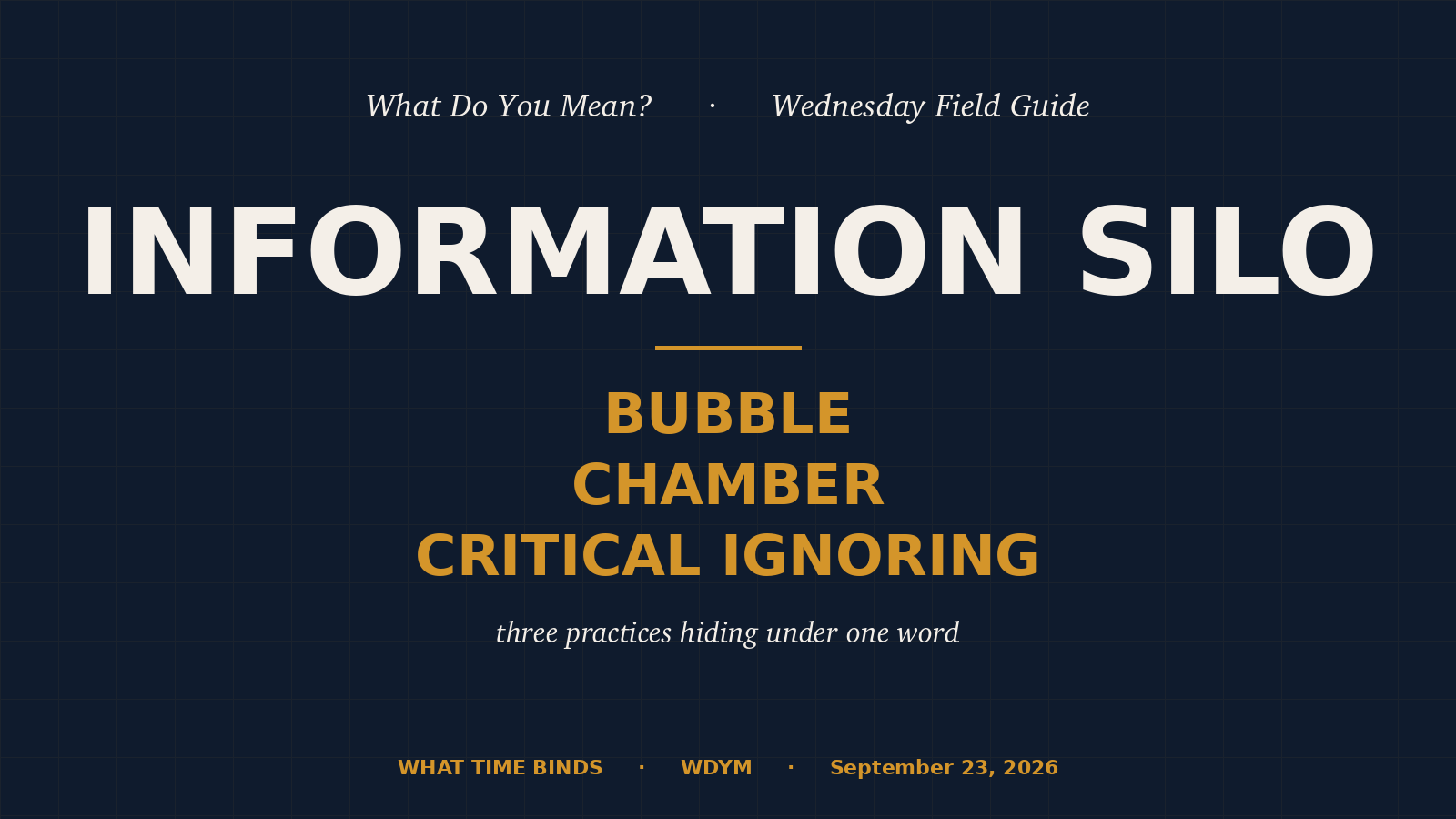
Information Silo
Stated definition: a feed where credible disagreement never reaches you.
Operational definition: a charge filed against anyone who stops feeding a lie.
The first definition names a real risk, and I take it seriously. The second is a weapon. When “silo,” “bubble,” or “echo chamber” gets thrown at someone for blocking an account like that one, ask which definition is doing the work.
A lie the record settled in 1961 survives on the attention we keep handing it. Every Wednesday I take one word an institution bent and ask the simple question: What Do You Mean? Subscribe, and the next one is in your inbox, free.
Three Things, One Name
The epistemic bubble. The philosopher C. Thi Nguyen defines it in “Echo Chambers and Epistemic Bubbles,” Episteme 17(2), 2020 (free copy), as “a social epistemic structure which has inadequate coverage through a process of exclusion by omission.” Credible disagreement never reaches you. Nobody attacked it. It is simply absent. Exposure repairs it.
The echo chamber. Nguyen’s second term: “an epistemic community which creates a significant disparity in trust between members and non-members.” You hear the outsider. You were trained to discount the outsider before the sentence ends. His own line draws the distinction: “In epistemic bubbles, other voices are merely not heard; in echo chambers, other voices are actively undermined.”
Critical ignoring. In “Critical Ignoring as a Core Competence for Digital Citizens,” Current Directions in Psychological Science 32(1), 2023 (free version), Anastasia Kozyreva, Sam Wineburg, Stephan Lewandowsky, and Ralph Hertwig named a civic competence: the deliberate choice of what not to spend attention on. They teach three strategies. Self-nudging redesigns your environment so unvetted content stops arriving by default. Lateral reading checks a source by leaving it and consulting independent ones first. Every link in this essay is an invitation to do exactly that. The third strategy has a plain name: do not feed the trolls. Block or ignore accounts that treat upsetting you as the point.
The first two are pathologies. The third is a skill. The charge of “silo” works by pinning the first one’s name on the third one’s practice.
Who Chose That Post
The silo charge assumes you built your feed and then locked people out of it. That describes the feed Facebook used to run.
On July 27, 2022, Mark Zuckerberg told investors that about 15 percent of the Facebook feed already came from AI recommendations of accounts people do not follow, and that he expected the share to double by the end of 2023. His description of the shift: feeds are “going from being driven primarily by the people and accounts you follow to increasingly also being driven by AI recommending content that you’ll find interesting from across Facebook and Instagram, even if you don’t follow those creators.” (TechCrunch, July 27, 2022)
I have never followed the account that posted the claim. I never friended it. My feed delivered it anyway. Blocking it took my choice back.
That also squares with January. The rule I wrote then was about people I value: “I’m not defriending people. I’m unfollowing their content.” Unfollow the stream, keep the relationship. There was no relationship here to keep. A stranger’s post, delivered by a ranking system, is pure stream, and block is the right tool for a stream.
I owe you the other half of that. Over the 28 days ending September 21, 98.7 percent of the views on my own Facebook posts came from people who do not follow me (my Facebook professional dashboard, August 25 to September 21, 2026). The system that carried my Warrior Ethos card to more than 463,000 people is the same system that carried that post to me. I use the machine. I also decide what it gets to feed me. You have that same choice.
What the Label Was For
The label was “Boule,” borrowed from a conspiracy theory about a Black professional fraternity founded in Philadelphia in 1904. Boule isn’t a word I use. It read like spaghetti thrown against a wall, and none of it stuck.
I am making this point purposefully, because the throw has a design. The Defense Department’s definition of reconnaissance by fire reads: “a method of reconnaissance in which fire is placed on a suspected enemy position to cause the enemy to disclose a presence by movement or return of fire.” Spaghetti against a wall is reconnaissance by fire in plain English. Throw something and watch what moves. On a platform built for engagement, anything that moves also feeds the post that threw it.
Nothing moved. I finished the block I had already started. That is the whole answer: fire discipline. Do not return fire at a position that is only trying to find yours.
The Record, Documented
Here is what the account asked its readers to disregard.
August 4, 1961: Barack Obama is born in Honolulu.
August 13, 1961: The Honolulu Advertiser prints the birth announcement.
August 2008: FactCheck.org publishes “Born in the U.S.A.,” its examination of Hawaii’s short-form certification.
April 27, 2011: The White House releases the certified long-form certificate.
September 16, 2016: Donald Trump, who had questioned Obama’s birth records since 2011, says it himself: “President Barack Obama was born in the United States. Period.”
September 21, 2026: The claim is in my feed.
Sixty-five years of record. Ten years since “Period.” The record did its job. The claim survives on something else.
You refuse to know. The record remembers. I refuse to forget.
What Starving It Does
The claim survives on attention. Herbert Simon described the economics of that in 1971: “a wealth of information creates a poverty of attention.” (”Designing Organizations for an Information-Rich World,” in Martin Greenberger, ed., Computers, Communications, and the Public Interest, Johns Hopkins Press, 1971, pages 37 to 52. The passage is reproduced and discussed here.)
Attention is what the platform sells and what the claim eats. Withdraw it at scale, and the claim starves.
Manoel Horta Ribeiro, Shagun Jhaver, Jordi Cluet i Martinell, Marie Reignier-Tayar, and Robert West tested that at scale in “Deplatforming Norm-Violating Influencers on Social Media Reduces Overall Online Attention Toward Them,” Proceedings of the ACM on Human-Computer Interaction, CSCW 2025 (free copy). They studied 101 influencers across 165 deplatforming events from 2016 to 2021. The standard objection says deplatformed audiences just move to smaller platforms, so the researchers measured attention across the whole web: Google search interest and Wikipedia pageviews. Twelve months out, search interest had fallen 63 percent (95% CI, -75% to -46%). Wikipedia pageviews had fallen 43 percent (95% CI, -57% to -24%).
The study measured platform bans. Individual blocks sit outside its data. It shows the direction attention moves when the amplifier loses its fuel. A network of readers who stop feeding the same account applies that pressure from the other end. One block rounds to zero. The pattern is the mechanism.
What November Inherits
Election Day is Tuesday, November 3. Forty-one days from today.
Every account built to harvest reactions knows the calendar too. Between now and then, claims about who was born where, who counts as Black, and which ballots are real will arrive in your feed engineered to make you answer. Each answer spends attention. Yours is finite, and the ballot needs its share: the down-ballot races, the judicial retention questions, the local measures written in language designed to go unread.
Spend it there. Read the ballot the way you read this piece. Every race, every proposition. vote411.org
The Pin
An information silo, in the sense the philosophy literature uses, is Nguyen’s epistemic bubble: a feed where credible good-faith disagreement never reaches you. Exposure to serious sources arguing from different premises repairs it.
Declining to feed nonsense, engagement bait, or accounts that answer evidence with slurs is critical ignoring. It has a name, a peer-reviewed citation, and evidence that it works.
A silo includes: reading only sources that share your priors on questions where evidence exists; refusing to read serious writers who disagree in good faith; building a feed from one political tradition and calling it enough. My test for the voices I keep: they cite sources, correct errors in public, and treat opponents as capable of reasoning. If you are still in my feed and connected, this essay answers why.
Critical ignoring includes: blocking an account you never chose that the feed delivered anyway; blocking an account that repeats a claim the primary record settled decades ago; blocking an account that answers a document with a label (sellout, Boulé, race traitor, cuck, RINO); unfollowing an account built to farm outrage; muting a relative’s stream while keeping the relationship.
The test before you block. Has the account ever cited a source, corrected an error in public, or engaged an opponent as capable of reasoning? Yes on any one: unfollow and keep the door open. No on all three: block, and call it by its name.
The script for after. When someone tells you the block made you a silo builder, say this:
“Name one source that shows its work that I refuse to read. If you can, I will read it tonight.”
That sentence takes fifteen seconds. It turns the charge into an offer. A good-faith critic takes the offer. A chamber changes the subject, and now you know which one you were talking to.
In January I wrote that I did not want an information silo. I still do not. I keep voices in my feed who make me defend my positions, and on Monday I blocked one account I never chose. Those two facts sit together without strain. One keeps my judgment honest. The other keeps a lie the record settled in 1961.
How the links work. Every link in this piece sits on the citation itself: the author, the publication, the date. That is how a claim carries its page with it. When you pass one of these facts along, pass the link with it.
Decision/Definition Log
Term pinned: Information silo. Stated definition: A feed where credible disagreement never reaches you. Nguyen’s epistemic bubble, Episteme 17(2): 141–161 (2020). Operational definition, as the charge gets used: A label filed against anyone who stops feeding a lie. Not the same as: Critical ignoring. Kozyreva, Wineburg, Lewandowsky, and Hertwig, Current Directions in Psychological Science 32(1): 81–88 (2023). Test before using the term on anyone: Name a credible good-faith source they refuse to read. If you cannot, the term does not fit.
Paid subscriptions open at 500 readers, and the paid product is Coded Threads, the codebooks built from these comment sections. A pledge now is a vote for that.
Jerry W. Washington, Ed.D., is a Marine Corps veteran of twenty-three years, a combat engineer by trade, an instructor at UC Irvine’s Division of Continuing Education, and the writer of What Time Binds, a record of how institutions bend words and how the page holds them to account.