

On May 11, 2026, Donald Trump posted this to Truth Social: “During my Historic Election in 2024, when I won every single Swing State, and decisively won both the Electoral and Popular votes by wide margins, the Republicans had an Election Integrity Army in every single State to preserve the sanctity of each legal vote.” He said the 2026 version would be “much bigger and stronger.”
The next day, the Republican National Committee formally launched the program in 17 states. The RNC did not name which 17.
Twelve weeks later, “Election Integrity Army” is a phrase running through Facebook feeds, cable panels, and state election-office phone calls. Ask three people what it means, and you will get three different answers.
That is the problem.
The word
“Election Integrity Army.”
Why it is a magnet
The phrase covers at least four operations happening in parallel right now. Each has its own legal footing. Each has its own rules of behavior. All of them share the phrase.
1. RNC poll watchers. State law governs what a poll watcher can do. In most states, watchers must be credentialed by a party or campaign, cannot approach voters, and can be removed for disruption. This is the version most reporters describe when they write the phrase into a headline.
2. The RNC legal apparatus. Newsweek’s May reporting described the “operational core” of the “army” as primarily legal: RNC lawyers, election-integrity directors in 13 battleground states, and volunteers positioned to become witnesses in litigation. This version does not appear at your polling place. It appears in court after Election Day.
3. Volunteer networks organized by outside activists. Scott Presler’s Pennsylvania operation is one example. These networks recruit door-knockers, ballot-chasers, and self-described “election observers” who often are not credentialed under state law.
4. Federal law enforcement or military at polling places. The administration has refused to rule this out. Trump on May 12 told PBS he would do “anything necessary.” Acting Attorney General Todd Blanche defended deploying ICE to polls at a March conservative conference. Senator Elissa Slotkin asked whether federal troops would go to polling places; Defense Secretary Pete Hegseth dismissed the question as a “gotcha hypothetical.” On July 17, DHS Secretary Markwayne Mullin threatened state election officials with “fines, penalties, and prison time” for refusing to hand over voter records.
Four operations. One phrase. Different laws for each.
The failure mode when meanings collide
A voter walks into a polling place and sees someone in a windbreaker with “Election Integrity” printed on the back. They freeze. Which one is it? Is it a state-credentialed watcher who cannot approach them, or a federal agent who can detain them, or a volunteer with no authority at all?
The voter is left to guess. The election judge is left to guess. The poll worker at the check-in table is left to guess.
The phrase functions this way.
An election judge who reads “Election Integrity Army” as credentialed poll watchers under state observer law lets someone in the door. That person may operate under a different set of assumptions. A voter reads the same person as a threat or an authority. Not everyone is reading from the same rulebook. The phrase absorbs every version and offers no way to sort them.
When meaning drifts under coordination pressure, coordination fails. That is what happens next.
The pin
“Election Integrity Army” is a rhetorical umbrella phrase. It has no single legal meaning. It refers to at least four separate operations running in parallel: (1) RNC poll-watching programs governed by state observer law; (2) an RNC-led legal apparatus filing pre- and post-election litigation; (3) volunteer networks organized by outside activists; and (4) federal law enforcement or military deployments the administration has refused to rule out.
If someone uses the phrase, ask which one they mean before you take any action based on it.
Boundary test
Includes:
Credentialed RNC poll watchers operating within state observer statutes.
RNC legal teams filing lawsuits, challenging results, or documenting witnesses.
Volunteer networks affiliated with the RNC operation.
Excludes:
Sworn peace officers on duty for polling-place security under state or local jurisdiction.
Nonpartisan election judges and clerks.
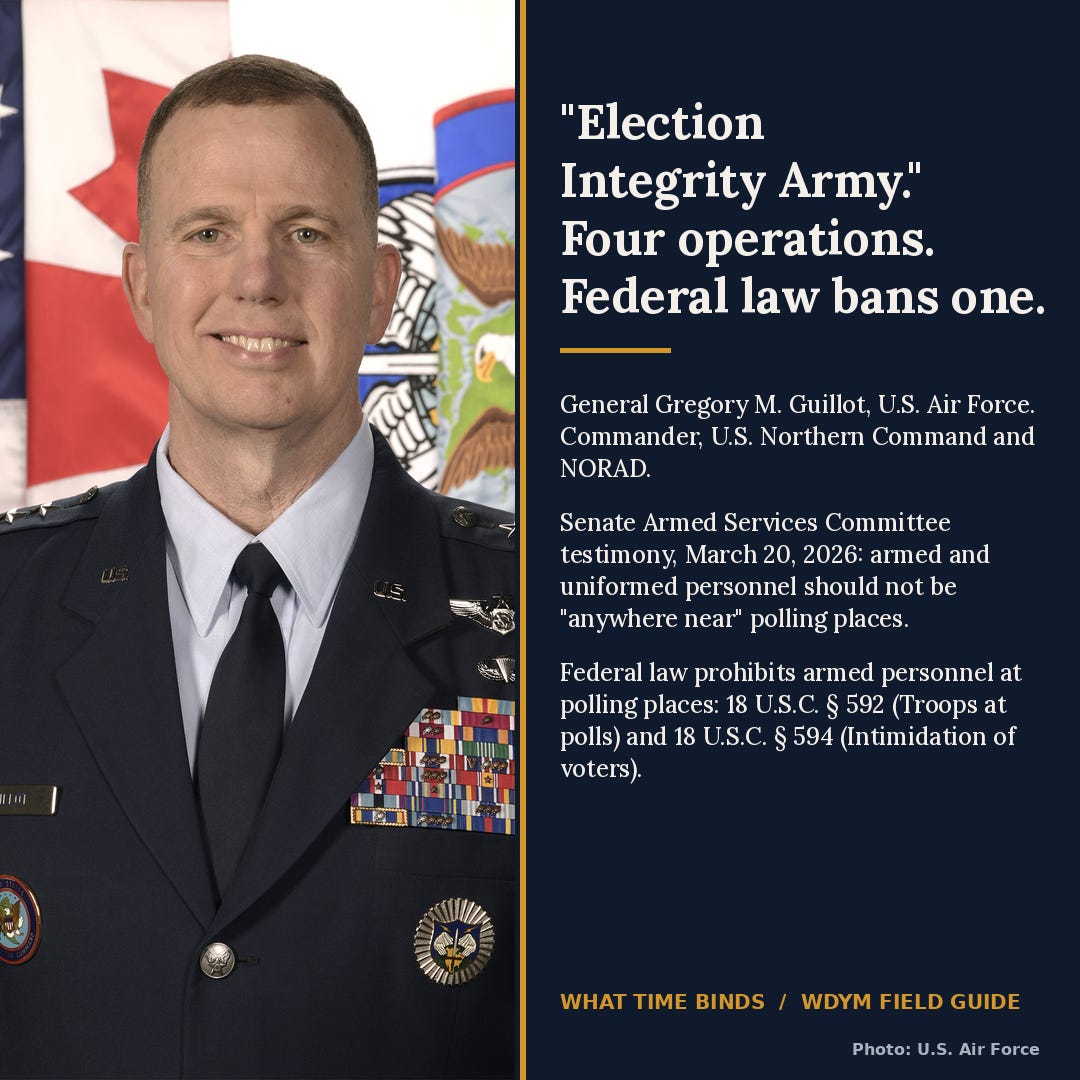
Federal armed personnel at polling places. Prohibited under 18 U.S.C. § 592 (dating to 1865) and 18 U.S.C. § 594 (voter intimidation). Air Force General Gregory Guillot told the Senate Armed Services Committee on March 20 that armed uniformed personnel should not be “anywhere near” polling sites.
Correct use:
“The RNC’s Election Integrity Army poll-watching program will operate in 17 states.” Specifies version. Specifies scope.
“The Election Integrity Army’s litigation team filed suit in Georgia this week.” Specifies version. Specifies function.
Incorrect use:
“The Election Integrity Army will be at your polling place.” Hides which version. Hides scope. Hides what the person there can lawfully do.
“The Election Integrity Army will make sure only citizens vote.” Implies enforcement authority the RNC program does not have and the federal law-enforcement version has not been authorized to exercise at polling places.
Before the polling place: the registration question
If you cannot know who is standing near you at the polling place, you also cannot assume you know where to register in the first place. Which site is the official voter registration site this cycle? That question has moved. The federal government has spent the last six months trying to reshape it.
Vote.gov used to be the plain answer: the federal front door that pointed voters to their state registration portals. Its status is in question this cycle. DHS is attempting to fold voter registration and verification into the SAVE Act enforcement apparatus, and a federal court has already blocked that “updated system” on voter-privacy and wrongful-purge grounds. Until the dispute settles, the reliable official registration site is your state’s Secretary of State portal. Not vote.gov. Not any third-party lookalike. Not any site that asks for information beyond what your state’s own registration form requires. If you already registered and cannot remember whether it went through, your Secretary of State’s office will confirm your status by phone.
One-minute script
When someone raises the phrase in conversation, say this:
“That phrase covers at least four different things. There is an RNC poll-watching program — state law governs what those watchers can do. There is an RNC legal team filing lawsuits. There are volunteer networks. And there is federal law enforcement or military the administration has not formally deployed but has not ruled out. Which one are we talking about? Because the rules are different for each.”
Log prompt
When you next hear “Election Integrity Army” from a friend, a candidate, a poll worker, or a news report, write down four things:
Who said it.
What specific action they described.
Which of the four versions above matches that action.
What your state law says about that version at your polling place.
If you cannot answer version four, call your state Secretary of State’s office before Election Day.
Return to the opening
Meaning drift is an infrastructure problem. When a phrase is engineered to absorb multiple incompatible operations under one banner, every actor working near it loses shared reality. Election officials cannot coordinate. Voters cannot know their rights. Poll workers cannot enforce the rules.
In my July 17, Binding on how an ideology becomes a Foreign Terrorist Organization, I traced how executive-branch language re-scopes institutional authority abroad. The domestic version of that pathway is running now. A DHS Secretary threatened state officials with prison time using a system a federal court had already blocked. That threat did not come from nowhere. It came from a longer pattern of language that dissolves the boundary between what the federal executive branch can lawfully do and what it says it will do.
Pin the phrase. Ask which version. If you see or experience intimidation at a polling place, report it to the DOJ Voting Section at 1-800-253-3931, to Election Protection at 866-OUR-VOTE, or to your state election board.
Before you cast your ballot, know what “Election Integrity Army” means the person standing near you is actually allowed to do.
Sources
Trump Truth Social post, May 11, 2026
RNC operation launch, May 12, 2026 (Democracy Docket, Newsweek, The New Republic)
Trump “anything necessary” quote, PBS Newshour interview with Liz Landers, May 12, 2026
Heather Honey (DHS Deputy Assistant Secretary for Election Integrity) call with state election officials, February 25, 2026 (NBC News, CNN)
Air Force General Gregory Guillot testimony, Senate Armed Services Committee, March 20, 2026 (Democracy Docket)
Acting AG Todd Blanche remarks on ICE at polls, March 2026 conservative conference
Defense Secretary Pete Hegseth “gotcha hypothetical” dismissal, Senate hearing, April 2026
DHS Secretary Markwayne Mullin news conference, July 17, 2026 (New York Times, PBS NewsHour, Spectrum News, The Hill, NBC News)
Brennan Center for Justice, “Sending ICE to Polling Places Is Illegal,” March 31, 2026
Padilla and Slotkin legislation, July 2026
DNC lawsuit against DOJ, Pentagon, DHS, July 2026 (NOTUS)
18 U.S.C. § 592, § 594