

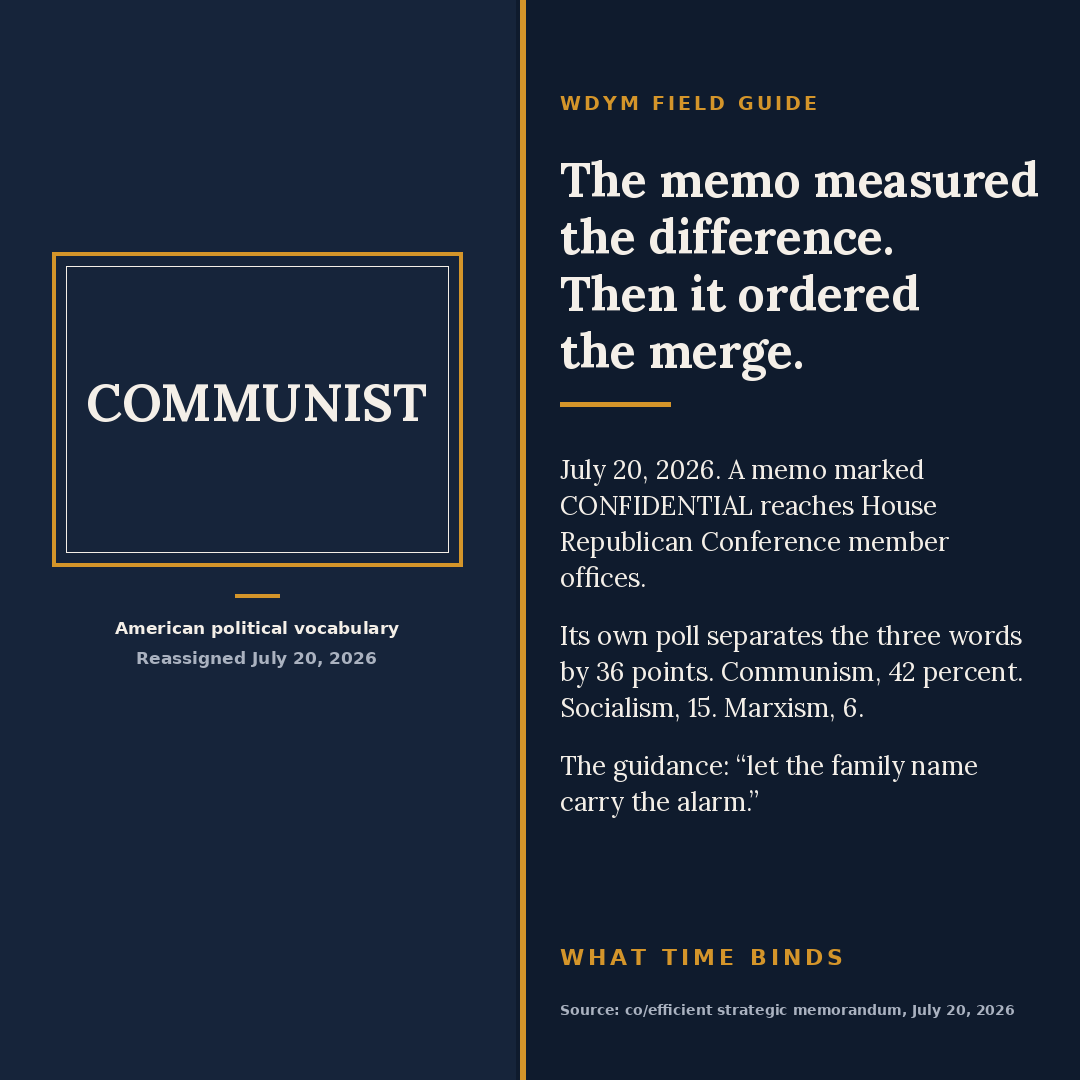
On July 20, 2026, the Republican polling firm co/efficient sent a two-page memo to House Republican Conference member offices. The header marks it CONFIDENTIAL. The footer reads “Prepared by co/efficient for the House Republican Conference.” Ryan Munce, the firm’s president, signed it. Washington Examiner reporter Hailey Bullis obtained a copy, and it has since surfaced online.
Page 1 carries a section heading: The Only Variable Is the Words.
Under that heading, Munce compares two survey questions that test the same tax policy. Framed in the third person, about growth and the national debt, the conservative position wins by 14 points and loses moderates 51 to 37. Framed in the second person, about whether workers should keep more of their own money, the same position wins by 54 and carries moderates 65 to 18.
Then Munce writes the sentence:
“The gap between +14 and +54 is not a different country; it is a different sentence.”
He is right. He measured what a sentence is worth, priced it at 40 points of margin, and sold the finding to House member offices.
Page 2 applies the same finding to three words that name three different things.
The word
“Communist.”
Why it is a magnet
The memo asked 2,634 registered voters a single question: “What do you consider the most dangerous system of government for the United States to pursue?”
Communism, 42 percent. Socialism, 15. Marxism, 6. None of the above, 24. Unsure, 12.
Munce’s reading of his own chart: “Americans still hold communism as far more dangerous and alarming than socialism and Marxism. That is an important indicator for Members: do your best to connect all three together, because these government systems are fruit of the same poisonous tree.”
The guidance section says it plainly. Bullet three:
“Call them what they are: Socialists, Marxists, Communists. Communism rings the loudest alarm with constituents (42 percent name it the most dangerous system), so do not retreat to the softer label just because socialism alarms fewer in the abstract. Connect all three, fruit of the same poisonous tree, and let the family name carry the alarm.”
Read that last clause again. Let the family name carry the alarm. The memo concedes the three words are not the same. Its own polling separates them by 27 points and 36 points. The instruction is to merge them anyway, so the fear attached to the most feared word travels to the other two.
The memo never argues that any Democrat is a communist. It does not make the claim once. It recommends the word for how the word polls.
Since then, the word has done exactly what a memo like that intends. On July 3 at Mount Rushmore, President Trump called the “communist menace” a “mortal threat.” On July 22 in Georgia: “We have some great candidates running, they got to win by a lot; otherwise we’re going communist.” In a July 28 endorsement video for Wisconsin candidate Michael Alfonso, the “radical left communists in Congress.” Speaker Mike Johnson has framed the midterms as a choice about whether the country goes “down this dark road of death to communism.” House Republican Conference Chair Lisa McClain: “the failed nightmare of communism.”
One word, moving fast, covering at least six different things and my Facebook thread.
The failure mode when meanings collide
Abdul El-Sayed won Michigan’s Democratic Senate primary on August 4. He rejects the democratic socialist label. Trump called him a communist the day before the vote.
Darializa Avila Chevalier beat thirteen-term Representative Adriano Espaillat in a June primary in New York. She once posted “seize the means of production” from an account she has since deleted. She told MS NOW she is not a communist and called the focus on the old posts a distraction.
Two candidates. Opposite facts. The same word applied to both.
Now put a voter in front of that. A Michigan voter hears “communist” on Monday about a candidate who has declined the socialist label. A New York voter hears “communist” about a candidate whose old posts quote Marx. The word did not change. The thing it points at changed completely, and nothing in the sentence tells the listener which one arrived.
That is what a magnet phrase does. It absorbs incompatible cases under one banner and offers no way to sort them. The voter cannot check the claim, because the claim has no fixed referent to check.
The memo built this on purpose. Bullet four instructs members to “take the same words to every district,” with “one message for the whole country; no separate playbook required.” A word that means six things is the only kind of word that can do that job.
The pin
“Communist,” in the 2026 midterm campaign, is an umbrella term deployed by design. A July 20 memo from co/efficient to House Republican Conference member offices instructs members to merge socialist, Marxist, and communist so the alarm attached to the most feared word transfers to the other two. The word currently covers at least six distinct positions with different programs and different histories.
When someone uses it, ask which one they mean, and ask what they want done about it.
Boundary test
What the words actually name:
Communism, as a system of government, means a single-party state with state ownership of the means of production. That is what 42 percent of respondents ranked most dangerous.
Marxism is a body of economic and historical analysis. It is not a system of government, which is what the memo’s question asked about. Six percent named it anyway.
Democratic socialism, as the Democratic Socialists of America define it in their own 2025–2026 program, means Medicare for All, universal rent control, tuition-free public higher education, a 32-hour work week, a wealth tax, and a Green New Deal with public ownership of major transportation and energy infrastructure. On governing structure, the program calls for replacing “the two-party system with a multi-party democracy through proportional representation elections,” a national popular vote for president, and an expanded House. It calls for public ownership of “the largest corporations.” It does not call for abolishing private property, nationalizing all industry, or a one-party state. On the specific charge the label carries, the DSA program asks for more parties, not one.
Social democracy describes the Western European welfare-state model, built and defended inside multiparty elections.
New Deal Democrat describes the tradition that produced Social Security and the minimum wage. Representative Ro Khanna notes that Republicans made the same charge against Franklin Roosevelt four times.
Correct use:
“Zohran Mamdani is a member of the Democratic Socialists of America.” Names the organization. Checkable.
“Darializa Avila Chevalier posted ‘seize the means of production’ in 2020 and now says she is not a communist.” Names the evidence and the response.
Incorrect use:
“The Democrats are communists.” Hides which of six positions is meant. Names no policy. Cannot be checked, which is the feature.
“Communism is on the ballot this November.” No communist party is on any 2026 ballot in the United States. The sentence transfers an alarm without making a claim.
No outrage
Three weeks have passed. A confidential memo to a congressional caucus reached the press and then the public internet. I found no statement from co/efficient, from Ryan Munce, or from the House Republican Conference about the memo, about its leak, or about whether the guidance stands.
The coverage has its own gap. CNBC ran a full piece on August 4 about why Michigan voters were hearing “communist.” The Washington Times ran one on July 28 about Republicans framing the midterms as a battle against communism. Both quote Johnson. Both quote McClain. Neither mentions the memo that told them to say it.
The instruction is public. The document is public. The strategy gets covered as though it emerged from conviction.
The numbers under the instruction
The memo’s authority rests on a survey that I do not believe anybody outside the firm has seen.
co/efficient is a real shop with a real record. Silver Bulletin grades it B+ with a moderate Republican lean. Federal Election Commission records show Republican campaigns and committees paying the firm through this cycle for polling and survey research, including $42,500 from the National Republican Congressional Committee on May 29, 2026. Nobody should read this as a front operation.
The July survey is a separate question. The memo reports 2,634 registered voters, fielded July 13 to 16, mobile text responses and landline interviews, weighted to age, gender, education, race, and region, margin of error 1.88 points. No toplines. No crosstabs. No question order. Three weeks after the document became public, none of that has been released, and the firm has not answered questions about it.
co/efficient states its own standard on its website, under a heading that reads Radical Transparency: “No black boxes. You see our methodology, our data, and our reasoning. We publish our work because we stand behind it.”
The instruction that 42 percent justifies is quoted, dated, and consistent across four outlets. The 42 percent is a number the country has been asked to take on faith.
One-minute script
When the word comes up in conversation, say this:
“That word is carrying at least six different things right now. There is communism, meaning a one-party state. There is Marxism, which is an analytical method. There is democratic socialism, which in this country means Medicare for All and rent control and proportional representation. There is European-style social democracy. There is New Deal liberalism. And there is ‘any Democrat.’ Which one do you mean? And what do you want done about it?”
Log prompt
The next time you hear “communist” from a candidate, an ad, a news anchor, or a neighbor, write down four things:
Who said it.
Which specific person or policy they applied it to.
Which of the six positions above that person or policy actually matches.
What action the speaker wants taken as a result.
If you cannot answer three, the word did its job and you learned nothing.
Read the ballot the way you read this piece. Every race, every proposition. Vote. vote411.org
Munce named the mechanism himself, on page 1, in a section heading: The Only Variable Is the Words. He proved it on a tax question, then turned it on three political labels.
There is one more thing worth knowing, and it belongs to me rather than to the memo. On September 25, 2025, NSPM-7 directed the Joint Terrorism Task Forces, the Attorney General, the Treasury, and the IRS toward domestic political violence. Its list of “common threads animating this violent conduct” includes “anti-Americanism, anti-capitalism, and anti-Christianity.” The memorandum instructs the IRS Commissioner to refer tax-exempt organizations and “the employees and officers of such organizations” to Justice for possible prosecution.
The co/efficient memo says nothing about any of that. It is campaign language, and it should be read as campaign language. But an adjective now sits in two places at once. In one, it moves a poll number. In the other, it appears on a federal list of investigative indicators. In our July 17 Binding on how an ideology becomes a Foreign Terrorist Organization, we traced how executive-branch language re-scopes institutional authority abroad. The word “anti-capitalism” is the domestic version of that same move, and a campaign that spends four months teaching a country to hear “communist” as a description of its neighbors is building the audience for it.
Ask which one they mean. Every time. Especially when the answer sounds obvious.
Sources
co/efficient, “The Fight Over the Economic Future of America,” strategic memorandum to House Republican Conference member offices, July 20, 2026. National survey of 2,634 registered voters fielded July 13–16, 2026; ±1.88 at the 95 percent confidence level.
Hailey Bullis, “Memo urges Republicans to tie Democrats to communism,” Washington Examiner, July 2026.
Chris Lehmann, “The GOP’s New Red Scare,” The Nation.
Garrett Downs, “Why Michigan voters are hearing ‘communist’ as they vote Tuesday,” CNBC, August 4, 2026.
George Caldwell, “GOP frames midterms as battle against communism as socialists gain foothold in Democratic Party,” The Washington Times, July 28, 2026.
Democratic Socialists of America, “Workers Deserve More!” 2025–2026 Program.
National Security Presidential Memorandum/NSPM-7, “Countering Domestic Terrorism and Organized Political Violence,” September 25, 2025.
MS NOW interview with Darializa Avila Chevalier.
Jerry W. Washington, Ed.D., served 23 years in the Marine Corps. He holds a doctorate in Organizational Change and Leadership from USC Rossier and teaches at UC Irvine Division of Continuing Education. He writes What Time Binds, an independent newsletter on language, institutions, and democratic accountability.