


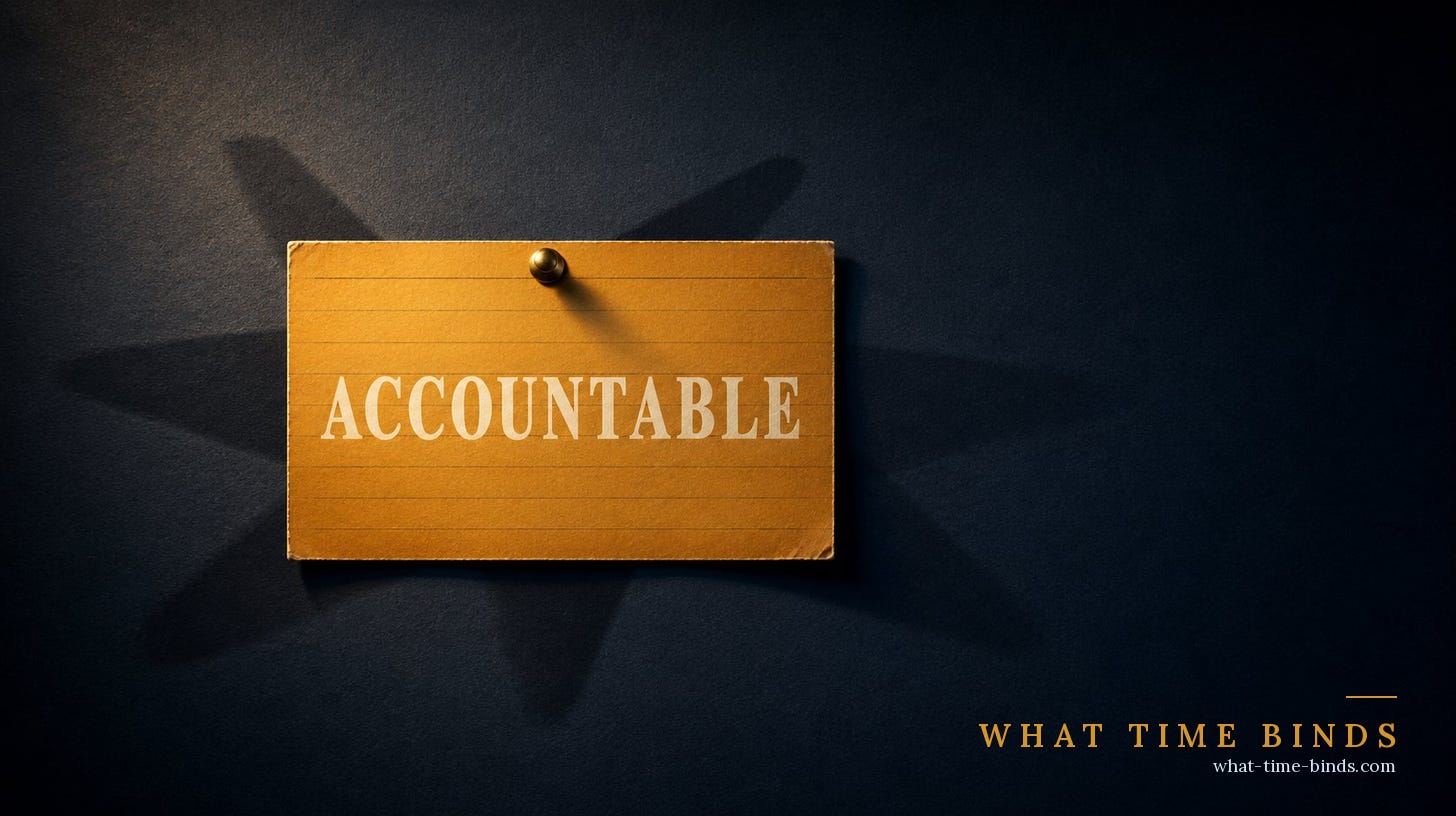
I started the week sketching a Pinned Terms strip about accountability with my daughter.
The setup wrote itself. Juno Tanaka stands at the whiteboard. Six people in the Ops Room. The card on the wall reads ACCOUNTABLE. Each character has a different definition loaded in their head, and none of them know it. Juno reaches up, pulls the card down, holds it in two fingers like contraband, and says, “This one’s a trench coat.”
That’s the gag. Three panels. A magnet word doing what magnet words do, a character calling it out, a small repair move written on the wall. Comic done.
Then I read Kendra Okposo’s HBR piece, “Accountability Must Be Chosen, Not Mandated,” and I closed the laptop on the strip.
The strip would still work as a strip. The problem was scope. What three panels can show needs forty minutes in a real meeting, and Okposo had already done most of the work to set that meeting up. Her case study with a global transportation provider is honest reporting. Her Mindset/Meaning/Mechanisms structure is clean. Her core finding earns the column inches HBR gave it: you cannot impose accountability, you can only build the conditions where people choose it.
I want to push on one of her three Ms: Meaning.
What Okposo means by Meaning
Okposo defines Meaning as the why that makes the choice worth it. Values like integrity. A shared goal that transcends any one person’s contribution. Care and commitment that survive when scrutiny fades.
That definition is correct, and it is doing only half the job.
There is another version of Meaning operating in the same conference room, and it breaks teams long before motivation gets a chance to do its work: the referent of the word accountability itself. Not why people should choose it. What they think they are choosing.
In a business performance meeting, six leaders agree they need to be more accountable. One means I will own the result regardless of what my function controlled. Another means I will surface bad news earlier. Another means I will stop blaming other functions in front of leadership. Another means I will deliver what I committed to or call it out before the deadline. Another means I will let myself be measured against numbers I disagree with. Another means I will do what I am told without asking why.
Six votes for accountability. Six different votes. The motivational why does not fix this, because each person is choosing a different thing. The room sounds aligned, but it isn’t.
This is the meaning failure that runs underneath the meaning failure Okposo names.
The case study is the proof
Read her case study carefully.
The transportation company’s leaders worked with BTS to “co-author a playbook” that broke accountability into “real, recognizable moments in their work, both great and not great.” Okposo lists the moments they pinned. Name the real problem under the symptom. Claim your role in the solution. Raise enterprise-level concerns even when they cross your function’s lines.
That co-authoring is the move. The leaders were not motivated into accountability. They wrote a shared definition of the word and then practiced it across three ten-week cycles. Thirty weeks of repetition mattered. So did the sequencing. The definition came first.
Okposo files this under Mindset and reinforces it under Mechanisms. Read it again, and the pinning sits in the middle: a working agreement on what accountable points to, in this company, in these meetings, this quarter. Without that agreement, the mindset shift has nothing to anchor to, and the mechanisms enforce six different things at once.
She did the work. I would name it Meaning, in the sense of shared reference, and call it the deeper repair move her clients actually executed.
Pin it in the room
If you sit on a leadership team where accountability keeps surfacing as a problem, run a forty-minute session before the next quarterly review. Pull the word off the wall. Treat it as a magnet word until the room has decided otherwise.
Three questions, written down, agreed by everyone present.
What does accountability include here? Two or three concrete behaviors. Surfacing a missed milestone within forty-eight hours. Naming what you personally controlled in the outcome. Bringing your function’s blockers to the all-hands before someone else has to.
What does it exclude here? Two or three behaviors people sometimes confuse with it. Taking blame for outcomes you did not influence. Public self-criticism that signals humility without changing behavior. Quiet compliance with a target you privately believe is wrong.
When do we revisit? Name the date. Quarterly is honest. Annual is a slow walk into the same drift.
The artifact is the agreement. It lives somewhere future-us can find it. The next leader who joins the team reads it before their first business performance review. The next time someone says “we need more accountability around here,” the room can answer: we have a working definition. Are we executing it, or do we need to revise it?
That is the conversation Okposo’s transportation company actually had. The playbook is the artifact. The thirty weeks were the practice. The Mindset shift was the result.
Back to the strip
I might still draw the comic. Juno’s trench coat line is too good to leave on the cutting room floor.
A strip can show the collision. It cannot carry the sentence the team writes after. That sentence is what holds the team together in the next quarter, the next reorganization, the next time the word accountability shows up on a slide, and everyone nods at a different meaning.
Choose accountability, by all means. First, decide together what you are choosing.
A few questions for your team
The last time someone on your leadership team said “we need to be more accountable,” what did they mean? What did the rest of the room hear?
If you wrote down the includes/excludes for accountability in your organization right now, would the document agree with the behaviors your performance reviews actually reward?
Who on your team has been carrying blame for outcomes they did not influence, because no one paused to define what accountability meant for that work?
Jerry W. Washington, Ed.D., is a retired Marine Corps Master Sergeant, a UCI Division of Continuing Education instructor, and the publisher of What Time Binds. He writes about meaning, time-binding, and how teams lose and recover shared reality under pressure.
If this piece was useful, forward it to one person on a leadership team that keeps having the same accountability conversation. Then subscribe so the next one finds you.
Your point about six votes for six different things hit home. I want to push on it from a slightly different angle. I've come to think that accountability after the fact is often something nobody can actually deliver. The damage is done, the result is fixed, and "owning it" mostly means absorbing the cost in some symbolic way. Which is why, in Japan especially, "taking responsibility" so often collapses into resigning from the position. But resigning isn't cleaning up after yourself. It's leaving the mess for someone else to handle. I find myself thinking real accountability has to live before the moment, not after — knowing what's actually mine to do, what I can and can't influence, where my discretion ends, what's being asked of me — and doing that work as cleanly as I can while it's still in motion.
Which is why your includes/excludes move feels important to me beyond the meeting room. Without that prior agreement, "accountability" becomes a word people reach for after something has already gone wrong, and at that point it's usually too late to mean anything except blame.
The other thing I notice is what happens when the word comes down from above. When leadership starts asking for "more accountability," I've seen it function less like a shared standard and more like a lever — something that presses on people's conscience to absorb costs the system itself isn't willing to name. The word sounds noble, and that's part of how it works. People want to be the kind of person who takes responsibility, so they pick up things that were never theirs to carry. Your forty-minute session protects against that, I think. Not just by aligning definitions, but by forcing the question of what isn't accountability — which is the part that usually gets weaponized.