


Author’s note
The Pentagon did not reduce the American death toll in its war with Iran. On Saturday, July 25, DCAS — the Defense Casualty Analysis System — moved four Army air defense artillery soldiers out of Operation Epic Fury and into a new category called Overseas Operations, built the same day and backdated to July 7. Fourteen plus four still equals eighteen. The count was divided.
The July 7 date came from a War Powers Resolution notification the President submitted to Congress on July 10 — three days after the notification’s own claimed restart, and the same afternoon he told the public the ceasefire was over. Under that legal framing, a five-month operation becomes two, and a fresh sixty-day congressional-authorization clock starts.
This piece has a position, and it is mine. There is one war with Iran. The paperwork calling it two is a legal fiction. Splitting a single continuous conflict into two operations on paper, and using the reclassification of four dead Americans as the mechanism, is unethical. The dead are not an accounting instrument. Their casualty records exist to tell the country the truth about the cost of a war. Rewriting those records to give an administration legal cover for hostilities Congress has not authorized fails an obligation to the four families and to every family whose service member is on active duty tonight.
The rest of this essay walks the public record field by field. Every claim is checkable from the receipts. The four soldiers still carry the government’s own hostile flag. Readers are free to weigh the reclassification differently. My position sits above; the evidence sits below.
It had to be October. Edson Range, Camp Pendleton. It was very dark. There were maybe about 72 of us, rifles raised in the air. And then the drill instructor yelled Count off.
One, two, three, four, five, seven. Stop. Start over. One, two, four. Stop. Get it right. Start from the top again. One, two, three, four, five — we got to somewhere around twenty, twenty-five, and someone would mess up, and we’d have to start over again.
We were exhausted. It was about 5:15 in the morning. The drill instructor was frustrated with us. But we had to get the count right. We needed to make sure we had all the Marines and all the weapons. The drill instructor would not fail at this.
It took us maybe six or seven different iterations. We finally got the count right. And then the drill instructor went to report the numbers.
There were 72 of us. 72 lives. 72 weapons.
The number that the drill instructor reported gets placed alongside all the other numbers reported by the other drill instructors. It’s contained in an entire log showing that every single Marine and every single rifle is accounted for. This will outlast anything that happens on the ground.
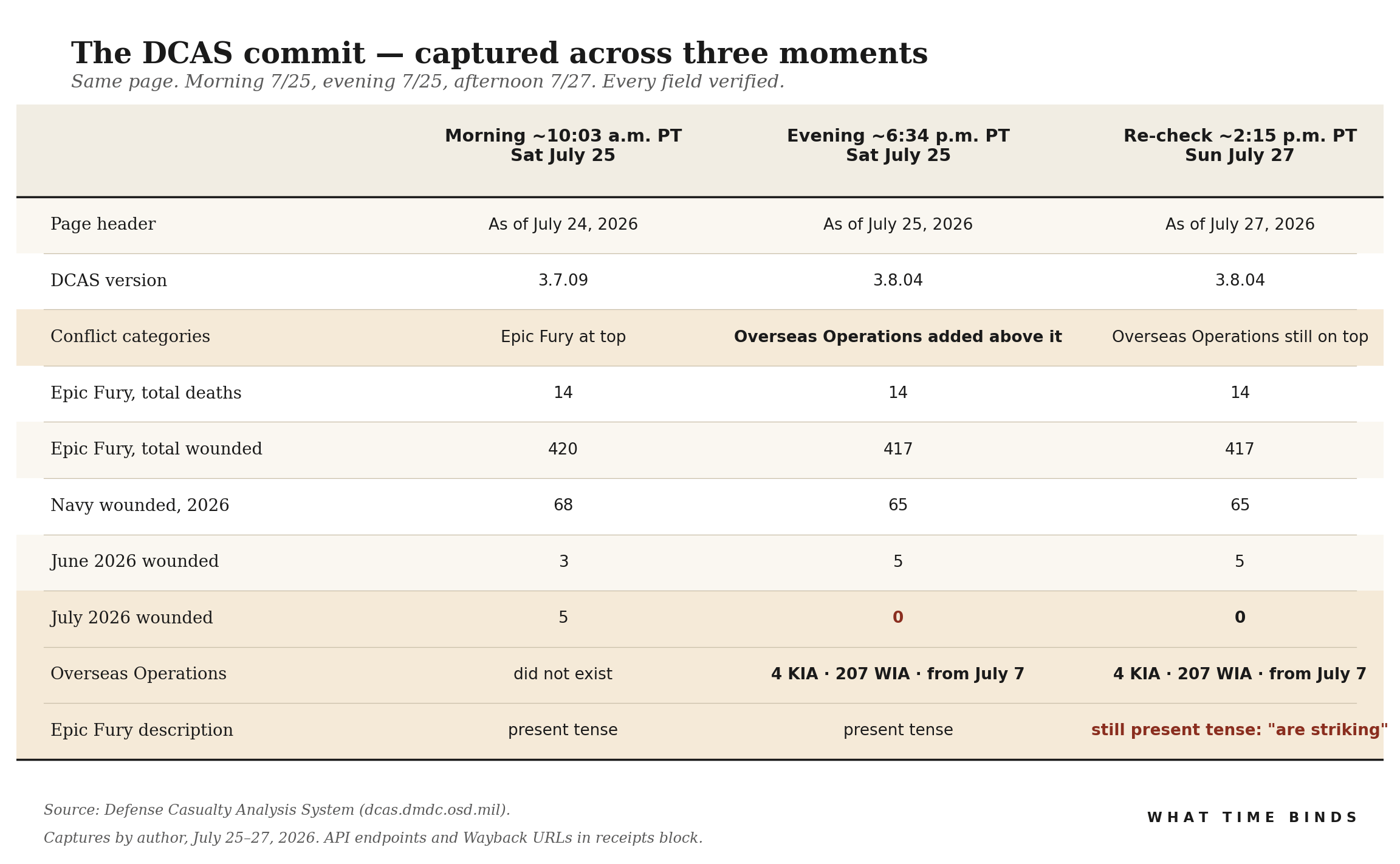
Saturday, July 25, 2026. The Defense Casualty Analysis System — a public Pentagon website run by the Defense Manpower Data Center — was open on a laptop screen at approximately 10:03 a.m. Pacific. The page header read “As of July 24, 2026.” Software version 3.7.09. The same page was open again the same day at approximately 6:34 p.m. Pacific. “As of July 25, 2026.” Version 3.8.04.
The morning state. Operation Epic Fury, the U.S. military’s campaign against Iran, listed fourteen total deaths and 420 wounded. The names-of-fallen roster held thirteen names, every death between March 1 and March 12, 2026. The fourteenth was Navy, category Pending, awaiting a public affairs release before the name could be added. The July 2026 row of the monthly table read zero hostile deaths, zero Army deaths, five wounded. No category sat above Epic Fury in the navigation.
The evening state. A new conflict category sat above Epic Fury in the left navigation. Its title read “Overseas Operations.” Its scope note read, verbatim, “Overseas operations casualties starting July 7th 2026.” Four names inside. Epic Fury July wounded now zero. Total Epic Fury wounded now 417. Version 3.7.09 to 3.8.04 is a point release. Two Army wounded had moved from July into June. Three Navy wounded had left Epic Fury’s totals.
14 + 4 = 18. The count was divided, not reduced.
The Pentagon addressed the July 23 change publicly on July 24. Chief Pentagon spokesman Sean Parnell called the coverage “one of the worst instances of the Fake News media manufacturing lies out of thin air.” He said the Press Office had explained to the New York Times “in detail that the site errors on the Defense Casualty Analysis System (DCAS) were due to a temporary data disruption.” Acting press secretary Joel Valdez described “temporary data disruptions” and “site anomalies… being resolved in coordination with the Military Services.” Separately, officials told the New York Times the four soldiers did not count against Epic Fury because they had died after an April ceasefire.
Two days later, on the afternoon of Sunday, July 27, DCAS still described Operation Epic Fury in the present tense: “U.S. and partner forces are striking targets to dismantle the Iranian regime’s security apparatus, prioritizing locations that pose an imminent threat.” Are, not were. As of the same afternoon, the four soldiers sat on the Overseas Operations roster because they had died in a war that, per the Pentagon’s own description a click away, is still happening.
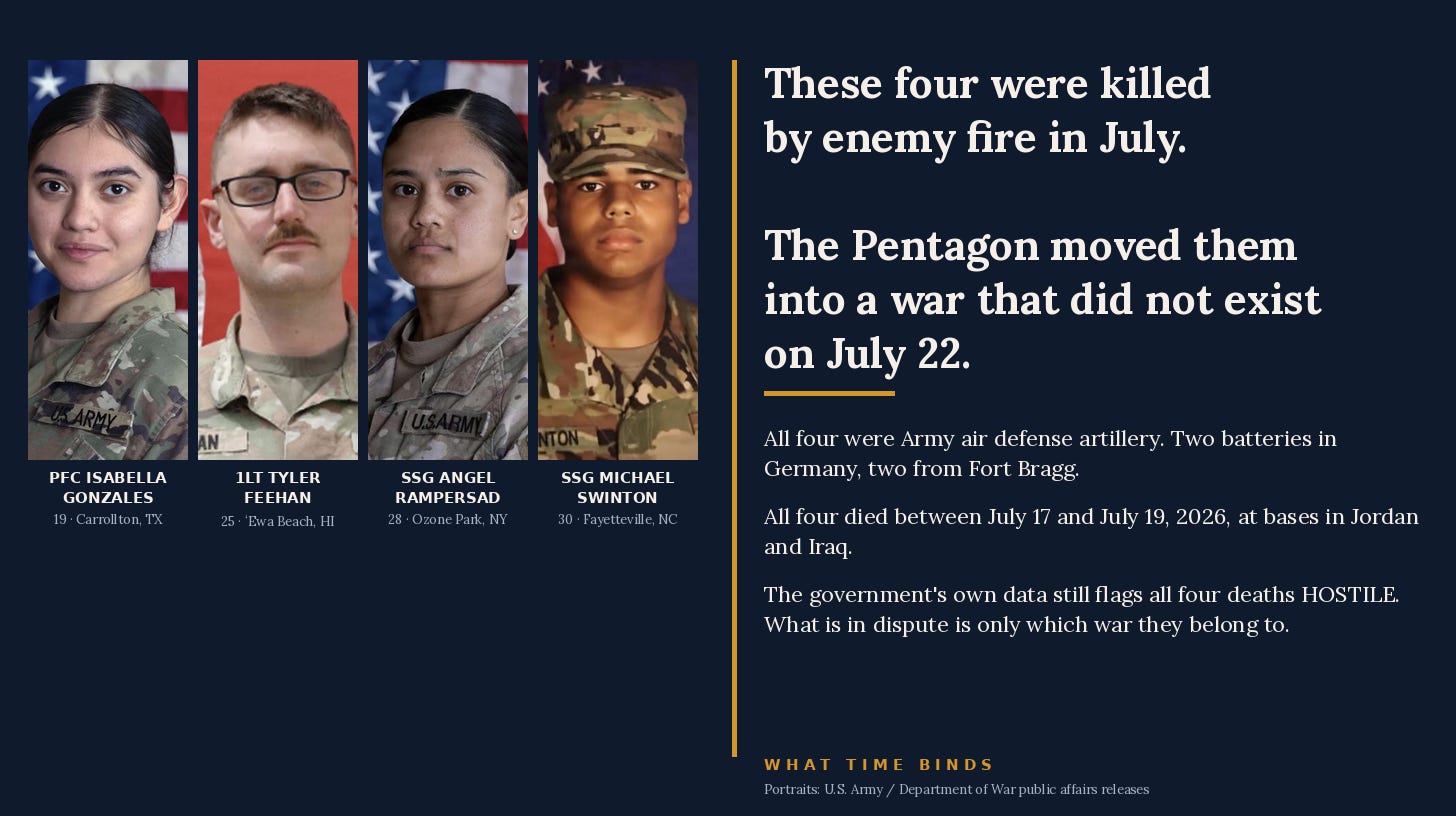
Four service members. PFC Isabella Gonzales, 19, of Carrollton, Dallas County, Texas, died July 17, 2026, at Muwaffaq Salti Air Base, Jordan. 1LT Tyler James Feehan, 25, of ʻEwa Beach, Honolulu County, Hawaii, died July 18, 2026, at the same base, of wounds from the same attack. SSG Angel Sarah Rampersad, 28, of Ozone Park, Queens, New York, died July 19, 2026; her casualty geographic code reads ZZ and her casualty country reads UNKNOWN. SSG Michael Emmanuel Swinton, 30, of Fayetteville, Cumberland County, North Carolina, died July 19, 2026, at Erbil Air Base, Iraq. Ranks, dates, and homes here come from DCAS. Press reporting on some of these details differs; where the government’s own record and the news reports diverge, this piece cites DCAS.
All four Army. All four active duty. All four air defense artillery. Gonzales and Rampersad served in the same battery — Battery A, 1st Battalion, 57th ADA Regiment, 52d ADA Brigade, 10th Army Air and Missile Defense Command, at Barton Barracks in Germany. Feehan came from Battery A, 2d Battalion, 55th ADA Regiment, 32d AAMDC, Fort Bragg. Swinton came from Battery D of the same 2d Battalion, 108th ADA Brigade, Fort Bragg. ADA crews operate the systems that intercept incoming missiles. When those systems fail, the operators are usually the first to die.
All four records carry the field value "hostile":"HOSTILE". The government’s own data attributes all four deaths to enemy action. That field is stored in the JSON the site publishes to any browser. The rendered web table hides it. A re-check at 2:15 p.m. Pacific on Sunday, July 27, confirms the four still sit in Overseas Operations, still flagged HOSTILE, dates and ranks unchanged. The record has held.
Nobody is arguing these four were accidents. Nobody is arguing they were peacetime losses. The Pentagon’s own data records enemy action in all four cases. The only thing at issue is which war they belong to. That is a filing question, not a fact question. The lives are not in dispute. The column is.
The word doing the work in this record is “operation.”
Inside a military bureaucracy, “operation” carries four meanings at once, and they normally travel together. A planning construct: the campaign a combatant command runs. A budget line: the appropriation Congress writes and the comptroller draws against. A public accounting category: the bucket DCAS uses to publish the dead and wounded. A legal boundary: the frame under which the War Powers Resolution counts days. When those four meanings agree, “operation” reads as descriptive. When they come apart, one of them starts to do work the others cannot see. Here, the accounting category and the legal boundary moved. The plan and the budget did not.
The War Powers Resolution of 1973 permits the President 60 days of hostilities without congressional authorization, plus 30 more to complete a withdrawal. Ninety days total. Operation Epic Fury began February 28, 2026, on presidential direction. All thirteen named deaths on its public roster fall between March 1 and March 12. By late July that operation has been running roughly five months, and the roster has grown by one Navy death still awaiting release.
A second operation with a start date of July 7, 2026 starts the ninety-day clock over.
Representative Thomas Massie, Republican of Kentucky, described the maneuver publicly on July 24, one day before the new category appeared on DCAS. “Let me explain this absurd ruse,” he wrote. “The Pentagon is pretending there have been two Iran wars separated by a brief cease-fire.” He added, in the same thread, that “by going more than 90 days without congressional authorization @SecWar IS BREAKING THE LAW and must be held accountable.” Massie described the shape of the maneuver before the shape existed on the page.
Senator Lisa Murkowski, Republican of Alaska, had raised the same objection three days earlier, in a formal hearing with Secretary of War Pete Hegseth on July 21. “The claim essentially allows the president to extinguish the War Powers clock just at the moment that it becomes legally inconvenient,” she said, “avoiding the congressional authorization that the Constitution requires and the War Powers Act intends.” Two Republicans, on the record, on the same page.
The July 7 boundary is not a mystery. Trump submitted a War Powers Resolution notification to Congress on Friday, July 10, 2026. The notification claimed hostilities had resumed effective July 7 and described the strikes as “defensive” and “limited.” The same afternoon he posted to Truth Social, “The Cease Fire is OVER!” The notification retroactively named a restart date three days before he himself said publicly that the ceasefire had ended. The administration’s underlying legal position, held since May: Trump’s earlier declaration that hostilities were “terminated” on May 1 stopped the War Powers clock, so July 7 begins a fresh sixty-day window. DCAS built the Overseas Operations category on July 25 and applied that same July 7 boundary. The database is not drawing the line. The database is following the line the White House drew for Congress. Secretary of State Marco Rubio, at a May White House briefing, called the War Powers Act “unconstitutional, 100 percent.” That is the frame in which this notification and this reclassification sit.
Operation Epic Fury publishes fifteen public data endpoints on the DCAS API: monthly summary, casualty type, sex, grade, age, component, race, ethnicity, names of fallen, plus seven constants variants. Overseas Operations publishes five: four category totals and a name list. Every parallel request for the missing OO endpoints returns the same string — [404: Not Found] The requested action does not exist. Verified missing as of July 27: monthly, components, ages, races, gender, grade, ethnicity. On top of that, every other named operation on DCAS carries a paragraph describing what it is — authorization, mission, adversary, start date. Overseas Operations carries none. Its scope note reads: “Overseas operations casualties starting July 7th 2026.” That is an accounting bracket. An operation description it is not.
Overseas Operations reports 207 wounded. Army 182, Navy 21, Air Force 4. The category supplies no time dimension. There is no public way to determine when any of those 207 were wounded, or under what circumstances. Epic Fury has published wounded by month since February and showed five for all of July on the morning of the 25th. What the additional 202 wounded represent, the public record cannot answer. The endpoint that would answer it does not exist. Combined wounded across Epic Fury and Overseas Operations totals 624; every wounded figure published before July 23 ran between 447 and 482. The roughly 150-figure difference is unexplained. No news outlet has yet reported it.
The replacement category is less accountable than the category it replaced.
The strongest counterargument runs like this. Federal agencies reclassify data continuously. Casualty records mature as investigations close. Reorganizing a database is ordinary administrative work. The Army did move two wounded soldiers from Reserve to Active Duty between the July 25 morning and evening captures, and the Army total held steady at 279 across that swap. Records do get corrected. Systems do get renamed. A reasonable skeptic can look at the July 25 commit and read routine maintenance.
Routine maintenance does not reduce the number of published data endpoints from fifteen to five. Routine maintenance does not add a category to the top of the navigation without a description of what the category covers, when every other category on the same site carries one. Routine maintenance does not build a public accounting bracket that stops short of every demographic breakdown its neighbor supplies.
Routine maintenance does not draw a boundary date preceding the public statement that justifies it. Routine maintenance does not arrive the day after twelve United States senators send a letter demanding an accounting. Senator Mazie Hirono and eleven Democratic colleagues wrote to Secretary of War Pete Hegseth on July 23, 2026, that “the American people, Congress, service members, and their families are entitled to a full and accurate accounting of the human costs of war.” The letter’s fourth question asked, verbatim: “Why does the DCAS ‘Casualties by Month’ report not reflect the July 2026 injuries the Department has publicly acknowledged, as of July 21, 2026?” The Pentagon’s response arrived early, two days before the July 30 deadline, and in a form the letter did not ask for. It came as a new category, Overseas Operations, which carries a running total of 207 wounded and no by-month endpoint at all. Question 4 was answered by being made structurally unanswerable.
Here is a workable pin. An operation boundary describes a change in mission, forces, or command authority. It is not an accounting instrument.
Boundary test. Includes: a boundary drawn from an actual change in mission, forces, or command authority, documented before the casualties it covers. Excludes: a boundary drawn after the fact, with a start date preceding the public statement that justifies it, producing no visible effect on the ground except a restarted legal clock and a reduced public data footprint.
Example. Operation Desert Shield to Operation Desert Storm. Desert Shield began August 1990, defensive posture, deployed to protect Saudi Arabia after Iraq invaded Kuwait. Desert Storm began January 17, 1991, offensive posture, air campaign against Iraqi forces. Different mission, announced in advance, no accounting benefit to anyone. Non-example: Epic Fury to Overseas Operations. Boundary July 7, 2026. Notification to Congress July 10. Category built July 25. Eighteen days after the first death it governs.
An earlier essay in this newsletter, published February 17, 2026 and titled “Version Control for Democracy in a Ghost-Map Age,” argued that a court-ordered restoration is only as good as the audit log that enforces it. That essay documented the removal of thirty-four panels from the President’s House site in Philadelphia on January 22, 2026, and Judge Rufe’s injunction ordering their reinstallation. It called the court order a restore command. It called the audit log — the record of who edited what, and when — the thing that makes the restore command real.
The Rogers page rewrite in the Defense Department biographies went unnoticed for roughly fifteen months. The DCAS change was caught inside eight and a half hours, with third-party timestamps on both ends. Captures at 10:03 a.m. and 6:34 p.m. Pacific on July 25. Six Wayback pages and two JSON endpoints archived by a third party the same night. Two archive.today saves. A re-check two days later confirming the state held.
What changed between those two cases was not the government’s behavior. The government ran the same play both times: edit the record, wait, and if nothing lands, the edit becomes the record. What changed sits on the reader’s side of the screen. Somebody was watching, and somebody knew where to look, and somebody had the tools to save the state before the state changed again. That took six or seven iterations to get right, at 0515, in the dark, with a drill instructor who would not fail at it. It costs something to build. The alternative costs more.
How to check a live federal record, and prove what it said
Open the record you care about. These four URLs return raw data in any browser and do not require login:
dcas.dmdc.osd.mil/dcas/api/report/wia/fallenByName/oodcas.dmdc.osd.mil/dcas/api/report/wia/fallenByName/oefudcas.dmdc.osd.mil/dcas/api/report/casualtySummary/monthly/oefudcas.dmdc.osd.mil/dcas/api/report/wia/casualtySummary/category/totWIA/ooPreserve the state before you analyze it. Put
https://web.archive.org/save/in front of any URL and hit return.Screenshot the page footer. Version numbers change when the software changes; that is often the only sign a commit landed.
Note the “as of” date printed on the page, not the date you looked at it. They rarely match.
Check whether a third party already holds an earlier capture. If none does, yours is now the earliest.
Compare against your own prior capture field by field. Totals hide movement between categories.
When the record and the press disagree, cite one and name which.
File the artifact where you can find it in six months. Then again in a year.
Back to Edson Range for a moment. Seventy-two Marines stood in the dark until the number was right, and then the drill instructor went to report the numbers. Isabella Gonzales was nineteen. Carrollton, Texas. DCAS records her as PFC. The press called her Pvt. Even her rank is on the record two ways. Somewhere in the Pentagon’s own log this week, her name was moved from one column to another because the war she died in was given a different name three days before the president said publicly there was a new war to give a name to.
A casualty count and a ballot are both records a citizen inherits from decisions made by someone else. Check the record before the next crew comes through. Then check the ballot the same way. Every race, every proposition. vote411.org.
The comparison table
If someone told you the Pentagon lowered the number of Americans killed in this war, send them this one. Every claim above is checkable from the receipts below. Nobody has to take my word for anything.
What Time Binds is Jerry W. Washington’s newsletter on how institutions repair meaning under pressure. Jerry advises leaders and organizations on aligning language, decisions, and accountability in high-stakes moments. If you’re facing one, hit reply if you’d like to talk.
Receipts, datestamped
Captured July 25–27, 2026, Internet Archive:
Epic Fury by month — https://web.archive.org/web/20260726013423/https://dcas.dmdc.osd.mil/dcas/conflictCasualties/oefu/byMonth
Epic Fury casualty summary — https://web.archive.org/web/20260726013851/https://dcas.dmdc.osd.mil/dcas/conflictCasualties/oefu/byCategory
Epic Fury names of fallen — https://web.archive.org/web/20260726013814/https://dcas.dmdc.osd.mil/dcas/conflictCasualties/oefu/namesOfFallen
Epic Fury military deaths — https://web.archive.org/web/20260726014034/https://dcas.dmdc.osd.mil/dcas/conflictCasualties/oefu/deaths
Epic Fury wounded — https://web.archive.org/web/20260726021056/https://dcas.dmdc.osd.mil/dcas/conflictCasualties/oefu/wounded
Overseas Operations names of fallen — https://web.archive.org/web/20260726013639/https://dcas.dmdc.osd.mil/dcas/conflictCasualties/oo/namesOfFallen
Overseas Operations casualty summary — https://web.archive.org/web/20260726013745/https://dcas.dmdc.osd.mil/dcas/conflictCasualties/oo/byCategory
API, Overseas Operations names — https://web.archive.org/web/20260726013641/https://dcas.dmdc.osd.mil/dcas/api/report/wia/fallenByName/oo
API, Epic Fury names — https://web.archive.org/web/20260726013816/https://dcas.dmdc.osd.mil/dcas/api/report/wia/fallenByName/oefu
API, Epic Fury monthly — https://web.archive.org/web/20260726013424/https://dcas.dmdc.osd.mil/dcas/api/report/casualtySummary/monthly/oefu
The “before” pair, crawled by a third party July 23, 2026, 10:03 p.m. PT:
Epic Fury casualty summary — https://web.archive.org/web/20260724050315/https://dcas.dmdc.osd.mil/dcas/conflictCasualties/oefu/byCategory
Epic Fury wounded — https://web.archive.org/web/20260724050316/https://dcas.dmdc.osd.mil/dcas/conflictCasualties/oefu/wounded
archive.today: https://archive.ph/V50bo (OO names) · https://archive.ph/uc6tV (OO summary)
Primary documents:
Hirono letter, July 23, 2026 — https://www.hirono.senate.gov/imo/media/doc/senator_hirono_iran_oefu_casualty_reporting_letter_f9smy2742sbw.pdf
CENTCOM, Operation Epic Fury Update, March 2, 2026 — https://www.centcom.mil/MEDIA/STATEMENTS/Statements-View/Article/4419315/operation-epic-fury-update/
Trump War Powers Resolution notification to Congress, July 10, 2026 — coverage: Roll Call (rollcall.com/2026/07/13/), US News (usnews.com/news/world/articles/2026-07-13/), E&E News (eenews.net)
Murkowski at Senate Armed Services Committee hearing, July 21, 2026
Rubio at White House press briefing, May 2026 (”unconstitutional, 100 percent”)
CNN, “Iran war casualty count eclipses 600 as Pentagon quietly changes accounting” (Davis Winkie, July 27, 2026)
My February 17 essay, “Version Control for Democracy in a Ghost-Map Age” — https://what-time-binds.com/p/version-control-for-democracy-in
Friday’s Binding, “Version Control, Round Two” — https://what-time-binds.com/p/friday-binding-version-control-round
How I make this: reporting and verification are mine, drafting is a collaboration with AI tools I review, and corrections get pinned, never buried. Full process: what-time-binds.com/how-i-make-this


