


I was in a conversation several years ago that should have been simple. It turned into a small lesson in how language quietly grabs the steering wheel.
We were talking about the word mindset. I asked, “What do you think a mindset is?”
The person didn’t hesitate. They broke it down like a mechanic: mind + set. A mind that’s been set in place. Fixed. Disciplined. Locked in. The kind of internal posture you “hold” so you don’t drift. A mindset, in that framing, feels like a mental parking brake.
And I get it. That’s a reasonable reading of the word, especially in a culture that treats discipline like morality.
But as we kept talking, I offered a different angle. When I hear set, I don’t only hear “fixed.” I hear a collection. A set of golf clubs. A tool set. A chess set. A Lego set. A data set. A drum set. A set list. A film set.
In that version, a mindset is less a single, fixed position and more like a toolkit. A repertoire. A selection of stances you can pick from, depending on what the situation demands. Sometimes you want the “set in place” version when you’re training, stabilizing, resisting temptation, or rebuilding trust. Other times, you want the “set of options” version when you’re learning, improvising, repairing a misunderstanding, trying to see around your own blind spots.
Same word. Two different frames. Two different created realities.
That moment (small, ordinary, almost forgettable) lands right at the center of Michael J. Reddy’s argument in his classic work on what he called the conduit metaphor: the hidden story English tells us about communication, meaning, and understanding.
And once you see it, you start seeing it everywhere.
The hidden story we tell about communication
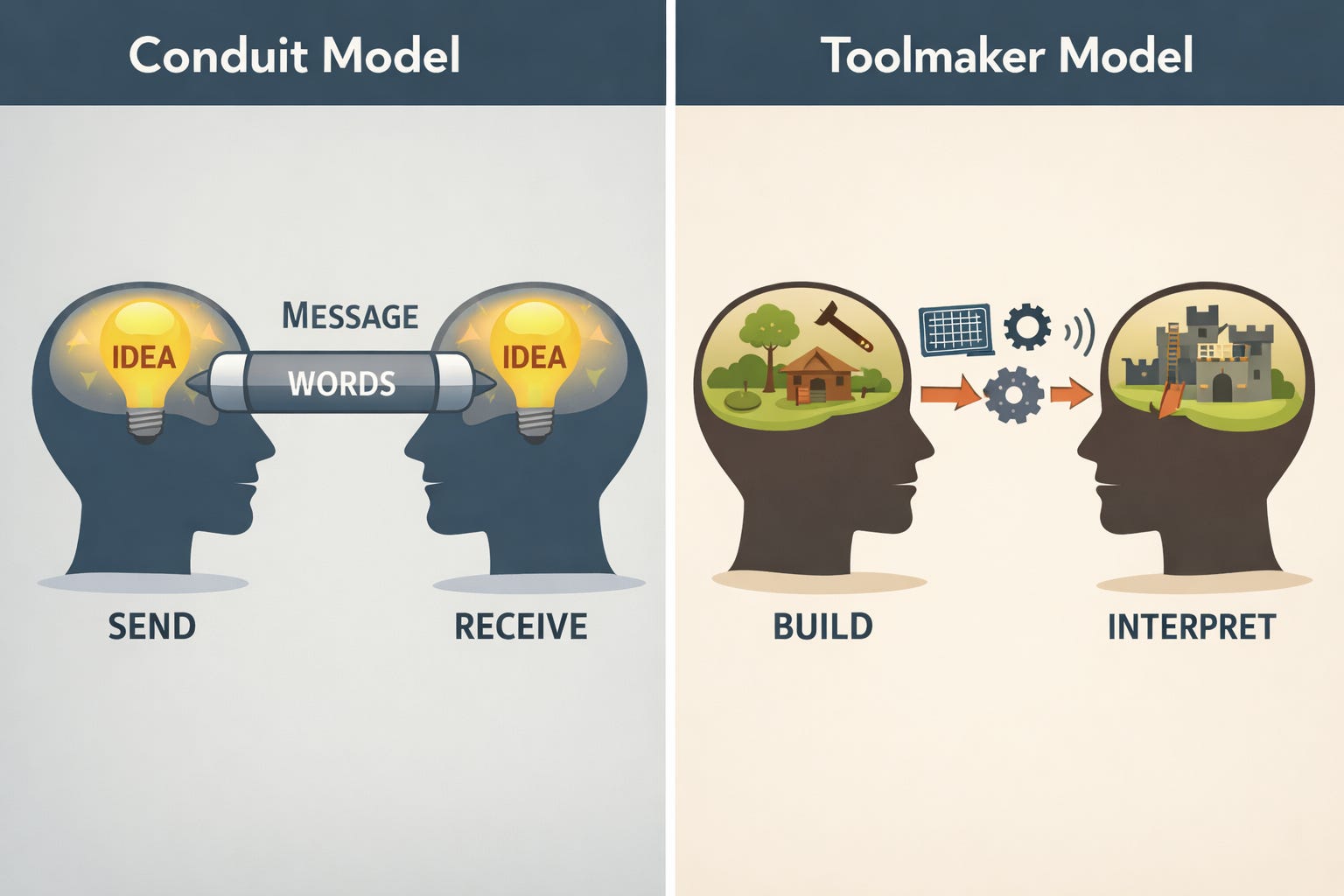
English encourages us to talk as if meaning is a substance and words are containers. Ideas go into sentences. Thoughts get packed into phrases. Messages get delivered. Meaning gets extracted. We try to get our point across.
Reddy’s claim is strong: English is saturated with this framework, so much so that it becomes the default mental model many of us use without noticing.
“Of the entire metalingual apparatus of the English language, at least seventy percent is…based on the conduit metaphor.”
When a framework becomes that dominant, it does a whole lot more than describe what we do. It trains what we expect. It creates a quiet promise:
If you put the right meaning into the right words, the other person will receive it.
That promise is comforting. It’s also one of the main reasons people talk past each other while feeling morally certain they were clear.
Here’s the trap: the conduit metaphor makes communication feel like transfer. Like shipping. Like moving a package from one mind to another.
So when misunderstanding happens, we reach for the wrong diagnosis: “They didn’t get what I said.” “They took it the wrong way.” “They’re twisting my words.” “They’re not listening.”
Sometimes that’s true. Plenty of people dodge accountability.
Still, the deeper issue is more ordinary: we’re using a model that implies success should happen automatically.
And when it doesn’t, we treat the failure like a personal defect.
“A picture held us captive”
There’s a line from Ludwig Wittgenstein that belongs on a sticky note above every serious conversation:
“A picture held us captive…for it lay in our language.”
The point is that these expressions about language are pictures, default diagrams, in the mind.
The conduit metaphor is one of the most influential pictures in modern life because it shapes arguments in classrooms or seminars, and it shapes marriages, workplaces, politics, and public trust. It shapes how people interpret headlines. It shapes how institutions “communicate” with the public. It shapes what we think a “message” even is.
And it shapes how we think communication ought to work.
The false promise of success without effort
Reddy draws a sharp distinction between two assumptions:
Success without effort: communication works naturally; failure needs explanation.
Effort creates partial success: miscommunication is the default; improvement takes work.
Here’s his line, blunt enough to feel like a corrective slap:
“Human communication will almost always go astray unless real energy is expended.”
This is one of those sentences that irritates people at first, then slowly becomes obvious.
Of course, it takes energy. Of course, meaning doesn’t simply “arrive.” Of course, people have different histories, associations, stress levels, incentives, and fears.
We keep expecting “transfer” because we’ve been trained to imagine meaning like cargo.
So Reddy offers a competing picture.
The toolmaker picture
Reddy asks you to imagine people living in separate environments who can’t enter one another’s world. They can’t swap experiences. They can’t hand over “meaning.” They can only exchange signals, rough instructions.
“No way…to visit each other’s environments… The people can only exchange…instructions… and nothing more.”
That is the punchline Reddy names radical subjectivity: your inner world isn’t shippable. Mine isn’t either. We can send marks and sounds. The rest is construction.
Once you accept that, a different way of speaking becomes more honest. Less magical. Less performative.
Reddy even gives a small example that’s funny because it’s painfully true:
“Did you get anything out of that article?”
Becomes something like:
“Were you able to construct anything of interest…on the basis of the assigned text?”
That shift sounds awkward in everyday speech, which is exactly why Reddy makes the point: English keeps pulling us back toward the conduit picture. We default to the language that pretends meaning is delivered.
The toolmaker picture insists on something else:
Meaning is built, not shipped.
Why this matters for time-binding and for adulthood
I’ve been working through a larger idea in my book project Adulthood of Humanity: our species has an extraordinary capacity to accumulate knowledge across generations, yet we routinely fail to convert that knowledge into shared understanding, wise institutions, and durable coordination. We only use it to build technology.
Reddy’s work helps explain why.
If your default model of communication is “transfer,” you expect:
clarity to be automatic,
misunderstanding to be abnormal,
interpretation to be passive,
“receiving” to be easy,
disagreement to be stubbornness or stupidity.
That model breeds moral confidence and social friction at the same time. It also makes institutions lazy. Leaders start thinking “messaging” is the same as meaning-making. They treat the public like an inbox.
Then they act shocked when the public doesn’t “get it.”
A mature civilization can’t afford that.
Adulthood, at any scale, means taking responsibility for the hidden assumptions that keep creating predictable failures. Reddy’s point is that many of our communication failures are engineered by the default picture.
This is also an AI story
If you care about AI’s social impact, Reddy’s work becomes even more urgent.
Why? Because large language models intensify the conduit illusion.
When a system can produce fluent text on demand, it’s easy to treat language as a pipeline: you “send” a prompt in; you “receive” meaning out. You start believing that clarity lives in the text itself.
But decades of pragmatics and cognitive science tell a more accurate story: communication isn’t only decoding. It’s inference.
Dan Sperber and Deirdre Wilson describe an inferential model where the communicator provides evidence, and the audience constructs meaning from that evidence.
A communicator “provides evidence…which is inferred by the audience…”
Even Claude Shannon—whose work made modern digital communication possible—explicitly set meaning aside in order to solve engineering problems:
“These semantic aspects of communication are irrelevant to the engineering problem.”
That move was powerful for telecommunications. It becomes dangerous when imported into human affairs as a theory of understanding.
And then there’s the warning from Emily M. Bender and colleagues: the field keeps chasing scale and fluency while skipping hard questions about risk, accountability, and meaning.
“We…ask: How big is too big?”
Reddy helps us see how all of these threads connect: once language is treated like a conduit, we begin to treat communication like a machine. We confuse output with understanding. We confuse signals with shared reality.
If you want better public discourse in an AI-mediated world, the work begins with upgrading the picture.
A toolkit you can use this week
This is where I want to make the essay practical—consistent with the tools I’ve been building in the What Do You Mean? section.
1) Run a conduit audit
Listen for container-and-transfer language in your own speech:
“I couldn’t get it across.”
“That went over your head.”
“Put it into words.”
“I gave you my thoughts.”
“Take this idea.”
“It didn’t come through.”
You’re not hunting “bad phrases.” You’re noticing the hidden picture they reinforce.
2) Swap in toolmaker questions
Instead of asking what someone received, ask what they built:
“What did you make of that?”
“What did you infer from it?”
“What did you assume I meant?”
“What part felt unclear or loaded?”
“What would count as understanding here?”
These questions force construction into the open.
3) Budget energy for meaning
Reddy’s “real energy” isn’t motivational talk. It’s engineering.
Energy looks like:
one example plus one non-example,
a rephrase in plain language,
a check-back (“Say it back in your own words”),
a shared definition,
a shared standard for evidence.
4) Treat misunderstanding as normal
When people expect perfect transfer, they treat divergence as betrayal.
When people expect partial mismatch, they treat repair as part of the process.
That single expectation shift lowers the temperature in nearly every hard conversation.
5) Upgrade “mindset”
Back to where we started: if mindset is treated as fixed, growth becomes a moral drama.
If mindset is treated as a set (a kit) you can choose from, practice becomes possible:
Stabilize when needed.
Flex when needed.
Train when needed.
Rest when needed.
A mature communicator keeps a set of interpretive tools, not a single stance.
The work is important because it is structural
Reddy didn’t give us a cute metaphor critique. He gave us a diagnostic tool for why modern society burns so much energy fighting over “messages” while starving meaning-making.
If you’re trying to build a healthier civic culture, if you’re trying to lead well, if you’re trying to use AI responsibly, this becomes foundational work: you repair the picture, then you repair the process.
And maybe you start with one word—mindset—and realize you’ve been living inside a diagram you never chose.