

The tools for diagnosing communication breakdowns exist. A team assessment instrument validated across 360 professionals in nine health systems (Cronbach’s α = 0.97) measures exactly the teamwork dimensions where meaning drifts. This post turns that research into something you can use this week.
Why a snapshot, and why now
In Post 1, you met the four phases and the 100%-vs.-12% gap. The framework makes conceptual sense. But concepts don’t repair meaning. Diagnosis does.
The Meaning Risk Snapshot is your team’s baseline. It tells you where meaning is most likely to fail, how your team’s culture shapes that failure, and what to measure again at Day 30 and Day 60 so you can track whether the moves in this course are landing.

Here’s how to fill one out.
The three parts of the snapshot
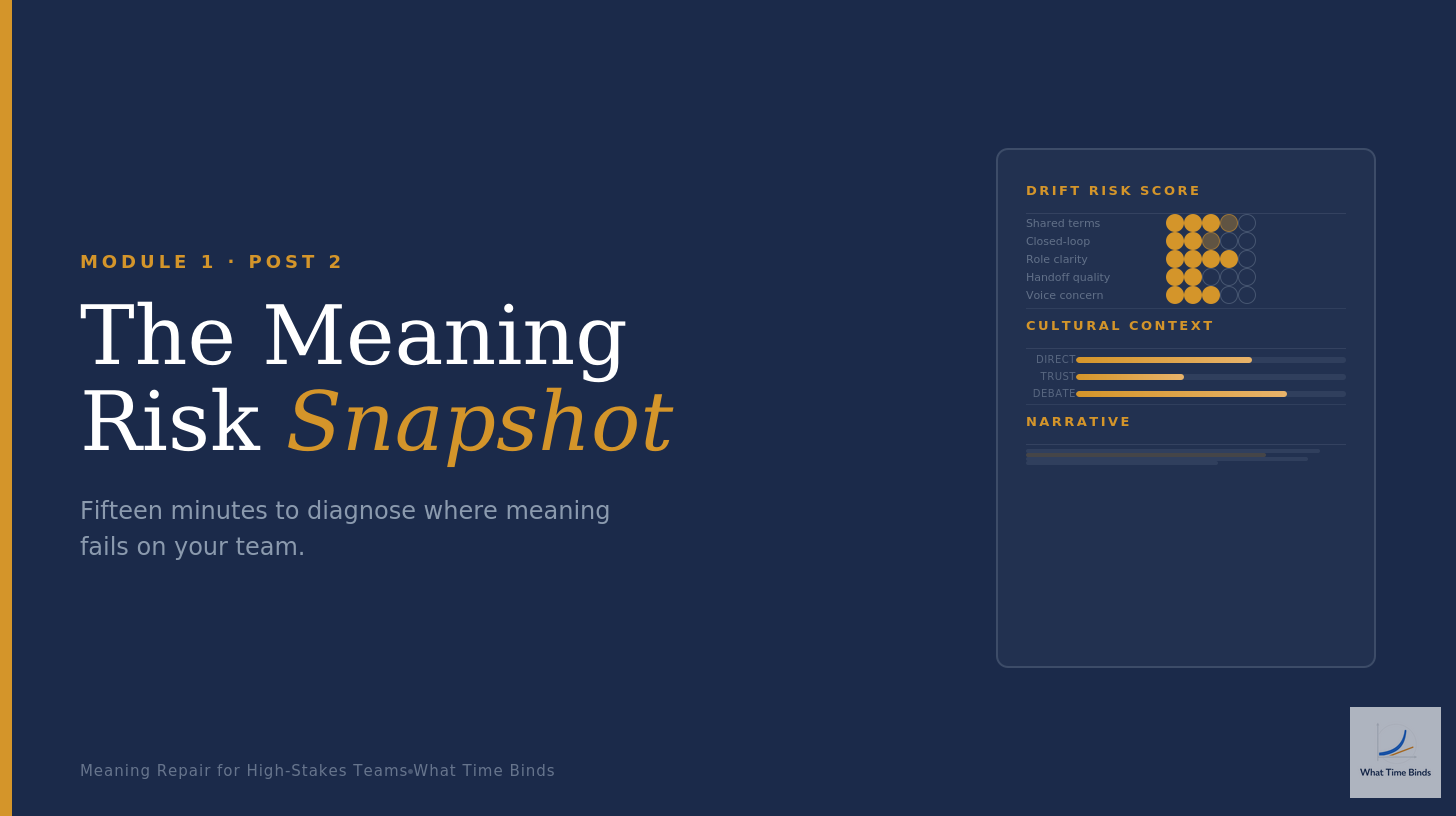
The snapshot has three sections, each about five minutes. Fifteen minutes total. You get a quantitative score you can track over time, a cultural context map that shapes how you adapt repair moves in later modules, and a narrative that names your specific targets.
Part 1: Meaning Drift Risk Score — ten Likert-scaled items adapted from validated instruments. This gives you a number.
Part 2: Cultural Context Map — a self-assessment based on Erin Meyer’s eight cultural dimensions. This gives you a picture of where gaps between team members might amplify drift
.Part 3: Narrative Risk Summary — three open questions. This gives you language.
Part 1: The Meaning Drift Risk Score
These ten items draw on the Team Assessment Tool (Ali et al., 2024), validated across nine U.S. health systems with exceptional reliability, and the Resuscitation-Specific Organizational Culture Instrument (Handley et al., 2024), which measures role clarity, shared mental models, closed-loop communication, team adaptability, and psychological safety. I’ve adapted their clinical language into terms that work for any team—project, operational, family, or community.
Score each item from 1 (strongly disagree) to 5 (strongly agree) based on your team’s typical behavior, not its best day.
1. Shared understanding of terms. When our team uses key terms (project names, status labels, priority levels, role titles), members mean the same thing.
2. Closed-loop communication. When someone makes a request or gives an update, the receiver confirms their understanding back to the sender.
3. Role clarity under pressure. During high-stakes or time-pressured work, every team member knows who is responsible for what.
4. Handoff quality. When work, decisions, or information transfer from one person or shift to another, the receiving person gets enough context to act without guessing.
5. Willingness to voice concern. Team members speak up when they notice something that seems wrong, incomplete, or unclear—even if the person they’d be questioning is more senior.
6. Leader receptivity. When someone raises a concern or questions a decision, the team’s leader(s) respond in a way that encourages continued speaking up.
7. Assumption surfacing. Our team regularly checks whether people are working from the same assumptions about scope, timeline, priorities, or definitions.
8. Debrief practice. After significant events (launches, incidents, major decisions, difficult conversations), our team reviews what happened and what to change.
9. Adaptability when plans change. When new information arrives mid-task, our team can redistribute roles and update shared understanding quickly.
10. Context travel. Information that is clear in one setting (a meeting, a document, a conversation) reliably reaches the people and settings where it’s needed next.
Scoring: Add your ten responses. Range is 10–50.
40–50 (Strong grounding): Your risks concentrate where pressure compresses the acceptance phase—handoffs, escalations, fast-moving situations. Focus on precision protocols (Modules 5–7).
25–39 (Mixed grounding): Some rhythms work; others drift. Most teams sit here. The narrative section (Part 3) helps you identify which items pull your score down.
10–24 (Significant drift risk): Meaning failures are generating rework and frustration on a recurring basis. The suppression-phase work (Modules 3–4) and cultural context map (Part 2) are especially important—the barriers are likely structural, not skill-based alone.
Record your score. You’ll retake this at Day 30 and Day 60.
Personal Repair History (unscored)
Before you move to the Cultural Context Map, take sixty seconds on two questions. These aren’t scored. They’re for your awareness only.
The last time it went badly. Think about the most recent time you raised a concern, asked for clarification, or questioned a decision, and it didn’t go well. Maybe you were dismissed. Maybe the conversation got uncomfortable. Maybe nothing changed. How long ago was that? Was it on this team or a different one?
The feeling that shows up first. When you imagine asking “what do you mean by that?” in your next meeting, what’s the first feeling that arrives: curiosity, caution, or dread?
That feeling is data about your own repair threshold. It was shaped by every team you’ve been on, every organization you’ve worked in, every time you spoke up and got rewarded or punished for it. Your threshold travels with you. It doesn’t reset when you change jobs. A person who has been dismissed for raising concerns across three organizations will experience “what do you mean?” differently than someone whose teams have always welcomed the question, even if both people are now sitting on the same team with the same manager.
This course can lower your threshold over ten weeks. But it helps to know where it sits right now, so you can feel it moving.
Part 2: The Cultural Context Map
Erin Meyer’s research produced a key insight: what matters for communication is the gap between team members on any dimension, not where any single person falls. A team where everyone communicates indirectly has fewer drift risks than a team split between direct and indirect communicators. The distance creates the danger.
For each of eight dimensions, place your team on the spectrum. If your team has significant spread, note the range rather than forcing a single point. The full snapshot instrument includes all eight with meaning-repair implications for each. Here are the dimensions:
Communication style: Low-context (explicit, precise) ←→ High-context (implicit, read-between-the-lines)
Feedback approach: Direct negative feedback ←→ Indirect negative feedback (softened, private)
Leadership expectation: Egalitarian (challenge-the-boss is normal) ←→ Hierarchical (deference to rank)
Decision-making: Consensual (discuss until agreement) ←→ Top-down (leader decides after input)
Trust basis: Task-based (competence and reliability) ←→ Relationship-based (personal connection over time)
Disagreement style: Confrontational (open debate is productive) ←→ Avoidant (confrontation damages relationships)
Scheduling orientation: Linear-time (sequential, deadline-driven) ←→ Flexible-time (adaptive, fluid)
Comfort with silence: Low (3 seconds feels long) ←→ High (12+ seconds is normal)
What to look for: Circle any dimension where your team spans more than half the spectrum. These are your cultural gap zones. In Module 4, you’ll use this map to decide whether leader-initiated repair, anonymous concern channels, or written pre-work would serve your team better than default verbal protocols.
One note: you’re rating your team as you see it, which means your placement reflects your own cultural lens. The goal isn’t objective measurement. It’s awareness of distance—enough to ask, later, “Would this move work the same way for everyone on my team?”
Quick inventory: where does your team’s meaning travel?
List the three channels where your team’s most consequential conversations happen. These might be live meetings, Slack threads, email chains, shared documents, presentations, or phone calls.
For each one, note whether it allows real-time correction, meaning the other person can immediately say “wait, that’s not what I meant” and you can adjust on the spot.
The channels that allow real-time correction are where repair happens naturally. The channels that don’t (a presentation deck, a policy memo, a recorded announcement, a published article) are where drift compounds fastest, because the acceptance phase has no space to occur.
This matters because teams routinely move their most important conversations from live channels to one-way channels without noticing what gets lost. A decision made in a meeting gets documented in an email. An email gets summarized in a slide. A slide gets presented to a room that has no context for the original conversation. At each step, the opportunity for someone to say “wait — what do we mean by that?” shrinks.
When you see your team moving a consequential conversation from a live channel to a one-way channel, that’s a moment to pause and ask: has everyone confirmed they mean the same thing, or are we locking in a version of shared understanding that was never actually verified?
Part 3: The Narrative Risk Summary
The score tells you how much drift you have. The map tells you the cultural terrain. This section names the specific failure points.
Answer three questions in writing. A few sentences each is enough.
1. The recurring failure. Describe one communication breakdown that has happened more than once on your team. Where does meaning typically diverge? When do people usually discover the gap?
2. The suppressed concern. Think of a time in the last month when you (or someone you observed) noticed confusion or disagreement but did not raise it. What was the context? What made speaking up feel difficult or pointless?
3. The costliest gap. What is the single communication pattern that costs your team the most—in rework, missed deadlines, strained relationships, or poor decisions? Name it as specifically as you can.
These three answers become the raw material for the rest of the course. The recurring failure is where you’ll practice spotting drift (Module 2). The suppressed concern is where you’ll practice repair stances (Module 3). The costliest gap is what your adoption plan (Module 10) should target first.
Your practice rep
Complete the full Meaning Risk Snapshot for your primary team this week. “Primary team” means the group of people whose communication quality most affects your work or life right now—your direct team at work, a project group, a family decision-making unit, a board you serve on.
Fill in all three parts. Record the date and your Drift Risk Score. File it somewhere you’ll find it at Day 30.
If you’re working through this course with a team, have each member complete the snapshot independently before comparing results. The places where your scores diverge are, themselves, meaning drift—and they’re some of the most useful data you’ll generate.
What's next: Post 3 — The Ten-Week Build. Your snapshot gave you the baseline. The next post sets the habit formation expectation for the course and introduces the Transfer Bridge — a prompt that moves repair practice beyond your primary team. Then in Module 2, you'll learn to classify the failures you named in Part 3. The taxonomy of meaning failures gives you the vocabulary to spot drift as it happens, before the cost arrives.
This is Module 1, Post 2 of Meaning Repair for High-Stakes Teams, a 10-module course on the What Time Binds Substack. The complete Meaning Repair Lexicon defines every term used in this course.