

When teams share a name for a behavior, they can see it, call it out, and reinforce it. Research on team communication adoption found that naming practices creates recognition and reinforcement—”When you call it something… it gives that opportunity to be present, then to really recognize like, ‘Oh, this is a strategy that I’m employing’” (Albright et al., 2025). Shared language is itself an intervention.
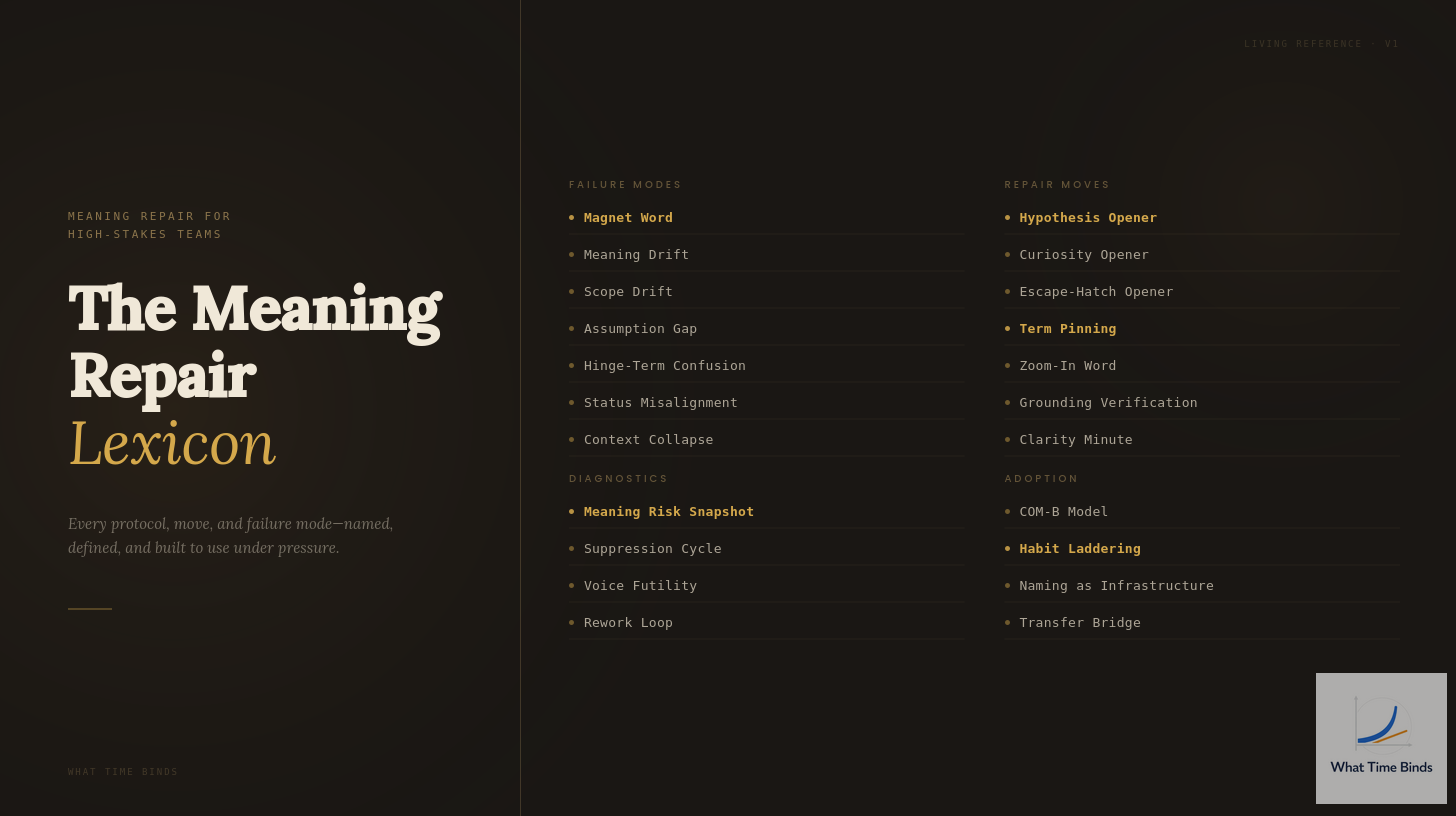
This lexicon is the course’s naming infrastructure. Every protocol, move, template, and concept below has a name short enough to use in a live conversation. You don’t need to memorize all of them before Module 1. Start with the four phases. The rest will arrive one module at a time.
The Four Phases
These are the backbone of the MRCI framework. Everything in this course maps to one of these phases.
Drift — Meaning diverges silently. Assumptions go unchecked, terms go undefined, context collapses. The grounding criteria for mutual understanding are not met, but no one notices yet. Drift is the default state of all communication under pressure. (Modules 1–2)
Suppression — Someone detects the drift but does not speak. Silence spreads through stories about what happened to others who raised concerns. Repeated voice futility teaches people to stop trying. Psychological safety erodes over time without active maintenance. Suppression is not passive—it is an active, self-reinforcing organizational process. (Modules 3–4)
Biographical Suppression Threshold — The cumulative effect of an individual's history of punished or ignored repair attempts across organizations and contexts. This threshold is portable — it travels with the person from team to team, job to job — and moderates how they receive repair attempts in any new environment, independent of the current team's actual psychological safety level. A person with a high biographical threshold may resist repair moves that would land easily with someone whose history includes more positive repair experiences. The threshold is not fixed; it can be lowered through repeated non-punitive repair reception over time. (Module 1, Module 3, Module 4)
Repair Activation — Someone speaks the first sentence. A repair move is deployed. This is the transition the course disproportionately targets, because it is where existing approaches most consistently fail. (Modules 3–7)
Outcome — Meaning is restored, or it isn’t. The result feeds back into the system. Successful repair builds psychological safety and makes the next repair easier. Failed repair reinforces suppression and makes the next silence more likely. (Modules 9–10)
Meaning Refusal — A pre-Phase 1 condition in which a person's definition of a key term is so fixed that verification attempts cannot register. The person has exited the space of engaged disagreement. Meaning refusal can result from accumulated suppression experiences across a career (biographical suppression), from deeply held convictions, or from expertise-based certainty. MRCI's repair moves operate within the space of engaged disagreement; recognizing meaning refusal is the skill of knowing when repair energy should be redirected rather than increased. (Module 1, Module 4)
The Six Failure Types
These are the categories of meaning breakdown your team will learn to spot and name. Introduced in Module 2.
Referent Ambiguity — A word or phrase points to different things for different people. “The client” means the project sponsor to you and the end user to your colleague. Neither of you knows you’re talking about different people.
Scope Drift — The boundaries of a task, decision, or conversation shift without anyone naming the shift. A meeting about launch timing becomes a meeting about product features. The original question is never answered.
Assumption Gap — A piece of context that one person holds but has not shared, because they believe everyone already knows it. The most dangerous assumption gaps feel too obvious to state aloud.
Hinge-Term Confusion — A term that carries real operational weight means something different to different team members. “Soon,” “priority,” “escalate,” “reviewed,” “approved”—these hinge terms pivot decisions, and their ambiguity is invisible until a cost reveals it.
Status Misalignment — People disagree about where a task, project, or decision stands—in progress vs. complete, pending review vs. approved, my responsibility vs. yours—without realizing they disagree.
Context Collapse — Information that was available in one setting (a meeting, a document, a conversation) does not travel to the next setting where it is needed. The meaning was clear once; it collapsed in transit.
The Repair Moves
These are the named actions you deploy in real time. Each is short enough to use mid-sentence, mid-meeting, mid-handoff.
Repair Stances (Module 3)
The first sentence of any repair. The hardest part. Three patterns:
Hypothesis Opener — “I want to check my understanding…” You state what you believe to be true and invite correction. Frames the repair as collaborative verification, not challenge.
Curiosity Opener — “Help me see what I’m missing…” You name your own incomplete picture and ask for the piece you lack. Lowers the stakes by centering your gap, not the other person’s error.
Escape-Hatch Opener — “I might be wrong, but…” You offer your observation with an explicit exit if it’s off-base. Gives the other person room to redirect without confrontation.
Precision Protocols (Module 5)
Three micro-protocols for repairing meaning at the word level:
Term Pinning — Stopping the conversation to define an ambiguous term. “When we say priority, I mean it ships this sprint. Does that match your understanding?” Converts a hinge term from vague to operational.
Zoom-In Word — Requesting specificity when language is too abstract to act on. “When you say soon, can you give me a concrete timeline?” Forces vague language into actionable form.
Grounding Verification — Confirming mutual understanding using a structured check: What was presented? What evidence of acceptance was obtained? Was the grounding criterion met? Does repair remain needed? Formalizes the acceptance phase that most conversations skip.
Meeting Moves I (Module 6)
Three moves for repairing meaning inside live meetings:
Clarity Minute — A 60-second structured pause at the meeting midpoint. The facilitator asks: “Let me check—what have we agreed to so far?” Surfaces divergent understanding before it compounds.
Term Pinning Live — Flagging and resolving an ambiguous term in real time during a meeting. The live version of the Module 5 protocol, adapted for the pace and social dynamics of group conversation.
Who/They Resolution — Replacing vague pronouns with specific names and roles. “They should handle that” becomes “[Name] will [specific action] by [date].” Converts diffuse ownership into traceable commitment.
Meeting Moves II (Module 7)
Three moves for repairing meaning around decisions:
Scope Check — Detecting when a conversation has drifted from its stated purpose. “Are we still deciding [original question], or has the question changed?” Names the drift so the team can choose whether to follow it or return.
Decision Framing — Using the Mediating Assessments Protocol to decompose a decision: define criteria independently, assess facts independently, then delay holistic judgment until all assessments are complete. Delays intuition without eliminating it.
Next-Step Precision — Closing every decision with a documented statement of who does what by when, using assigned roles. Converts agreement-in-principle into trackable action.
The Leadership Protocols
Tools for leaders who shape the climate where repair either happens or dies. Introduced in Module 4.
Silence Audit — Identify the 2–3 stories your team tells about what happened when someone raised a concern. These stories are the suppression infrastructure. Name them, then write counter-narratives: what you, as a leader, would do differently.
Visible Response Protocol — When someone raises a concern, three steps: (a) acknowledge it in the moment, (b) name the next step, (c) close the loop within a defined timeframe—even if the answer is “we considered it and decided not to change.” Directly counters the mechanism that produces learned helplessness from repeated voice futility.
PS Micro-Behavior Tracker — A weekly observation tool. Select 8–10 observable micro-behaviors associated with psychological safety (questions asked, uncertainty admitted, disagreements voiced, information volunteered) and tally them during one meeting per week. Provides behavioral data instead of self-report.
Counter-Narrative — A story you tell deliberately to replace a suppression story. If the team story is “Last time someone flagged a problem, they got sidelined,” the counter-narrative is a concrete example of a concern being raised, heard, and acted on—or at least acknowledged.
The Decision Tools
Structures for preventing the re-deciding loops that erode meaning. Introduced in Module 7.
DACI Roles — Driver (owns the process), Approver (makes the final call), Contributors (provide input), Informed (need to know the outcome). Assign before the decision begins, not after.
Decision Log — A running record: Decision ID, date, context, options considered, reasoning, who decided, and review date. Makes decisions visible and retrievable. Roughly half of decisions made in meetings are never followed through because ownership and documentation are unclear. The log is the forcing function.
Decision Hygiene Checklist — A protocol card for clean decisions: Decompose into criteria. Assess independently before group discussion. Take the outside view. Delay holistic judgment. Assign a decision observer. Document with rationale. Set a review date.
MAP (Mediating Assessments Protocol) — Define independent criteria in advance, make fact-based assessments independently, then delay holistic judgment until all assessments are complete. The formal structure behind Decision Framing.
The Debrief Tools
Structures for reviewing what happened—especially the communication events teams naturally avoid. Introduced in Module 9.
Debrief Paradox — The finding that events containing critical communication breakdowns are significantly more likely to go undebriefed than events without communication breakdowns. The very events that most need review are systematically avoided because the confusion persists and inhibits structured discussion.
Hot Debrief — 5–10 minutes, immediately post-event. Adapted from the STOP5 format for communication: Summarize what was communicated and intended → Identify what was understood correctly → Pinpoint where meaning diverged → Set action points for communication change.
Cold Debrief — 30–60 minutes, days after the event. Uses the Timeline Debriefing Tool to reconstruct the communication sequence and map MRCI phases: When did drift occur? What suppression behaviors appeared? What triggered repair? What was the outcome?
Communication Trigger Checklist — The explicit list of conditions that warrant a communication-focused debrief: ambiguity discovered after the fact, concerns raised but not acted on, assumptions that turned out to be wrong, or hierarchy that prevented someone from speaking up.
PEARLS — An alternative debrief structure with four phases: Reactions (how did that feel?), Description (what happened?), Analysis (blending self-assessment with directive feedback), and Summary (what will we do differently?). Particularly useful for teams that find open-ended debrief formats too unstructured.
The Measurement Concepts
How we track whether meaning repair is actually happening. Introduced primarily in Modules 1 and 10.
Meaning Risk Snapshot — The baseline diagnostic completed in Module 1 and repeated at Day 30 and Day 60. Combines adapted Team Assessment Tool items (quantitative, Likert-scaled) with a cultural context field and a narrative risk summary.
Leading Indicators — Metrics that predict future communication quality: structured handoff compliance, speaking-up behavior rates, debrief completion rates, psychological safety scores. Updated frequently.
Lagging Indicators — Metrics that confirm past communication quality: communication-related adverse events, rework metrics (clarification requests, re-dos, meeting-to-resolution ratio), escalation-to-resolution time. Updated less frequently.
Delta Values — A scoring method: percentage of positive responses minus percentage of negative responses. Reveals nuanced shifts that positive-only scoring misses. Applied to the 5-item communication climate pulse survey.
Rework Loop — Any cycle where work is redone because meaning failed the first time: clarification requests, task re-assignments due to misunderstanding, meetings called to re-decide what was already decided. The operational cost of unrepaired drift.
Communication Quality Scorecard — The dashboard combining leading and lagging indicators with trend tracking. The course’s measurement centerpiece.
The Adoption Concepts
How repair moves become habits instead of one-time experiments. Introduced across the course, formalized in Module 10.
COM-B Model — Every behavior requires three things: Capability (knowledge and skills), Opportunity (environmental and social support), and Motivation (reflective and automatic drivers). When a repair move isn’t happening, COM-B diagnoses which ingredient is missing.
Habit Laddering — Starting with one practice for 6–8 weeks before adding complexity. Research shows starting slowly and increasing gradually maintains habits 1.5 times longer than starting at full intensity. The course’s recommended adoption sequence.
Naming as Infrastructure — The principle that giving a practice a shared name is itself an intervention. When you call it a “Clarity Minute,” it becomes visible, recognizable, and reinforceable. Every term in this lexicon serves this function.
EAST Framework — Design heuristic for nudges and prompts: make the desired behavior Easy, Attractive, Social, and Timely. Applied to how repair moves are cued in daily workflows.
Transfer Bridge — The prompt at the end of every module asking: “Where outside your current work role would this move have changed an outcome this week?” Converts each module from workplace-specific to life-applicable.
The Course Structures
Terms for the course’s own learning design.
Repair Rep — The spaced repetition post published as Post 3 of each module. Revisits concepts from 1–2 prior modules with a new scenario. Based on evidence that spaced repetition produces 80% retention at 30 days versus 20% with traditional methods.
Cost Anchor — The one-sentence statistic at the opening of each module connecting the topic to a concrete operational or human cost. Grounds abstract concepts in real consequences.
Recall Prompt — The 2–3 sentence prior-knowledge activation at the start of each module’s first post. Creates a prediction the reading can confirm or disconfirm.
Worked Repair — A two-column example showing what happened (left) and the repair move with annotations (right). Appears in Modules 3–7 before learners attempt their own repair moves.
Progress Map — Self-assessment checkpoints at Modules 4, 7, 9, and 10 with calibrated items like: “At this point, I can diagnose a meaning failure within 60 seconds: never / sometimes / reliably under pressure.”
MR-OS (Meaning Repair Operating System) — The collective name for all 10 deliverables. Each deliverable is a component the learner builds from their own workflows and retains as a permanent team resource.
The Key Theoretical Anchors
Concepts from the research traditions the course draws on. You don’t need to cite these in conversation—but knowing where the moves come from strengthens your understanding of why they work.
Grounding Theory (Clark & Brennan, 1991) — Communication requires a presentation phase (speaker presents an utterance), an acceptance phase (the partner provides evidence of understanding), and a grounding criterion (mutual belief of sufficient understanding). Most communication failures happen because the acceptance phase is skipped.
Psychological Safety — The shared belief that the team is safe for interpersonal risk-taking. Starts high in new teams and declines over time without active maintenance. Leader behavior predicts 52% of the variance. Not the absence of conflict—the presence of conditions where people can speak without fear.
Coactive Vicarious Learning (CVL) — Learning to stay silent by hearing stories about what happened to others who spoke up, rather than from direct personal experience. The mechanism by which suppression becomes cultural.
Acquiescent Silence — Silence that results from learned helplessness: speaking up has failed so many times that the person stops trying, even when new opportunities arise. Distinct from silence driven by fear or strategic withholding.
Noise (Kahneman, Sibony, & Sunstein) — Unwanted variability in judgments that should be identical. When two people make the same decision differently for no defensible reason, that is noise. Decision churn—re-deciding what was already decided—is noise made visible in team behavior.
The Cultural Adaptation Terms
Concepts for adapting repair moves across cultural contexts. Woven into the course from Module 1.
Power Distance — The degree to which less powerful members of a team accept and expect that power is distributed unequally. In high-power-distance teams, subordinates are less likely to initiate repair with superiors. The course offers alternative pathways: leader-initiated repair and anonymous channels.
High-Context / Low-Context Communication — High-context cultures (e.g., Japan, China, much of Asia and Africa) rely on implicit, relationship-based communication where meaning lives between the words. Low-context cultures (e.g., U.S., Germany, Scandinavia) rely on explicit verbal statements. Neither is better. But undetected drift is more likely in high-context settings, and direct repair moves may feel confrontational.
Cultural Gap — What matters is not where any single culture falls on a dimension, but the distance between team members on that dimension. A team where everyone is high-context has fewer drift risks than a team where half are high-context and half are low-context.
Safety Listening — An alternative to “safety voice” for high-power-distance teams. Instead of expecting subordinates to speak up, leaders actively solicit concerns. The repair activation comes from the top, not the bottom.
Face-Saving Mechanism — Any repair pathway that allows a person to surface a concern without publicly contradicting someone of higher status. Written pre-work, anonymous channels, private 1:1 conversations, and third-party facilitation are all face-saving mechanisms.
This lexicon is a living document. It will be updated after each module with new terms, refined definitions, and examples drawn from the course community’s discussions. Bookmark it. Return when you encounter a term you’ve forgotten. Use the names in your meetings, your handoffs, your conversations. The names are the infrastructure.
Next: Module 1 — The Meaning Risk Snapshot → Where is meaning failing right now?