


Update, October 17, 2026: Sgt. Maj. (Ret.) Mario P. Fields and I talk this essay through in Episode 1 of What Do You Mean?, our new podcast. It runs nineteen minutes and goes live Sunday, October 18, at 1:00 PM PT.
Update, October 9, 2026: Today a federal judge set aside the Justice Department Civil Rights Division’s voter-roll policy, and she opened her opinion with the Division’s own history. This page has kept a record on that Division since July. The new entry sits under MONITORING. What follows is the August 26 essay with the September 25 and October 9 entries added.
Update, September 25, 2026: Today the Court lifted a second lower-court order on voting, 6-3, unsigned. Justice Jackson wrote the dissent, joined by Justices Sotomayor and Kagan, and cited her Trump v. California dissent inside it. The ledger below has a fifth entry. One fact in it cuts against my STANDING pin, and I say so there. What follows is the August 26 essay with that entry added.
Author’s note. I moved this piece from next Monday’s essay slot into this Wednesday’s WDYM slot because the ruling came down Monday, the mechanism is happening this week, and the reader who shows up on Wednesday needs to see what is being pinned before the first ballot goes out for November. I am writing this as a Marine Corps veteran who cast a UOCAVA ballot for many years, from Camp Pendleton, from recruiting duty in Austin, from Okinawa, and from Camp Leatherneck in Helmand. I am writing as the father who cast a ballot alongside his wife and three daughters for the first time in November 2024, and who has watched the words around and about voting change. — JWW
November 2024. Five of us in a car. My wife, my three daughters, and I, all wearing I Voted stickers, my youngest with hers on her nose. She was twenty. It was the first November my whole family voted together.
I have voted in every federal election of my adult life. For twenty-three years of that record I was in uniform, mailing a Federal Post Card Application to a Kansas county clerk from wherever I was stationed. Camp Pendleton. Austin. Okinawa for six years with my family. Camp Leatherneck in Helmand. Home of record: Kansas. The envelope always went to the same county. The Uniformed and Overseas Citizens Absentee Voting Act had been the ritual of my adult life. The Military and Overseas Voter Empowerment Act, signed on October 28, 2009, as part of the FY2010 National Defense Authorization Act, streamlined the machinery. I trusted the machinery because the machinery worked.
This piece is about what happened between November 2024 and this August. What has been done around voting in the last twenty-two months.
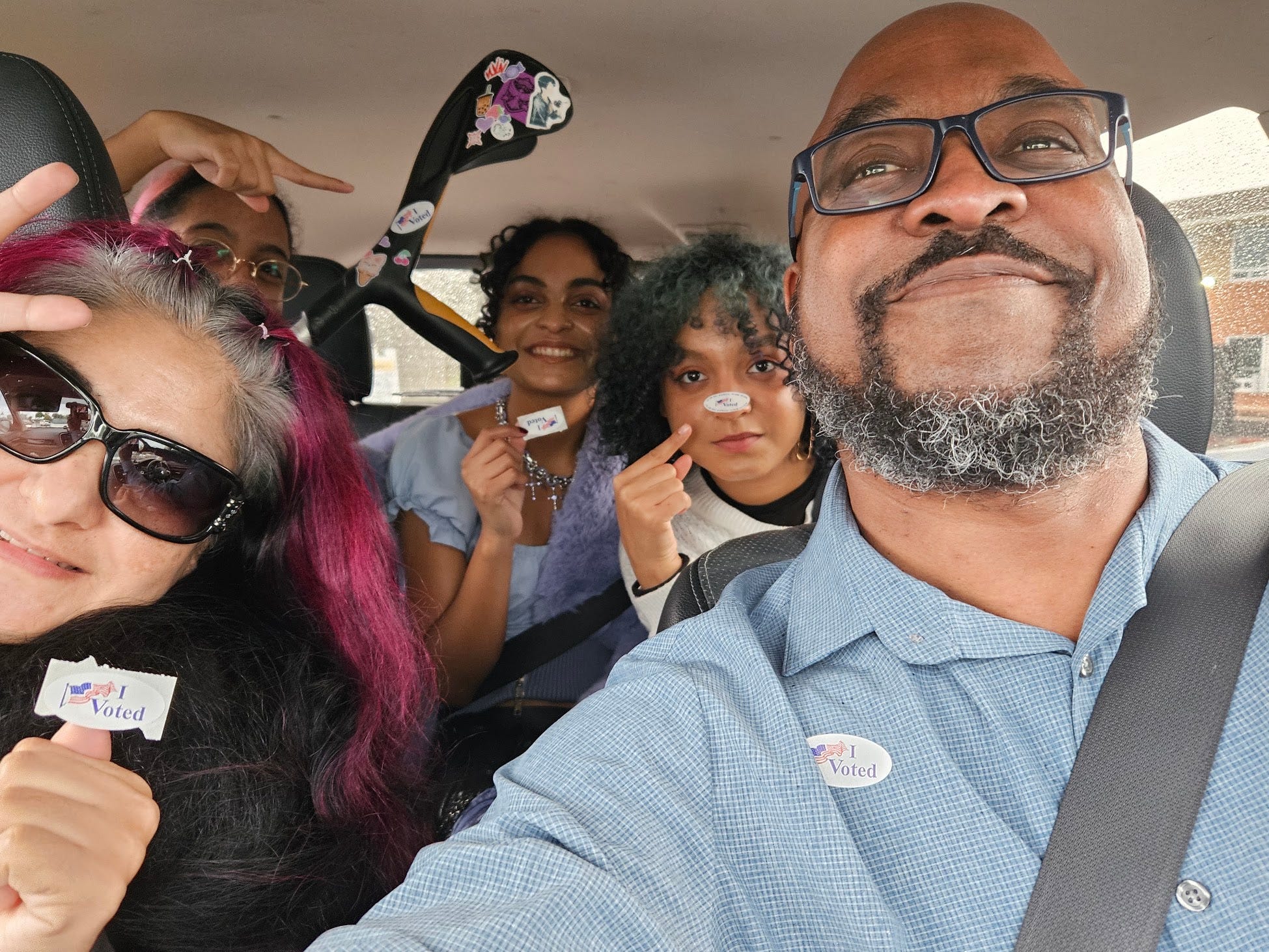
November 2024. First November my whole family voted together. My youngest had just turned of age.
What is settled
On March 31, 2026, President Trump signed Executive Order 14399, “Ensuring Citizenship Verification and Integrity in Federal Elections.” 91 Fed. Reg. 17125. The Order directs the Secretary of Homeland Security to compile Citizenship Lists and send them to each state (§2(a)). It directs the Attorney General to “prioritize the investigation and, as appropriate, the prosecution” of state and local election officials who issue ballots to ineligible voters (§2(b)). It directs the Postal Service to initiate rulemaking to require unique barcodes on every outbound ballot envelope and to allow USPS to refuse to transmit ballots from any voter not enrolled on the appropriate list (§3).
Twenty-three states and the District of Columbia sued in the District of Massachusetts. The district court enjoined §§2 and 3. The First Circuit refused to stay the injunction, 2-1. On Monday, August 24, 2026, the Supreme Court granted the stay, 6-3. The Trump v. California per curiam is unsigned. Justices Sotomayor and Kagan dissented. Justice Ketanji Brown Jackson dissented separately, alone, in twenty-three pages, and called the ruling “a grave misuse of our equitable emergency powers.”
The Department of Justice’s Voting Section, the office that would enforce federal voting-rights law against the state and local officials the Order threatens with prosecution, has three attorneys left.
One Justice kept a ledger
Justice Ketanji Brown Jackson joined the Court in June 2022. Since then, she has dissented in five voting-rights and election-law rulings where the majority sided against voters, minority communities, or state election officials. The dissents are on the record. Read them in order, and a pattern shows up.
May 23, 2024. Alexander v. South Carolina State Conference of the NAACP. 6-3 on racial gerrymandering. Jackson joined Justice Kagan’s dissent, which called the district court’s factual findings that South Carolina drew a race-based congressional map “more than plausible.” The majority set those findings aside.
August 22, 2024. Republican National Committee v. Mi Familia Vota. Emergency stay concerning Arizona’s proof-of-citizenship voter registration law. Jackson dissented from the partial grant of the stay. Four Justices, Jackson among them, would have denied the RNC’s application entirely. The case was about a state requiring documentary proof of citizenship for voter registration. Executive Order 14399 takes the same premise national.
April 29, 2026. Louisiana v. Callais. 6-3 on Section 2 of the Voting Rights Act. The Court held that Section 2 does not require Louisiana to keep two majority-Black congressional districts despite African Americans making up more than 32% of the state’s population. A week later, on May 4, 2026, when the Court accelerated the ruling’s implementation, Jackson wrote a four-page dissent to the follow-up order and called the Court’s action “unwarranted and unwise.”
August 24, 2026. Trump v. California. Jackson wrote alone in twenty-three pages, called the ruling “a grave misuse of our equitable emergency powers,” and closed with the line: “This is not a close call.”
September 25, 2026. Department of Homeland Security v. League of Women Voters. No. 26A308. The Court lifted Judge Sparkle Sooknanan’s June 22 order and let DHS run its rebuilt SAVE database, which now draws on Social Security records to check the citizenship of registered voters. The unsigned majority wrote that the federal government “has an obligation to respond to requests from state and local election officials seeking to verify the citizenship of voters.” Jackson wrote twelve pages, joined by Justices Sotomayor and Kagan: “the harm caused by burdening or disenfranchising even a few lawful voters outweighs the nonexistent harm that the Government experiences when it is prevented from taking an action that it likely lacks the authority to take.” She cites her Trump v. California dissent inside it.
The day before, at the University of the District of Columbia School of Law, she asked: “Why is it that one party should get a fast pass to the Supreme Court of the United States when so many other parties are queued up, waiting patiently for the court’s attention?”
Two facts from the same opinion cut the other way, and they belong on this page. The majority found that the League of Women Voters and the Electronic Privacy Information Center “likely have standing.” The courthouse door I describe under STANDING stayed open this time. The government won on the balance of harms instead. Jackson herself writes that the ruling “will likely have minimal short-term impact,” because federal law bars states from systematically striking voters from the rolls within 90 days of an election. Before November 3, states can run only what the majority calls “individualized inquiries.”
That phrase is the next word to pin. The majority uses it to show the government is harmed. The dissent uses it to show voters are protected for now. The Wednesday Field Guide takes it up on September 30. Until then, check your own registration at vote411.org. A citizenship flag is easier to answer in October than at the polling place.
Alongside those dissents, Jackson has spoken publicly about the Court’s use of the emergency docket. In an April 2026 speech at Yale Law School, she said the practice has a “corrosive effect” on the judicial system.
The pattern she has been documenting from inside the institution is the pattern this essay describes from outside it. The institution has been inconsistent. She has not.
What is being pinned right now
The Court’s ruling did not decide the lawfulness of the Executive Order. It decided that the states cannot be in court yet. That distinction matters because the Order is being implemented while you read this. USPS promulgated its proposed rule on June 2, 2026. The Government blew past the July 29 deadline the Order set for a final rule, then issued that final rule on August 21, 2026 — three days before the Supreme Court's ruling and while the District Court's injunction against implementing §3 was still in force. The Federal Register formally published it today, August 26. Justice Jackson names the timing choice as strategy: the executive controls when a rule is proposed and finalized, and delaying gives it a court order that blesses the strategy of proposing contested changes, prompting chaos, and keeping valid legal claims at bay.
Here are the words being pinned this week. Read them as a sentence. Together they answer who gets to vote in November.
INTEGRITY
Plain definition. The property of a process that produces accurate results without corruption. In election law, it names chain of custody, signature verification, and audit trails.
What “integrity” is doing. It is the frame that lets a President reorganize the machinery of state elections by executive order, and lets the Republican National Committee sue overseas voters in swing states without evidence. In October 2024, Judge Sima Patel in Michigan and Judge John Smith in North Carolina both dismissed RNC lawsuits challenging overseas ballots, in each case finding no evidence of fraud. The lawsuits used “integrity” as their basis. The evidence side of the word was empty.
Pin. Election integrity is a property of a process, verified by audit and observation. It is not a permission slip for anyone with power to reshape who counts. Includes: chain of custody, signature verification, post-election audit. Excludes: prosecuting state officials for issuing ballots the Attorney General does not want issued. Example: a bipartisan post-election audit. Non-example: EO 14399.
MONITORING
Plain definition. Watching a process to detect and correct deviations. In federal voting-rights law, it names the Justice Department’s Voting Section observing polling places under the Voting Rights Act.
What “monitoring” is doing this week. The DOJ still uses the word. The office behind the word has three attorneys.
Pin. Monitoring is enforcement staffed by people with authority to act. A word used to describe an empty office is not monitoring. Includes: federal observers with legal authority under §2 of the Voting Rights Act. Excludes: the chilling of state and local election officials by federal prosecutors. Example: DOJ election observers in the 1965 Selma federal registration effort. Non-example: three attorneys.
October 9, 2026. A federal court read the Division’s history back to it. In Common Cause v. U.S. Department of Justice, No. 26-1352, Judge Sparkle Sooknanan set aside the Civil Rights Division’s voter-roll policy under the Administrative Procedure Act. The Division had demanded unredacted voter rolls from 49 states and the District of Columbia, and 18 states sent them. Its own records call the program the “list maintenance project.”
The 78-page opinion opens on the institution before it reaches the law: the “crown jewel” of the Justice Department, created under the Civil Rights Act of 1957, “forged in the Civil Rights Movement.” Then: “Against that backdrop, this case is anomalous.” She calls it “a policy adopted by the current Civil Rights Division,” and she reads past the label: “Behind all the window dressing, the challenged policy represents the federal government’s attempt to decide who gets to vote.” She holds that none of the laws the Department cited authorize it.
This page has kept the same record from outside. On July 13 I wrote that the Division was created in 1957 to enforce federal civil rights law, and that “the phrase ‘civil rights’ had not changed. What it protected had.” On July 30 I quoted Assistant Attorney General Harmeet Dhillon describing her goal as turning “the train around and driving it in the opposite direction.” On September 16: “The words ‘civil rights’ haven’t changed. What they protect has.” The court reached its reading on its own record, with the force of law behind it.
Two facts belong beside the opinion. Judge Sooknanan served as the Division’s principal deputy assistant attorney general under Kristen Clarke, the predecessor I named on September 16. And her June 22 order is the one the Supreme Court lifted on September 25, the fifth ledger entry above. Weigh her history paragraph with both in mind. The holding rests on the statutes.
The pin above says monitoring is enforcement staffed by people with authority to act. The Division that houses the Voting Section put its weight behind a different job, and a court has now named it.
ELECTION INTEGRITY ARMY
Plain definition. None. The phrase is a brand.
What “election integrity army” is doing this week. It labels four operations under one phrase. Poll watching by trained partisan observers, which is legal in most states under state rules. Ballot chasing, which is a term for coordinated absentee-ballot collection and is regulated state by state. Voter intimidation at drop boxes, which federal law prohibits. Private surveillance of election workers, which crosses state harassment lines and, at some scales, federal ones. One phrase, four operations, only one of which the private label makes legal.
Pin. “Army” is a legal category. A self-appointed civilian group is not one. Private groups that describe themselves as an army performing election duties are performing four different acts, at least one of which is a federal crime. Includes: state-credentialed poll observers with rules and complaint procedures. Excludes: armed private groups at drop boxes. Example: certified election observers.
Non-example: masked men in tactical vests at a drop box.
INTERNAL DIRECTIVE
Plain definition. An order from a President to his own subordinates that binds no one outside the executive branch. It usually names scheduling memos, coordination directives, budget guidance.
What “internal directive” is doing this week. It is the frame the Trump v. California majority used to say Executive Order 14399 is not reviewable in court because the Order addresses federal officials. Justice Jackson’s reductio is the pin: imagine a “purely internal” directive from a President to the Postal Service ordering it not to deliver mail-in ballots in disfavored states. That would still be a directive to federal subordinates. It would still be unreviewable under the majority’s frame. The label does not survive its own logic.
Pin. An order is “internal” if it does not require action by anyone outside the executive branch and does not create the threat of federal action against anyone outside it. EO 14399 requires state cooperation and threatens state officials with prosecution. It is not internal. Includes: scheduling and coordination inside the executive branch. Excludes: an order that runs on state cooperation and is enforced by federal prosecution of state officials. Example: a memo setting the executive’s work-from-home policy. Non-example: EO 14399.
The Court keeps pinning these words on its emergency docket, and one Justice keeps writing down what each pin costs. Every Monday I take one word an institution bent and show the page it bent on. Subscribe and the next one is in your inbox, free.
STANDING
Plain definition. The legal doctrine that decides who is allowed to sue. It exists to keep courts from hearing hypothetical cases.
What “standing” is doing this week. It is the doctrine the Court used to close the courthouse door on twenty-three states with constitutional duties to administer elections. Under Trump v. California, states that are already spending money, retraining officials, and rewriting guidance because of the EO have no concrete injury. Under Purcell v. Gonzalez (2006), the same states cannot file after the final rule issues because that filing would come too close to the election. Too early now. Too late later. Justice Jackson names the trap in a footnote.
The Court decided a related case, Bost v. Illinois State Board of Elections, less than a year ago. In Bost, the Court held that a political candidate had standing to challenge an election rule change based on a general fair-election interest. Today the Court holds that twenty-three sovereign states with constitutional duties to administer elections do not. Jackson: “This means either Bost is wrong or today’s decision is indefensible (or both).”
Jackson herself dissented in Bost. She thought the candidate should not have received standing either. Her point in Trump v. California is that the Court cannot grant standing there and deny it here in the same twelve months without contradicting itself.
Pin. Standing exists to prevent hypothetical cases from being heard. It has been used this week to prevent a documented, imminent case from being heard because the executive can delay its own finalization. That is the opposite of what the doctrine exists to do. Includes: gatekeeping for cases with no real injury. Excludes: gatekeeping for cases whose plaintiffs are already suffering the injury the doctrine was written to require. Example: dismissing a suit over an executive order that has been rescinded. Non-example: dismissing a suit by state election officials who have already reallocated staff and rewritten guidance because of the order.
What I am not saying
I am not saying every executive order is illegal. Presidents issue orders. Some are lawful. Some are not. Some are unreviewable for reasons that make institutional sense. That is not the piece.
I am not saying every 2026 vote will be blocked. Millions will be cast and counted. Kansas will send ballots to its overseas voters starting forty-five days before November 3. My daughters will vote again. That is not the piece either.
I am not saying the Supreme Court is corrupt. Corruption is a specific claim requiring specific evidence. The claim I am making is different. I am pointing to doctrine used against its purpose. Standing exists to prevent hypothetical cases. It was used this week to prevent a documented case. That is a doctrinal failure, and it is bad enough on its own.
I am not saying Republicans invented voter suppression. The record on both parties is long. The claim I am making is about a specific week in which a President, a Court, and a private label all pinned the same five words in the same direction, and about what those five pins do to a November election that is seventy days away.
I am not saying citizenship should not be verified. Every state already verifies eligibility at registration. The claim I am making is about what happens when a federal Citizenship List (one the Government has conceded will be incomplete) becomes the gate through which state ballots must pass, and when state officials who mail ballots to voters not on that federal list face federal prosecution.
What I am saying
The words being pinned this week decide who gets counted before anyone casts a ballot in November. Turnout is the last step. The words are the first step, and the first step is happening now.
I am writing as a UOCAVA voter who trusted a federal machinery for twenty-three years and cast a ballot alongside his wife and daughters in 2024. Every word I have pinned in this piece touches that vote. INTEGRITY is the frame the RNC used in 2024 to try to invalidate ballots like the ones I mailed. MONITORING is what the DOJ office with three attorneys still calls what it no longer has the staff to do. ELECTION INTEGRITY ARMY is what private groups call themselves when they replace the office with three attorneys. INTERNAL DIRECTIVE is what the Court called an executive order that reaches into every state’s ballot-mailing system. STANDING is what the Court used to keep the states that administer those systems out of court.
The five pins are a sentence. The sentence says: the executive branch and the Court have arranged the words so that the challenge to the executive branch cannot be heard in time to matter.
One Justice on that Court has been documenting the arrangement since 2024. Her ledger is public.
What the reader owes
Read the words before you accept them. When someone says integrity, ask who wrote the list. When someone says monitoring, ask how many attorneys. When someone says army, ask which of the four operations they mean. When someone says internal, ask who is being prosecuted. When someone says standing, ask who is being kept out.
Register if you have not. Read your county’s rules for absentee and mail-in voting. Read your ballot before you fill it out. Understanding the ballot is the first thing an accountable public owes itself.
Read the dissent, too. Someone on the inside has been reading the institution for you.
November 2024. Five of us in a car. My youngest with the sticker on her nose. It was the first November my whole family voted together.
Twenty-two months later, the Court told twenty-three states they came too early. Purcell will later tell them they came too late. One Justice on that Court has been keeping the ledger since 2024. This week she wrote twenty-three pages naming the trap and called the ruling a grave misuse of our equitable emergency powers.
The last remaining check on definitional control is a reader who moves slowly, checks the source, and refuses to accept the word as given.
Read the words. Read the ballot. Read the institution. Read the dissent.
Note, August 26, 2026 (afternoon). This piece originally described the Government as having blown past the July 29 deadline for a final USPS rule — accurate as of Justice Jackson's dissent. USPS issued that final rule on August 21, 2026, three days before the Supreme Court's ruling and while the District Court's injunction against implementing §3 was still in force. The Federal Register formally published it today, August 26 (Doc. 2026-17238). The clause in "What is being pinned right now" has been sharpened to reflect that timeline. Democratic plaintiffs (DSCC, DCCC, DNC, Democratic Governors Association, Schumer, Jeffries) filed a supplemental complaint and renewed motion for preliminary injunction against the USPS rule on August 25, 2026 in the U.S. District Court for D.C. Hearing sought on or around September 4.
Note, September 25, 2026. Added the fifth ledger entry (DHS v. League of Women Voters, No. 26A308) and changed “four” to “five” in the ledger’s opening line. The entry records two facts from that opinion that cut against the STANDING pin as written in August: the majority found the plaintiffs likely have standing, and the dissent expects minimal short-term impact because of the 90-day window. Nothing else in the August text changed.
Note, October 9, 2026. Added the October 9 entry under MONITORING (Common Cause v. U.S. Department of Justice, No. 26-1352, D.D.C.), with links to the earlier pieces on the Civil Rights Division, and a new update line at the top. Nothing else in the August text changed.
What Time Binds runs on readers. If this piece told you something you did not already know, forward it to someone who needs to read it. If you want the next one, subscribe below.
What Time Binds studies how meaning drifts and how we repair it. One field guide like this every week, free.
How I make this: reporting and verification are mine, drafting is a collaboration with AI tools I review, and corrections get pinned, never buried. Full process: what-time-binds.com/how-i-make-this