

At 10:03 a.m. on April 29, 2026, Justice Samuel Alito read the majority opinion in Louisiana v. Callais from the bench. The Voting Rights Act, he said, must be “properly construed.” Section 2 still stands. Race-conscious districting fails the Equal Protection Clause. Six justices agreed.
At 10:41 a.m., Justice Elena Kagan read her dissent. She used a different sentence. The majority had rendered Section 2 “all but a dead letter.”
Same opinion. Same courtroom. Same words on the page. Two incompatible readings of what just happened.
Outside the building, the gap widened. Ilya Shapiro called it “a victory for the colorblind Constitution.” Janai Nelson, who argued the case for the NAACP Legal Defense Fund, called it a recasting of “the Reconstruction amendments as Redemption amendments.” The White House called it “a complete and total victory.” Joyce Vance called it the moment a Court that “appeals to history and tradition to undo so many established rights” ignored the history of Black disenfranchisement to arrive at its decision.
Each side was certain. Each side had the text. The text did not settle it.
That is the question this issue is asking. Not whether Callais was rightly decided. Not whether Section 2 is dead or merely wounded. The question underneath the legal fight: what kind of conversation is this?
I am not a lawyer. I am not a politician. I am not a historian. I repair meaning. To repair something, you have to identify what’s broken.
What broke on April 29 was not Section 2 of the Voting Rights Act. Section 2 is statutory text. It still appears in the United States Code. What broke was the shared definition of a single phrase in the Fourteenth Amendment. That phrase tells courts when race can be considered and when it cannot. The majority and the dissent both used the words “color-blind” and “race-conscious.” They meant opposite things. The illusion of shared vocabulary held. The shared meaning did not.
A note on the piece I never sent
I drafted an essay on the Trump v. Barbara oral arguments three weeks ago. It was finished. I had a publish button to press. I did not press it.
Reading it now, I understand why I set it aside. The Barbara piece named a magnet word, allegiance, doing the work of unpinning a 158-year-old definition of citizenship. The mechanism was clear. What I could not see, in early April, was that allegiance was not the only word doing that work this Term. Three weeks later, Callais arrived with a second magnet word, color-blind, doing the same job on the same set of Amendments. Same Court. Same architecture. Different vocabulary.
The Barbara piece will run when the Court decides the case in June. For now, it lives as evidence: the pattern was visible before the second ruling confirmed it. A repair worker is allowed to say I saw this coming only when the receipts hold up. Mine do.
The five picks below come from people who saw the fracture from five different angles. A former U.S. Attorney. A historian of American democracy. A constitutional commentator on the right. A writer who saw the magnet word coming two years ago and named it on the day the ruling dropped. And the country’s leading scholar of how the Court actually operates. Then a book. Then a question for you.
Let’s read.
1. The Supreme Court’s Decision in Louisiana v. Callais — Joyce Vance, Civil Discourse (April 29, 2026)
Vance was a U.S. Attorney in Alabama for seven years. She prosecuted voting rights cases. She knows what Section 2 used to do because she used it.
Her Callais post went up the night of the decision. She refused the hot take. She told her readers she would read the opinion carefully and write again later in the week. Then she did one thing: she pulled the through-line from Trump’s “blood and soil” speech the night before to the Alito opinion the next morning. Two events. One project.
Vance closes with Justice Ginsburg’s old line about why dissents matter. Dissents are written for the future. They wait there until the country catches up.
If you want a former federal prosecutor’s read on what Callais broke, this is the cleanest one in print.
Watch it or listen below:

2. April 29, 2026 — Heather Cox Richardson, Letters from an American (April 29, 2026)
Richardson does what most of the legal commentariat could not. She does not isolate Callais. She pairs it with Trump’s White House welcome speech for King Charles III the night before. In that speech, Trump described America as a nation founded on “Anglo-Saxon courage” and “blood and noble spirit.”
Her implicit argument carries the issue. The Reconstruction Amendments built one definition of American belonging: birthright, multiracial, structural. The “blood and soil” rhetoric and the Callais ruling are dismantling the same definition together, in the same week, from two different rooms.
Read this one second. Vance gives you the legal fracture. Richardson gives you the historical altitude.
Read it below:
3. The Court Just Said Race Can’t Draw the Map — Tyler Piekarski, The Founders’ Signal (April 29, 2026)
I include this pick on purpose. Piekarski writes from the right. His Callais post defends the ruling. He argues the Court did not kill the VRA. He argues Louisiana was caught between two federal courts giving opposite orders. He argues Alito resolved a real contradiction.
His framing sentence: the Court “killed the doctrine that racial arithmetic belongs in the map room.”
Read him to feel the magnet word at work. Piekarski uses color-blind the same way Alito uses it. The classification itself is the harm, regardless of which direction the classification runs. Vance and Kagan use color-blind the opposite way. The willful refusal to see the structural harm the Reconstruction Amendments were written to address.
Same word. Two definitions. Both sides certain they hold the original meaning.
This is the cleanest articulation of the conservative legal position on Substack right now. If you want to know what your reasonable neighbor on the right is reading and why it makes sense to him, read Piekarski.
Read it beow:

4. The Supreme Court Has Gone “Colorblind” and Just Killed the Voting Rights Act — Shari Dunn, Shari Dunn’s Substack (April 29, 2026)
Dunn put the magnet word in her title. Colorblind, in scare quotes. She wrote in Salon in November 2024 that Trump’s plan to dismantle DEI was “a colorblind path to Jim Crow 2.0.” Her Callais post on April 30 opens with one line: “I take no pleasure in being right.”
Then she does the historical work. She traces the word colorblind back to Plessy v. Ferguson (1896). Not to Justice Harlan’s famous dissent, the line everyone quotes. To the majority opinion. The 1896 majority told Black Americans that segregation imposed no real harm on them, and that any harm they felt was, in the Court’s words, a “fallacy” the “colored race chooses to put upon it.” Dunn’s argument: the Plessy theory has walked back into American law under a different name.
This is the cleanest articulation of the magnet word in print. Read Dunn fourth among the picks here on Substack. She gives you the word in the courtroom, the word in 1896, and the word doing damage in 2026, in one essay.
Watch or listen here:

5. They Are Who We Thought They Were — Steve Vladeck, One First (April 30, 2026)
Vladeck teaches at Georgetown. He wrote The Shadow Docket. He is the country’s most trusted analyst of how the Roberts Court actually operates.
His Callais bonus issue does something the other four picks do not. He steps off the outrage track. His argument: nobody who has been watching this Court should be surprised by Callais. The personnel made the outcome inevitable. Shelby County (2013) → Brnovich (2021) → Callais (2026) is one arc, not three separate rulings.
Then he names the deeper problem. The fix is not court-packing. The fix is congressional response to the Court’s statutory readings. Congress wrote Section 2. Congress reauthorized it. Congress can write it again. The Court’s confidence rests on its bet that Congress will not.
The title is borrowed from the old Dennis Green press conference. The point is the same. The Court is what its record showed it was. Pretending otherwise is the move that produced the surprise.
Read it here:

The book
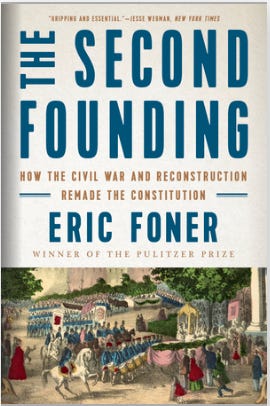
The Second Founding: How the Civil War and Reconstruction Remade the Constitution — Eric Foner (W.W. Norton, 2019)
Foner is the Pulitzer-winning DeWitt Clinton Professor Emeritus at Columbia. He is the most authoritative living historian of Reconstruction. The Second Founding covers the Thirteenth, Fourteenth, and Fifteenth Amendments as one integrated repair: birthright citizenship and voting rights as two halves of the same constitutional project.
This is the book that holds the room together this week. Callais and the pending Barbara case are both about whether the repair Foner documents is permanent infrastructure or a revisable preference.
Foner’s own line, from a 2019 NPR interview, lands harder now than it did then: “Not that long ago, the Supreme Court overturned, basically, the Voting Rights Act of 1965, which was passed virtually unanimously by Congress to enforce the 15th Amendment. Nobody, I think, thought that they were going to do that. But they did.”
The book to read this weekend if you want to understand what the Court is reviewing — and what it is unwriting.
The Second Founding | Eric Foner | W. W. Norton & Company
One thing I wrote
The Barbara piece is finished. It is sitting in my drafts. It will publish the day the Court rules in June. The reason it is not running now is in the callout box at the top of this issue.
What I am writing next What Do You Mean? essay — on the word color-blind and what it has been asked to carry since Justice Harlan first used it in 1896. That one runs Monday.
Send me what you’re reading
Especially if it’s on Substack. If you read a piece on Callais this week that named the magnet word honestly, from any direction on the political map, send it to me. Reply with “For the Binding” in the subject line, DM me on Notes, or tag me in a Note with the piece. Every submission gets read. Pieces that run get tagged.
A question for you
The Reconstruction Amendments use a small handful of phrases — equal protection, due process, subject to the jurisdiction, the right to vote. Each phrase was pinned in 1868 or 1870 to repair a specific catastrophe. Each phrase is now under pressure.
Pick one. In your own words, write the definition you think the drafters were trying to make permanent. Then write the definition you see being substituted in 2026.
The gap between those two sentences is the repair work in front of all of us.
Reply with both. I will publish a list next Friday.
The Friday Binding is a weekly ritual inside What Time Binds. Five reads worth passing forward, each framed through the meaning repair lens. Every Friday morning, free.
— Jerry Washington, Ed.D. • what-time-binds.com