


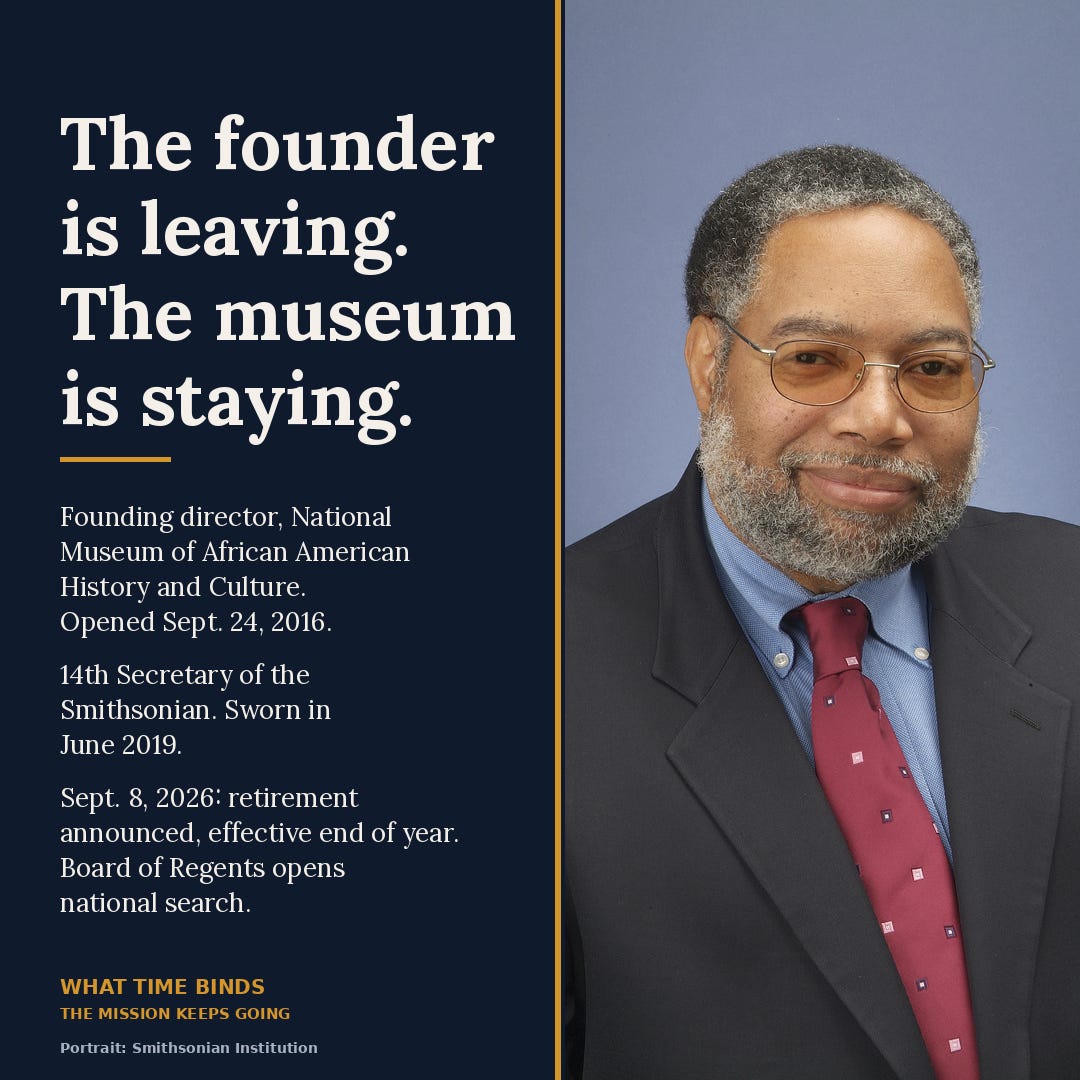
Author’s note. I moved this piece into today, Wednesday, September 9, because the news broke Monday and by Tuesday two Facebook posts had already staked a claim on the frame — one from a sitting Congressman posting a press card off the retirement, one from a private account calling the retirement “a quiet win nobody is talking about.” The reader who shows up mid-week needs to see what is being pinned before it hardens. I am writing this as a Marine Corps veteran who spent twenty-three years inside an institution where the mission always outlived the officer who ran it. I helped plan the shutdown of 3rd Combat Engineer Battalion. I PCS’d before the final ceremony. I sat as senior enlisted in retirement ceremonies for close friends and for Majors I respected. One friend served beside me for the full twenty-three years. I write about institutions because I know what it looks like from the inside when one loses a leader and the mission keeps going anyway. That is what happens next at the Smithsonian, and the reader deserves to see it clearly before someone else names it wrong.
— JWW
My years in the Marine Corps taught me one fundamental fact. The mission keeps going.
I stood through more change-of-command ceremonies than I can count. As a senior enlisted Marine, I cased the colors for retiring Majors. I sat in retirement ceremonies for close friends. I helped plan the shutdown of 3rd Combat Engineer Battalion in 2014. I PCS’d before the final ceremony. I left before the last salute, and the Marines who stayed carried the mission the Corps had reassigned them to. One close friend served beside me for the full twenty-three years. Every ceremony taught the same thing. A person leaves. The mission goes on. Always.
Two Facebook posts landed on my feed today, one day after the Smithsonian’s founding director of the National Museum of African American History and Culture announced his retirement. A sitting United States Congressman posted a press card with his own portrait against the Capitol dome: “The days of using America’s museums to teach Americans to hate their own country are coming to an end.” The same Congressman told Fox News last month that the Smithsonian needed to “clean house.” A private account with a hashtag stack ranging from #MAGA to #FBI called the retirement “a quiet win nobody is talking about” and told the reader Lonnie Bunch “suddenly realized he’s ‘old as dirt.’” Both posts want the reader to read the retirement as a decisive move in a fight over who owns the American story. Neither has the authority to make that reading true.
Let me tell you what a retirement is.
A retirement is a personnel action. Lonnie G. Bunch III will step down at the end of calendar year 2026, effective on a date he chose. He gave his reasons on the record to NOTUS. He said, “I have to be honest, it has been stressful.” He said he wants to “wake up in the morning and not look at my cellphone.” He said he has spent nearly half his life at the Smithsonian and it is time for his next chapter. Those are his sentences. He owns them.
The Smithsonian is a public trust older than the retirement of any of its officers. It was chartered by an act of Congress in 1846 on the bequest of James Smithson, a British scientist who never set foot on American soil, “for the increase and diffusion of knowledge.” The National Museum of African American History and Culture was authorized by Public Law 108-184, signed by President George W. Bush on December 16, 2003, after unanimous consent in the Senate and a voice vote in the House. Two Republican presidents and two Democratic presidents watched it get built. Congress asked for the museum. Bunch drove the fundraising, the collections, the architecture, and the opening on September 24, 2016. Fifteen days from today, on the tenth anniversary of that opening, the museum will have hosted almost thirteen million visitors from all fifty states and nearly two hundred countries. None of them came because a director’s name appeared on a business card. They came because the objects were there.
The objects are what “the museum” actually is. Nat Turner’s Bible. Harriet Tubman’s shawl and hymnal. The glass-topped casket that carried Emmett Till home to his mother. The Point of Pines slave cabin from Edisto Island. Chuck Berry’s red Cadillac. A shard of stained glass from the Sixteenth Street Baptist Church in Birmingham. A Tuskegee Airman’s training plane. These artifacts belong to the American people. They will still be there on January 1, 2027, when the founding director’s retirement takes effect. They will still be there when the fifteenth Secretary of the Smithsonian is sworn in. They will still be there when the sixteenth is. That is what “public trust” means.
The Congressman’s line trades on a smaller word: using. His sentence says museums are being used to teach Americans to hate their country. Museums are buildings. Visitors do the reading, on their own terms. Some walk out changed. Some walk out unchanged. What they carry with them is not a script the museum handed them. It is their own reading of what the record shows. The founding director’s job was to make the record available. The visitor’s job was to look. The Congressman’s job was to write the appropriation. Nobody’s job was to tell the visitor what to feel.
The other post claims Bunch left because “the White House threatened the federal money.” The Smithsonian’s federal appropriation, 62% of the Institution’s operating budget, is authorized by Congress, not by the White House. Reducing it requires a vote. A threat in a press release is not a reduction. The threat is real. The reduction has not happened. Bunch’s stated reason for leaving is the stress of eighteen months under sustained public attack, not a specific appropriation cut. On this, the record is what it is.
Which brings me to what is actually about to happen, and to why the “win” frame is premature.
The Smithsonian is governed by a Board of Regents of seventeen members. The Chief Justice of the United States, John G. Roberts Jr., serves as Chancellor. The Vice President serves ex officio. Three senators are appointed by the President Pro Tempore of the Senate. Three representatives are appointed by the Speaker of the House. Nine citizen Regents are elected by joint resolution of Congress. Franklin D. Raines chairs the Board. Roger W. Ferguson Jr. is Vice Chair. Toni Bush chairs the Governance and Nominating Committee, which is where the Secretary search will run. Those names will pick the next Secretary. Not the White House. Not the Congressman. Not the Facebook posts. The Board will announce an Acting Secretary and open a national search.
The search will run against a standard. Let me name the standard leadership actually is.
Leadership is a practice. Its test is what the practice builds. Bunch spent nearly two decades doing the work leadership requires. He raised the money — hundreds of millions of dollars, most of it private, most of it from ordinary people who sent what they could. He built the collection object by object. He hired the historians and made room for their disagreements. He commissioned the architecture. He wrote the wall text and rewrote it until the text carried the country instead of a single reading of the country. He walked among the visitors after opening, because a leader who cannot be in the room with the people the institution serves is not a leader. Call it professional will paired with personal humility. Call it servant leadership. Call it adaptive work. Call it whatever you like. The measure is what he made. He made a room where more people could enter. That is the entire test.
Pseudo-leadership is what fills the space when the practice is absent. It is the sitting official who calls for a purge but has never raised a dime, hired a scholar, or curated a case. It is the private account signed with a credential no institution recognizes, telling the reader that a retirement is a win. Neither has built a room. Both are counting the founder’s departure as their achievement. A career at that altitude is not a scoreboard. It is a building, and the building remains.
The next Secretary will be measured by the same test. Not by whether the appointment pleases a Congressman or a Facebook post. By what the Secretary builds, protects, expands, and hands back to the American people. That is the standard citizens can hold. It is the same standard the Regents can be asked to apply.
Every citizen who cares about what the museum is for has one job between now and the announcement of the fifteenth Secretary: make sure the Regents know that the country you saw at the museum — the country that includes Nat Turner and Chuck Berry and the Sixteenth Street children and the Tuskegee Airmen and every visitor who ever walked out changed — is the country you want the next Secretary to steward.
Here is what that looks like.
Renew or begin your Friends of the Smithsonian membership. The 250th anniversary discount is live and it is tax-deductible. Every membership funds programs across the Institution, and every member’s name is a data point in a database the Regents can see.
Visit the museum. Before September 24 if you can, so your family becomes part of the ten-year record. If you cannot travel to Washington, the NMAAHC digital collections are open and free.
Write one Regent by name. The Office of the Regents reads its mail. Office of the Regents, Smithsonian Institution, PO Box 37012 MRC 050, Washington, DC 20013-7012. Address your letter to Chair Franklin D. Raines, to Chancellor John G. Roberts Jr., or to Governance and Nominating Chair Toni Bush by name. One page. Your name. What the museum has meant to you. That is a citizen letter, and it belongs on the record.
Ask your senator and your representative one question in writing. What criteria will they apply to the next Secretary of the Smithsonian, and what do they consider disqualifying? Get the answer on paper.
If you are a historian, a curator, a donor, or a Regent yourself, publish one specific standard you believe the fifteenth Secretary must meet. Sign your name.
None of this is a partisan move. It is a citizen move. The Smithsonian belongs to all of us because Congress said so in 1846 and again in 2003. The visitors who walked those halls belong to every state, every party, every faith, and no faith. The record they saw and the record they carried out is not the property of any administration.
I want to close on the visitors, because that is what a heartfelt essay owes.
In the comments under my July 9 post, a Black woman who grew up in segregated Charlottesville, Virginia, wrote about her first visit to the Smithsonian. She was eleven years old. The only “point of interest” available to her in Charlottesville was Thomas Jefferson’s Monticello — then a stagnant tourist site where the guides refused to discuss slavery, and where the name Sally Hemings could get a visitor asked to leave. Her uncle, a distinguished artist who taught at a segregated high school, invited her to ride with him and his art students to Washington, DC, to see Da Vinci’s Mona Lisa at the Smithsonian. She wrote: “For me, it was love at first sight. Rooms and rooms of art and buildings and buildings of adventure.” She spent leisure days there for decades. She wrote, “That area of DC became my happy place.”
That is what the museum is for. That is what a “guilt trip” frame cannot see. It is a love story. A Black girl from segregated Charlottesville falls in love with human civilization inside a building the country said was hers too. The building did not tell her to feel that. The building let her look. She did the rest. Multiply that love story by almost thirteen million. That is what Lonnie Bunch’s leadership made.
Lonnie Bunch spent his career building a room where more people could have that experience. He earned the right to walk off the deck plates. He earned the right to stop looking at his cellphone. The country he stewarded owes him a straight thank-you, not an argument about whether he lost.
He did not lose. He handed the mission off. The mission keeps going. That is what a career at that altitude looks like at the end of it.
The rest of us pick up the cellphone he set down. Not to defend one man. To defend one museum. And through it, to defend one American story big enough to hold Nat Turner and Chuck Berry and a girl from segregated Charlottesville and every visitor whose name is not in this essay but who is part of the record just the same.
Congress asked for the museum. The founding director built it. Now the story is under our care.
A note on voting. The Smithsonian’s Board of Regents includes three senators and three representatives chosen by the party leadership of each chamber, and nine citizen Regents elected by joint resolution of Congress. The next Congress you elect helps choose who chooses the next Secretary of the Smithsonian. November 3, 2026 is fifty-five days from today. Register if you have not. Read your county’s rules for absentee and mail-in voting. Read your ballot before you fill it out. If you care about who tells the American story next, the ballot is one of the levers that decides it.
— JWW