


Two Facebook posts landed in my feed the same week. Same photograph of Dr. Anthony Fauci at a 2020 hearing. Opposite captions. One came from the political left and called him a hero the country failed. The other came from the political right and called him a criminal the country pardoned. Neither caption engaged the record underneath the photograph. Both used the same face as a scoreboard.
I built a post that named three facts the two posts excluded.
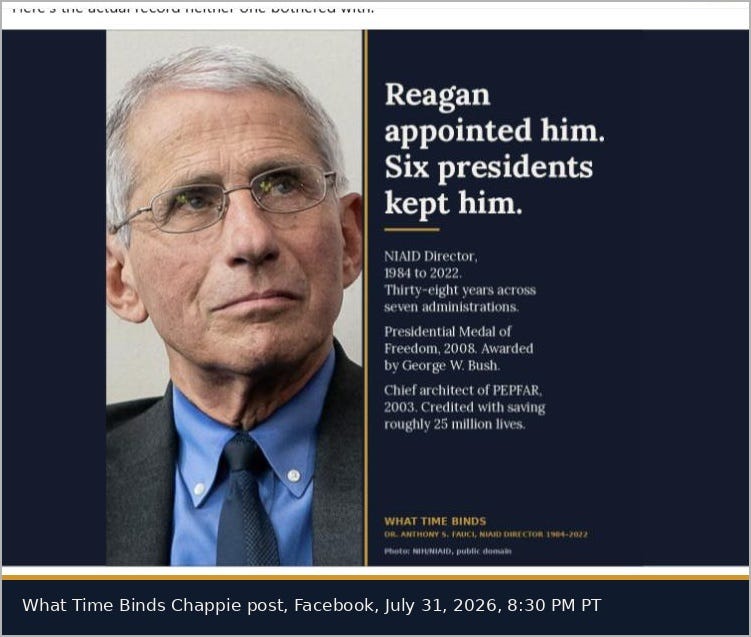
Reagan appointed him. Six presidents kept him across thirty-eight years at NIAID. Presidential Medal of Freedom, 2008, awarded by George W. Bush. Chief architect of PEPFAR in 2003, credited with saving roughly twenty-five million lives. Three specific, dated, verifiable facts.
Senator Rand Paul released 1,141 pages of Fauci’s personal diary, and the comment section became the story.
This is a piece about a document, three captions placed on it, and what I found when I read all 1,141 pages myself. Every page I quote is reproduced below. You do not have to take my reading on faith. Look at the page and decide for yourself.
Part One: The claim
A commenter arrived under the post with a claim I clipped for my Facebook comment section, because the wording matters.
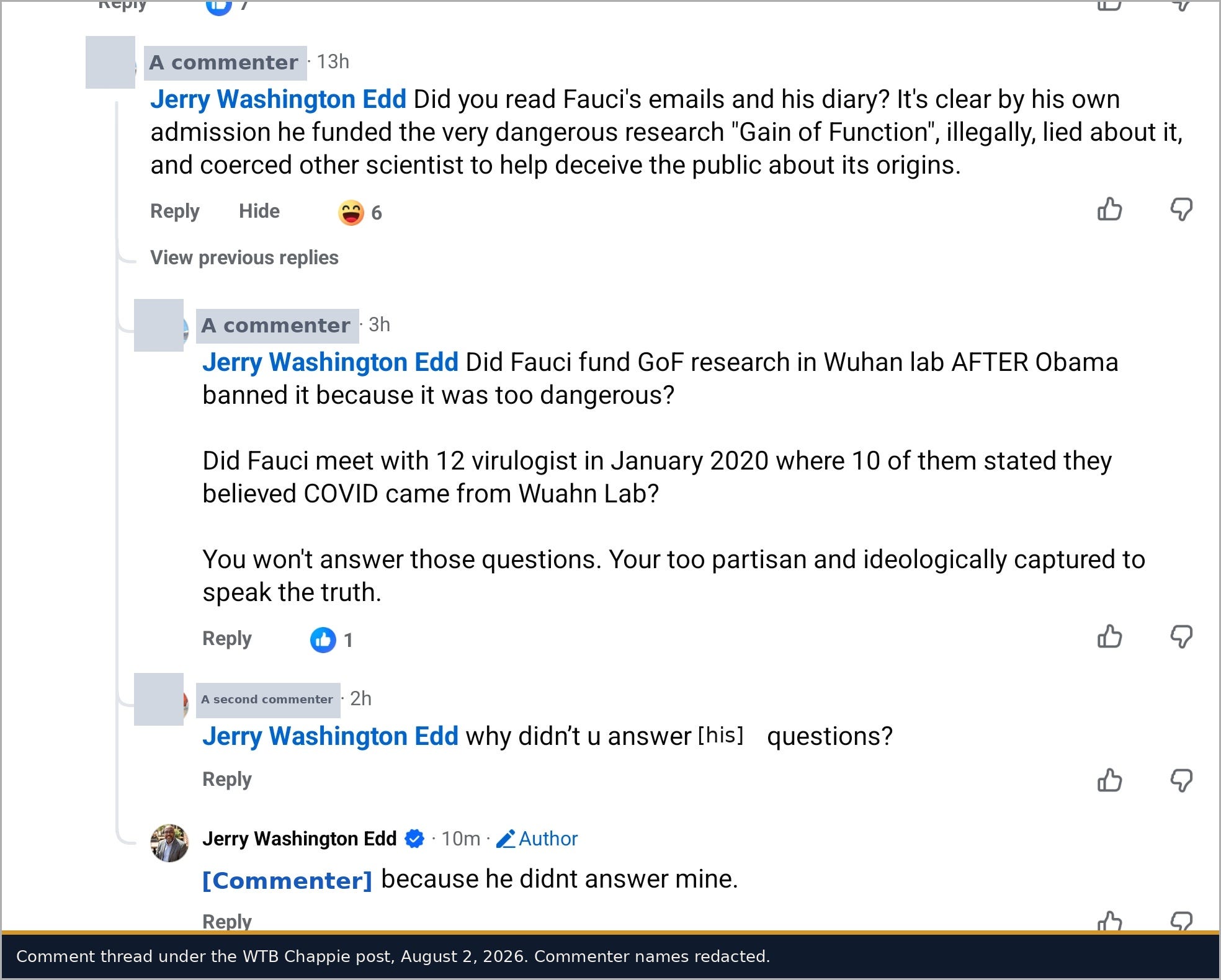
“Did you read Fauci’s emails and his diary? It’s clear by his own admission he funded the very dangerous research ‘Gain of Function’, illegally, lied about it, and coerced other scientist to help deceive the public about its origins.”
What I read here. Four claims stacked, each one depending on the one before it. The load-bearing phrase is “by his own admission.” That phrase does specific rhetorical work. It says the proof is inside the document. It says the document is a confession. It invites the reader to treat the diary’s existence as the argument and skip the reading.
What this cannot be read to say. It is not a citation. There is no page number, date, or quotation. A reader who wanted to check this claim would not know where to start, which is the point I would make about most claims that travel this fast.
I had read the release. So I asked for the page.
A question for you: When someone tells you a document proves something, how often do you open the document? Be honest with yourself before you read the next section.
Part Two: The answer
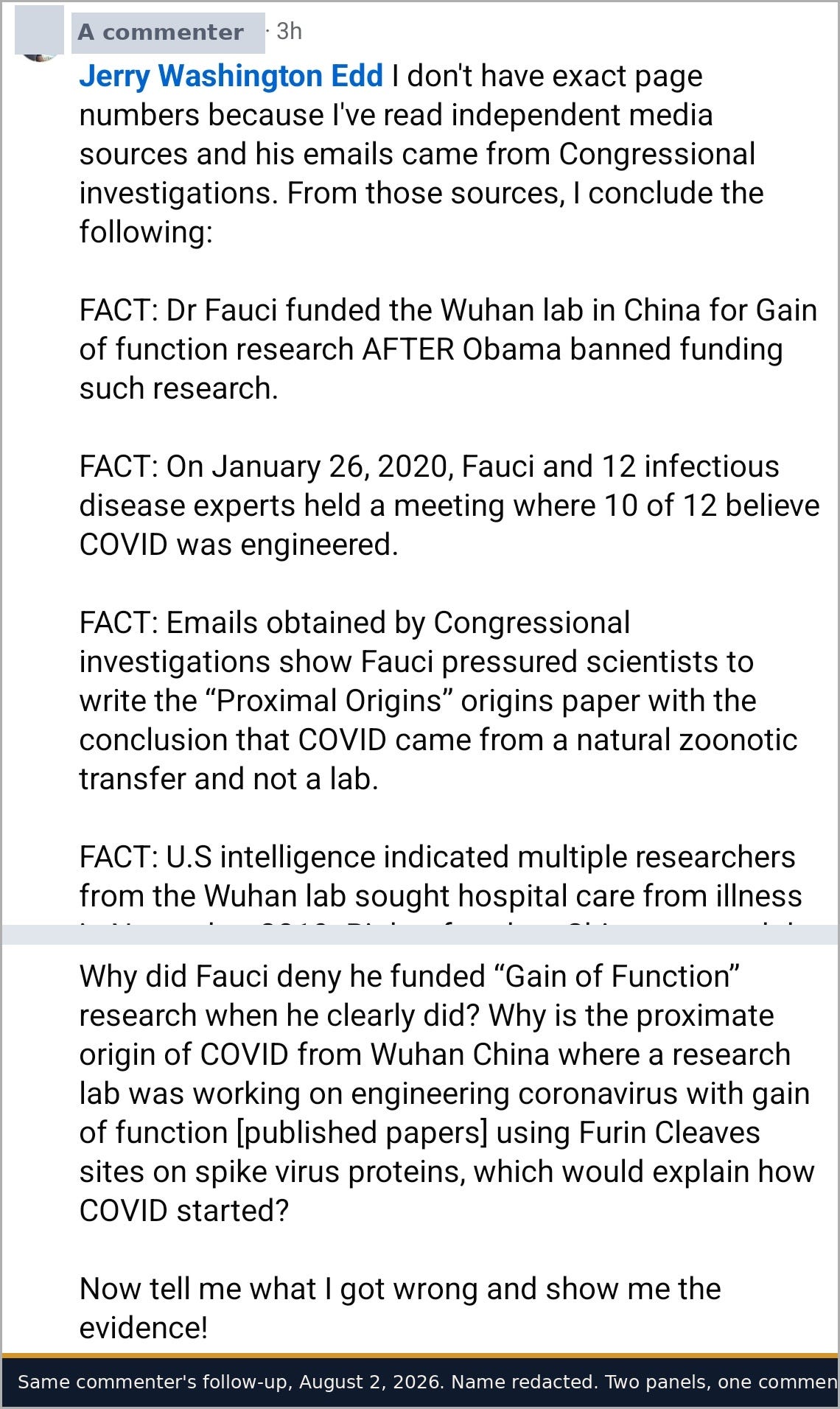
The reply opened with one sentence I want you to read again:
“I don’t have exact page numbers because I’ve read independent media sources and his emails came from Congressional investigations.”
Then four claims labeled FACT, and a closing challenge: “Now tell me what I got wrong and show me the evidence!”
What I read here. A person arguing in good faith, by his own lights, who has told me plainly where his information comes from. He cited a document as proof. When asked for the passage, he said he had read what other people said about the document. His source was never the diary. His source was the commentary running around the diary.
What this cannot be read to say. It cannot be read as proof that he is arguing dishonestly. It cannot be read as proof that people on his side of the aisle do this and people on mine do not. I have a coded record of 885 comments under this post, and the same strategy appears on both sides in roughly equal measure.
I want to be careful here, because this is where the essay could go wrong. He is not stupid, and he might not be lying. He assembled a structured argument, numbered it, and invited correction. That is more intellectual effort than most comment sections produce. The failure is not in his character or his politics. It sits in one step of his method, and it is a step most often skipped.
A question for you: Look at his four FACTs. Before you scroll further, mark which ones you believe you could source to a primary document in under ten minutes.
Part Three: What the diary says about the January 2020 calls
His second FACT reads: “On January 26, 2020, Fauci and 12 infectious disease experts held a meeting where 10 of 12 believe COVID was engineered.”
Here is the diary. Two pages, in sequence. Read them.
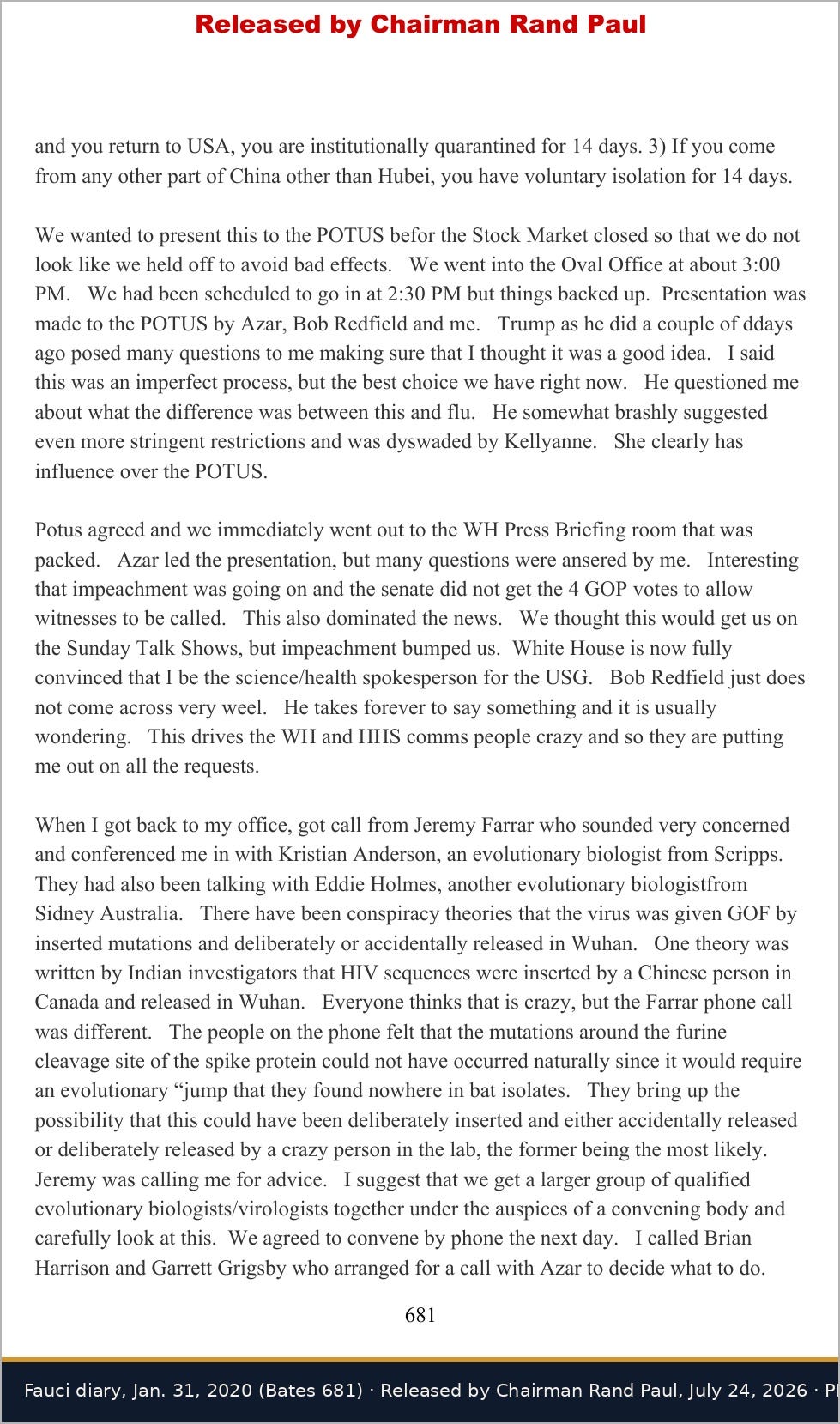
This is January 31, 2020. The relevant passage sits at the bottom of the page:
“When I got back to my office, got call from Jeremy Farrar who sounded very concerned and conferenced me in with Kristian Anderson, an evolutionary biologist from Scripps… The people on the phone felt that the mutations around the furine cleavage site of the spike protein could not have occurred naturally… They bring up the possibility that this could have been deliberately inserted… Jeremy was calling me for advice. I suggest that we get a larger group of qualified evolutionary biologists/virologists together under the auspices of a convening body and carefully look at this.”
What I read here. Three working virologists told Fauci their first look at the genome suggested engineering was possible. Fauci’s recorded response was to convene a larger expert group and examine the claim. He wrote this in a private log the same night. This is the strongest passage in the entire release for anyone arguing that Fauci took lab origin seriously, and it deserves to be quoted by people making that argument. It is real.
What this cannot be read to say. It cannot be read as Fauci concealing a lab-leak finding. The sentence immediately after the concern is Fauci proposing to widen the review. A person burying a finding does not convene more experts to look at it.
Now the next page.
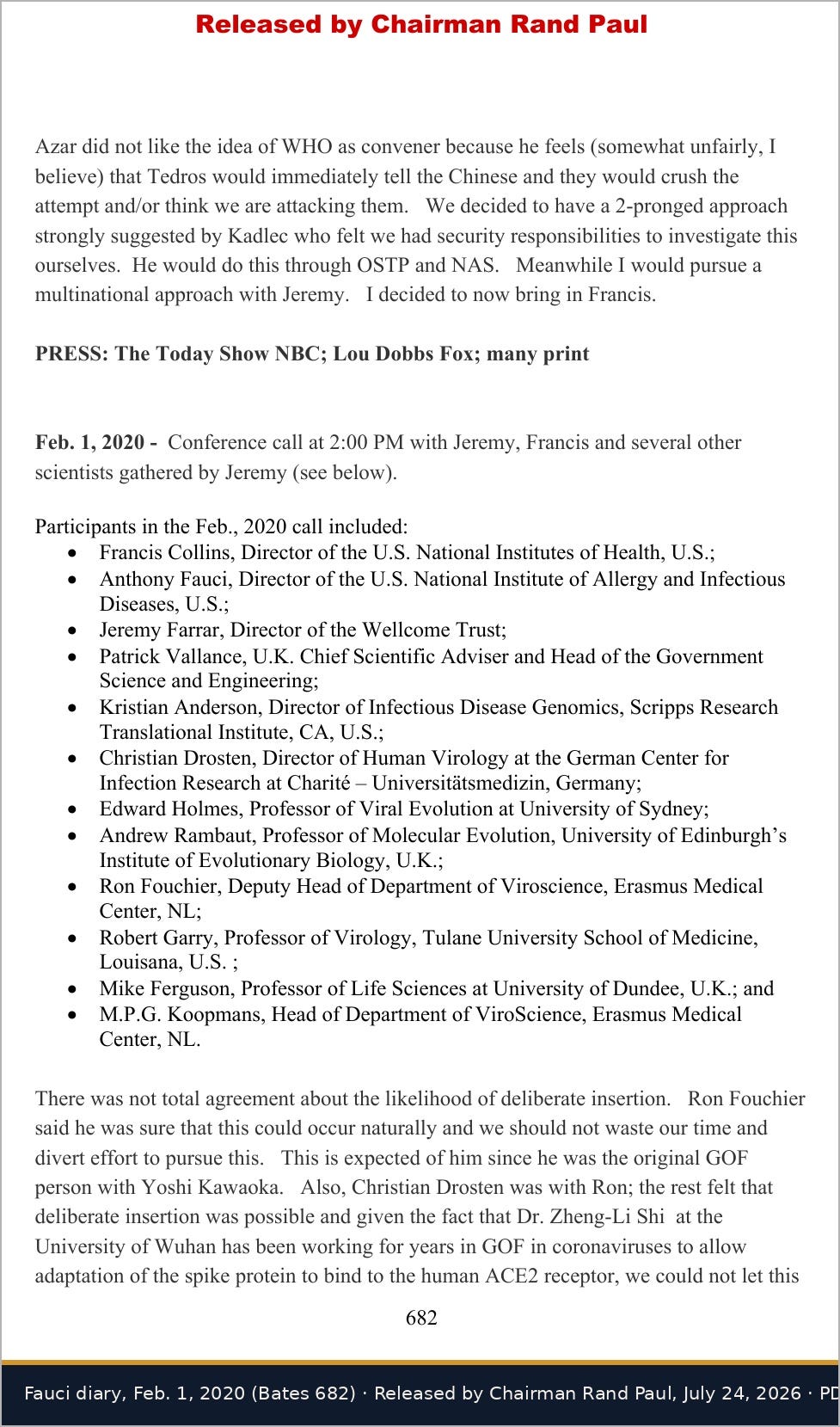
This is February 1, 2020. The diary lists twelve named participants, Fauci among them, and then reports the outcome:
“There was not total agreement about the likelihood of deliberate insertion. Ron Fouchier said he was sure that this could occur naturally and we should not waste our time… Also, Christian Drosten was with Ron; the rest felt that deliberate insertion was possible…”
What I read here. The commenter’s arithmetic is closer than I expected. Twelve people were on the call. Two are named as dissenting. That leaves ten. If you are counting heads, “10 of 12” is a defensible read of this page, and I am not going to pretend otherwise.
What this cannot be read to say. It cannot be read as ten scientists concluding the virus was engineered. It also cannot be read, from the other direction, as ten scientists dismissing the idea. They said it was possible and worth investigating. Both captions on this page are wrong in opposite directions.
Two things in his sentence do not survive the page. The date is wrong: the call was February 1, not January 26. And the verb is wrong, which matters more. The diary says the ten felt that deliberate insertion was possible. His sentence says they believe COVID was engineered. Possible is a hypothesis you test. Was is a conclusion you reach. The distance between those two words is the distance between science and a verdict.
A question for you: Read the page yourself. Would you have written possible or was? What does your answer tell you about the frame you brought to the page?
Part Four: The follow-up quotes that should be read by everyone
Five days later.
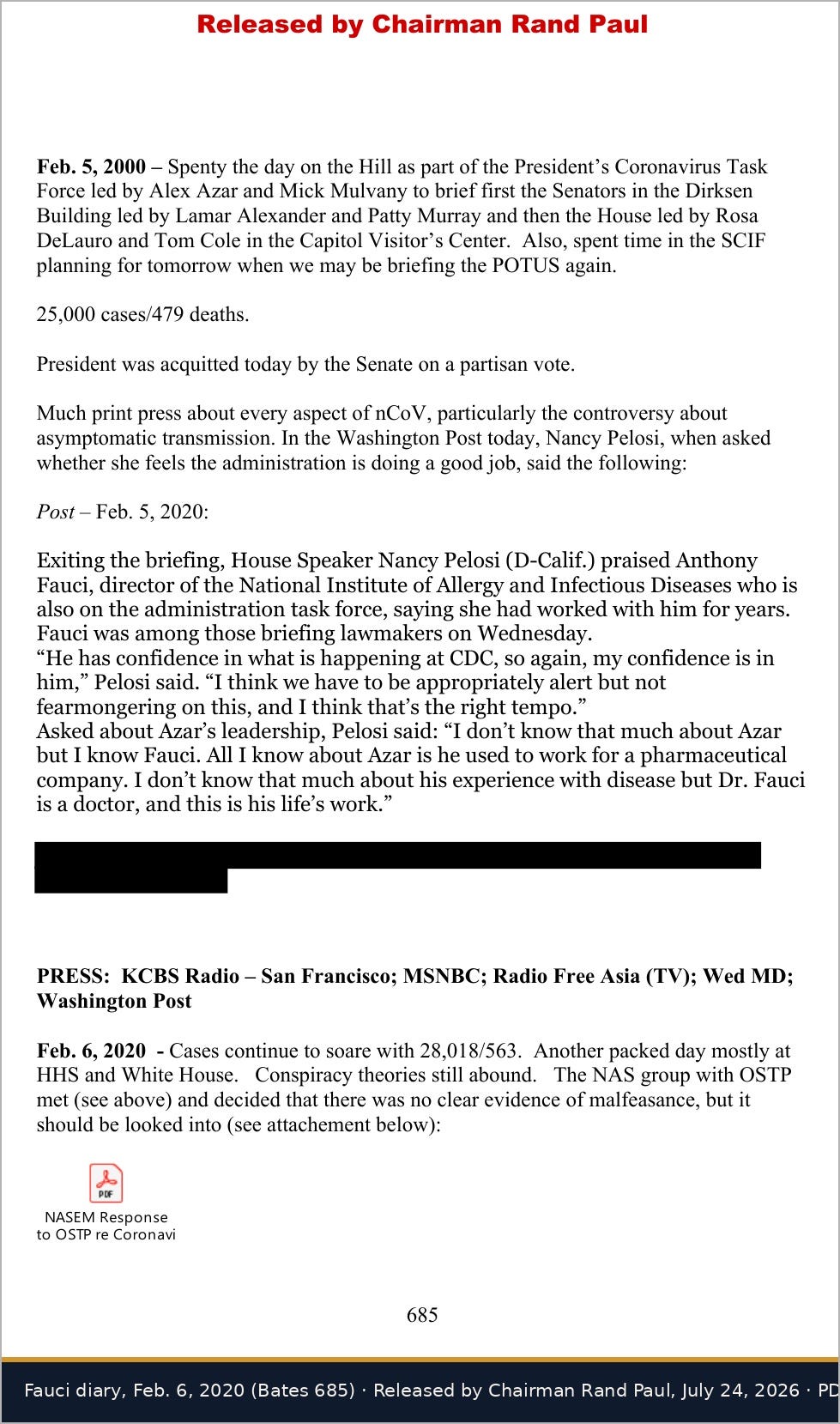
“Conspiracy theories still abound. The NAS group with OSTP met (see above) and decided that there was no clear evidence of malfeasance, but it should be looked into.”
What I read here. The convening Fauci proposed on January 31 happened. It reported back within a week. Its conclusion was no clear evidence of malfeasance, with a recommendation for further investigation. That is a process working, recorded contemporaneously, in a private log.
What this cannot be read to say. It cannot be read as the question being settled. The NAS group itself said it should be looked into. Anyone who quotes this page as proof that lab origin was ruled out in February 2020 is doing the same thing to it that the meme lineage does to the January 31 page.
Part Five: The page that answers the central claim
The commenter’s claim was that Fauci admitted, in the diary, to funding gain-of-function research. Here is the diary on that subject. Fauci is writing to himself, in May 2021, in private notes he did not expect anyone to read.
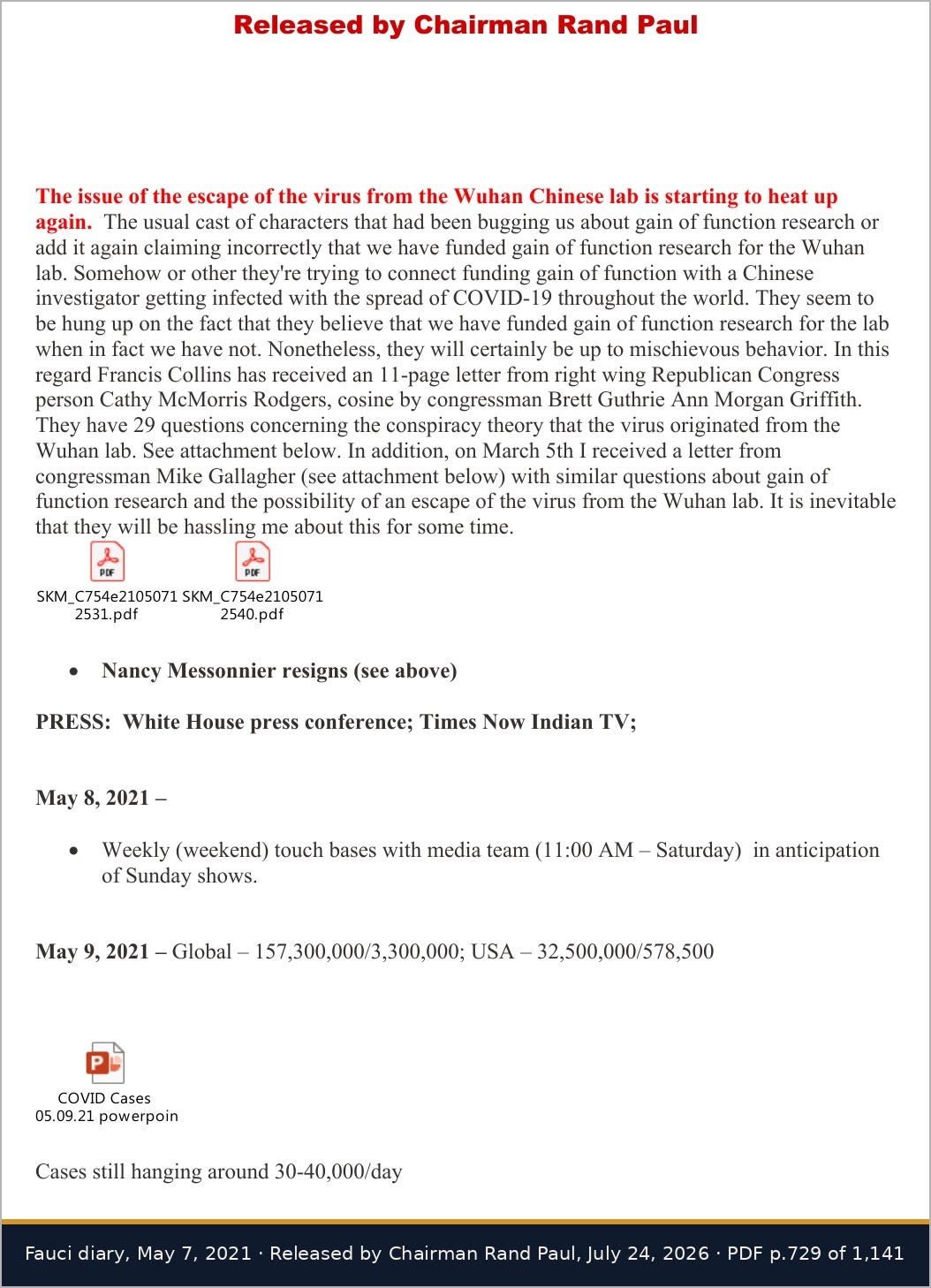
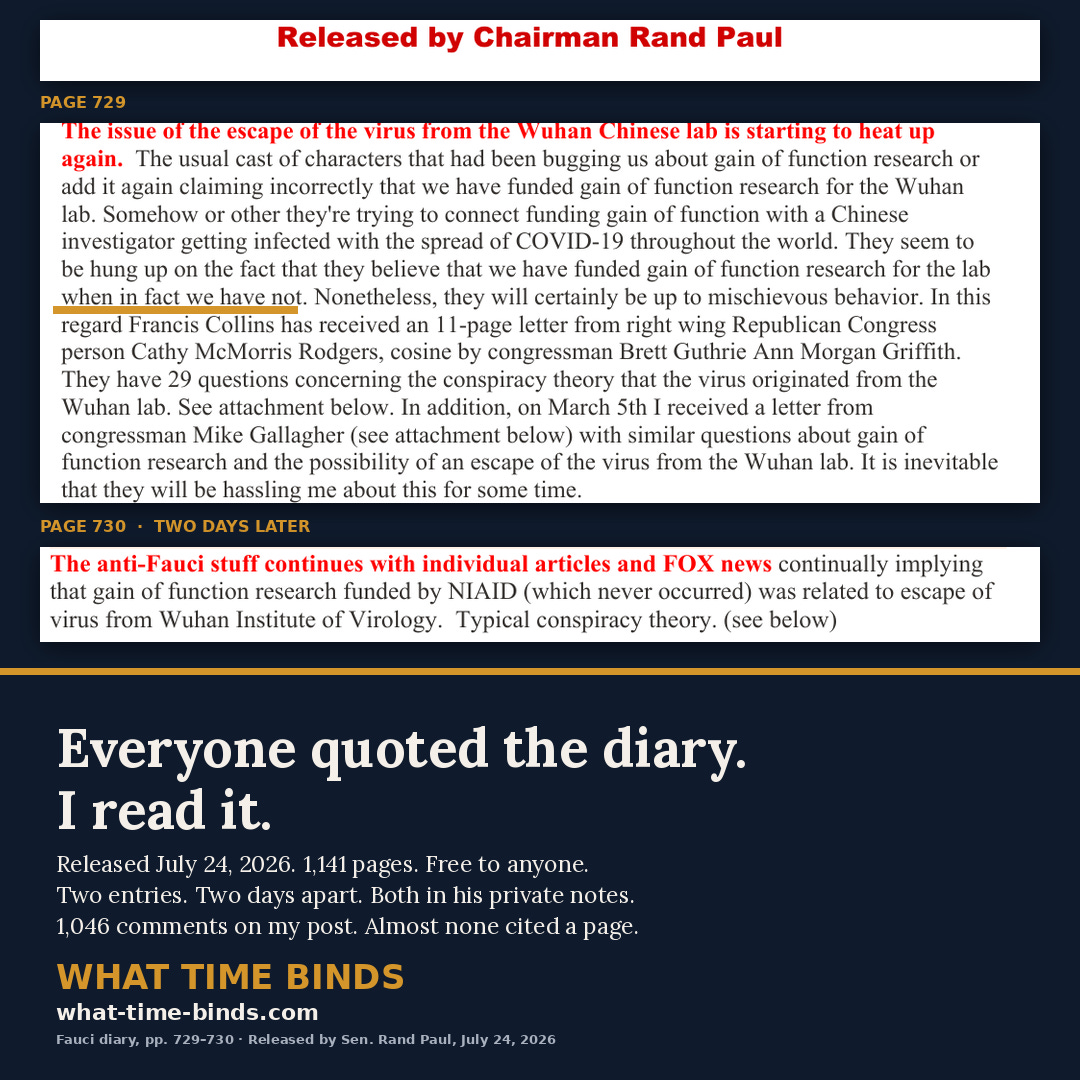
“…claiming incorrectly that we have funded gain of function research for the Wuhan lab… They seem to be hung up on the fact that they believe that we have funded gain of function research for the lab when in fact we have not.”
Two days later, in the same log, he calls the NIAID funding claim one “which never occurred” and labels the framing a conspiracy theory.
What I read here. The document offered as proof of an admission contains a denial. Fauci’s private position and his public position are the same position. A person keeping a secret does not write the cover story in a diary he believes no one will read. Whether he was correct about the funding question is a separate argument, and a real one, involving definitions of gain-of-function that NIH and its critics genuinely dispute. But “he admitted it in the diary” is not an argument anyone can make after reading page 729.
What this cannot be read to say. It cannot be read as proof that NIAID’s funding of EcoHealth Alliance was appropriate, or that the House Select Subcommittee’s 2024 findings were wrong, or that no reasonable person can criticize NIH grant oversight. Those debates are live, and this page does not settle them. It settles one narrow thing: what the diary says about the admission claim.
One note on method. The first sentence of that page appears in red bold. My first thought was that Senator Paul's office had marked it. I checked before writing that down. The office's stamp on every page is Arial Black in one shade of red. The emphasis inside the text is Times New Roman Bold in another, matching the diary's own typeface, and it appears on 269 pages marking things like a good day, a phone call from the President, and a note from Joan Baez. The red belongs to the document, not to the Senator.
A question for you: You have now seen the page. If you came in believing the diary contained an admission, what would it take to change your mind? Name the specific evidence. If nothing would, that is worth contemplating.
Part Six: The vanity charge
USA Today ran an opinion column by Nicole Russell two days after the release. Her headline said Fauci’s COVID diary shows he put ego ahead of American lives. The evidence offered was a set of entries where Fauci logged his own press.
Those entries are real. Time ranked him first among Leaders in the 100 Most Influential People. Time named him Guardian of the Year. He recorded these things.
Here is one of the pages where he does that.
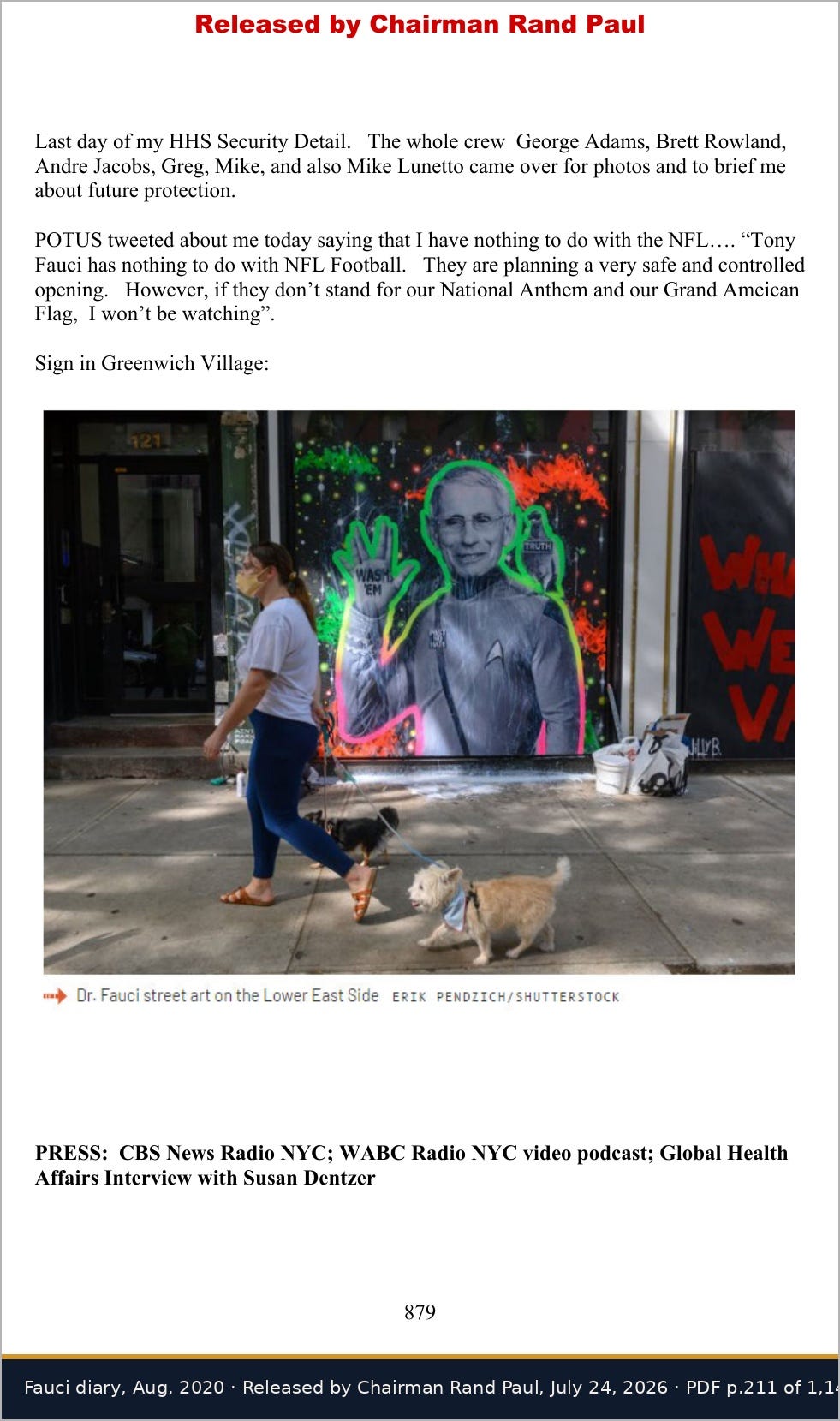
“The problem is that now I am one of the most recognizable and well-known people in the world. This is very strange; however, it is triggering increased hate mail and threats. My security detail… are getting more careful and concerned.”
And from April 2020:
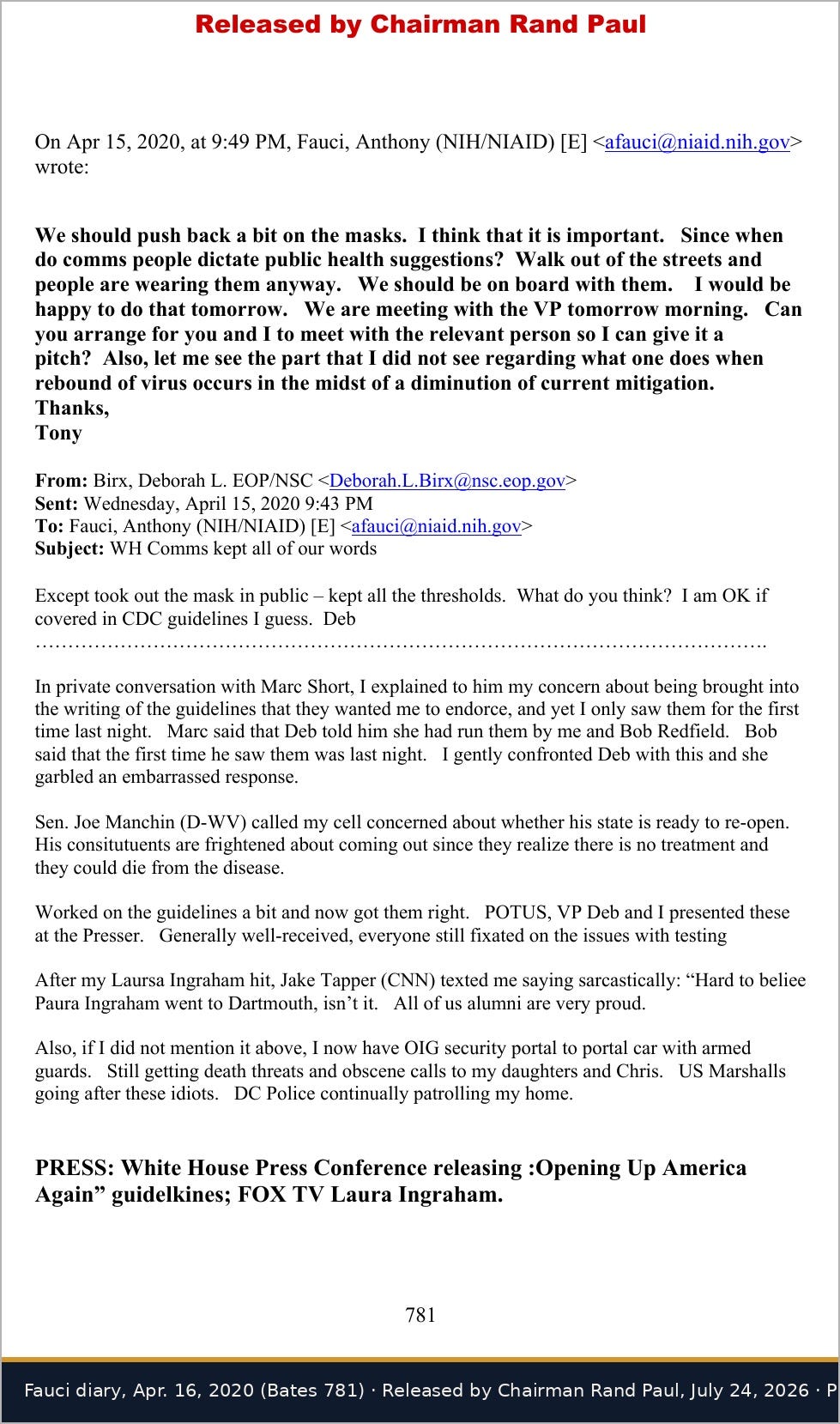
“I now have OIG security portal to portal car with armed guards. Still getting death threats and obscene calls to my daughters and Chris. US Marshalls going after these idiots. DC Police continually patrolling my home.”
What I read here. A man tracking his own visibility and tracking, on the same pages, what that visibility was costing his family. The fame entries and the threat entries are not in separate sections of the diary. They are interleaved, often within a few lines of each other, because they were the same experience.
What this cannot be read to say. It cannot be read as proof that Fauci was free of vanity. Read the whole release, and you will find a man who noticed his press coverage closely and wrote about it often. A reader could fairly call that vanity. What the pages will not support is the causal claim in the headline: that vanity displaced lives in a specific decision. To sustain that, a columnist would need an entry showing him choosing a position because it protected his standing. I read 1,141 pages looking for that entry. I did not find it.
The column had the rankings and left out the armed guards. I do not think that is a factual error. It is a curation choice, and curation choices are how captions get made.
A question for you: If someone assembled a document of everything you wrote down in your worst year and published only the parts that flattered their thesis, what would the caption on your face say?
Part Seven: The polarization not remembered
One more page, because it changes what the current frame allows people to recall.
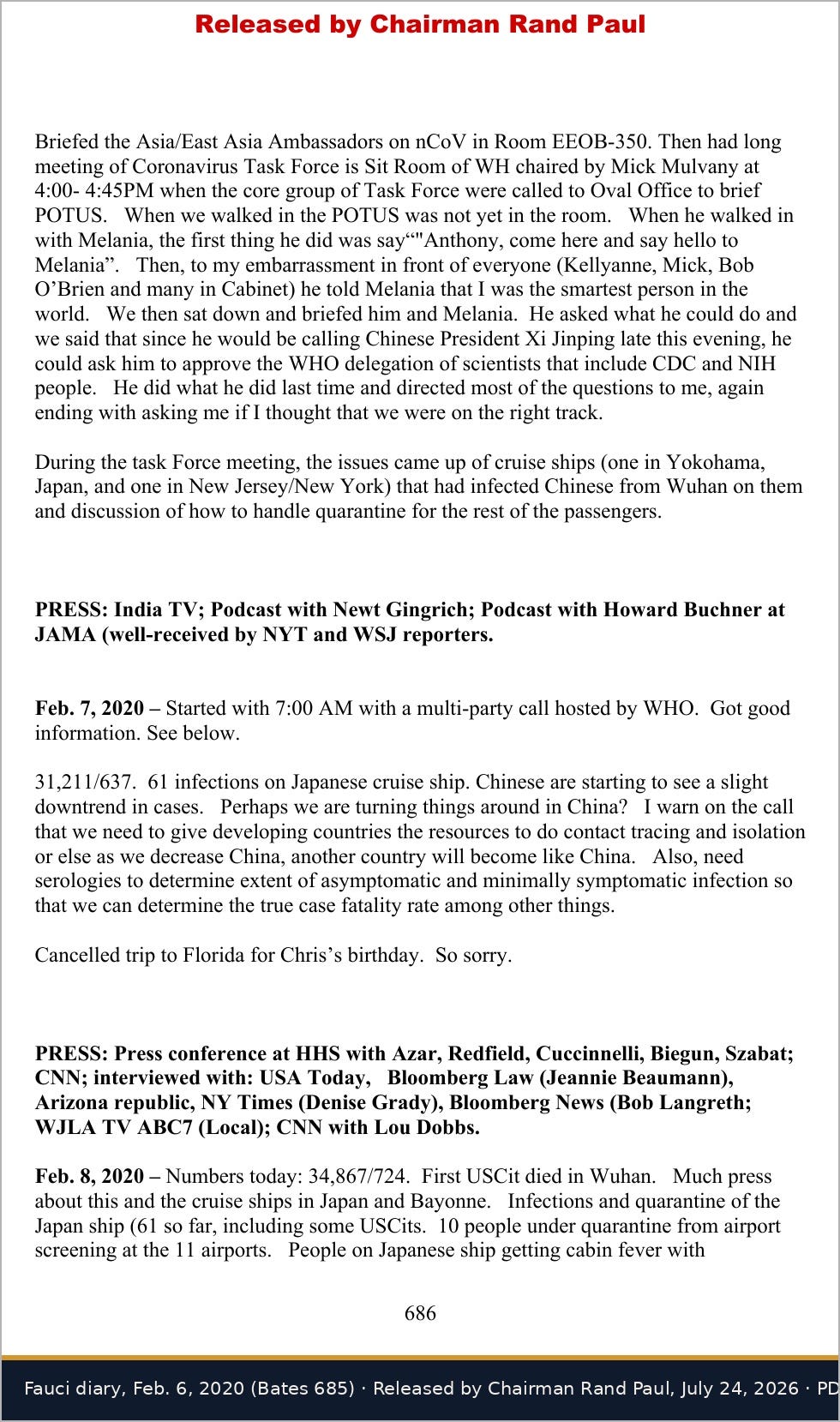
February 6, 2020, in the Oval Office. Fauci records that the President greeted him warmly in front of the Cabinet and, to Fauci’s own stated embarrassment, told the First Lady that Fauci was the smartest person in the world. Two months later, Fauci records that the President called his cell phone at home to check on him after hearing he was in semi-quarantine.
What I read here. In the winter and spring of 2020, these two men were working colleagues, and the warmth in these entries is not performative. Fauci had no reason to flatter anyone in a private log.
What this cannot be read to say. It cannot be read as evidence that the later conflict was invented, or that either man was insincere afterward. Relationships move. The diary records the movement. Both of the memes that started this whole thing require the relationship to have begun where it ended.
What the coding shows
As stated, I examine 885 comments under the post the way I would code open-ended survey responses, because that is what my training prepared me to do. I finished a doctorate at USC Rossier in 2023 with a dissertation on media literacy during the COVID-19 pandemic. I did that research while the pandemic was happening. Mis- and disinformation were a significant part of my research.
The finding that surprised me least is the one I want to leave you with. The pattern I documented in 2023 does not belong to one political side. In this thread, supporters of the post and opponents of the post used the same rhetorical structure at similar rates: personal experience presented as universal proof, a document invoked without being read, escalation when asked for a source. The content differed. The method did not.
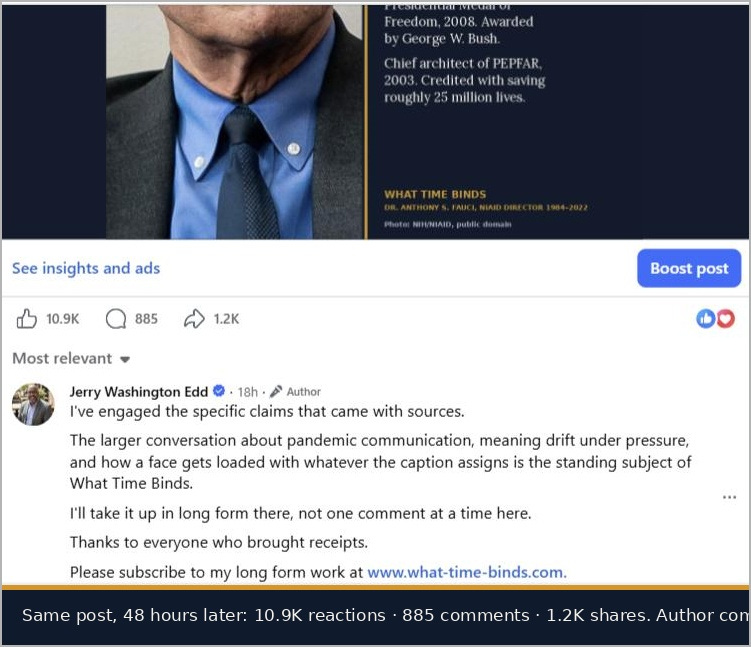
Thirteen thousand eight hundred reactions. One thousand comments. One thousand six hundred shares. Almost none of it engaged the three facts on the image. The record held because nobody attacked it. They argued about everything around it.
The ask
Here is the practice I want you to take with you, and it is small enough to actually adopt.
The next time a post invokes a document to prove a claim, ask for the page. Not a summary. Not a link to a video about it. Not an article citing it. The page in the document. If the person cannot produce the page, you have learned something important about where the claim came from, and you have learned it without arguing about politics at all.
Then do the harder half. Open the document yourself. The Fauci diary is 1,141 pages, free, searchable, and one click away. It took me an evening. Most of what I found sat in the plain text, findable with a search box, by anyone who cared to look.
A diary is a log and a log records. It does not confess. When a senator releases 1,141 pages and asks the country to read them as a confession, the country’s job is to open the file. When a commenter invokes those pages, his job is to have read them. When a columnist calls them evidence of ego, her job is to include the entries about the armed guards that sit on the same pages as the ones about the magazine cover.
Three captions. One face. The document underneath them is the same one for everybody who opens it.
I am asking you to open it.
The document: The Fauci diary release, 1,141 pages, published by the Senate Homeland Security and Governmental Affairs Committee under Chairman Rand Paul on July 24, 2026. Every page reproduced above carries its PDF page number so you can find it yourself.
Read all 1,141 pages at Senator Paul’s reading room.
This is what What Time Binds does. Find the document. Read the document. Show you the page. New pieces most weeks, free.
Then answer one of the questions above in the comments. I want to know what people actually do with a document when it is sitting in front of them. I read every reply.
If someone you know quoted this diary last week without opening it, send them this.