

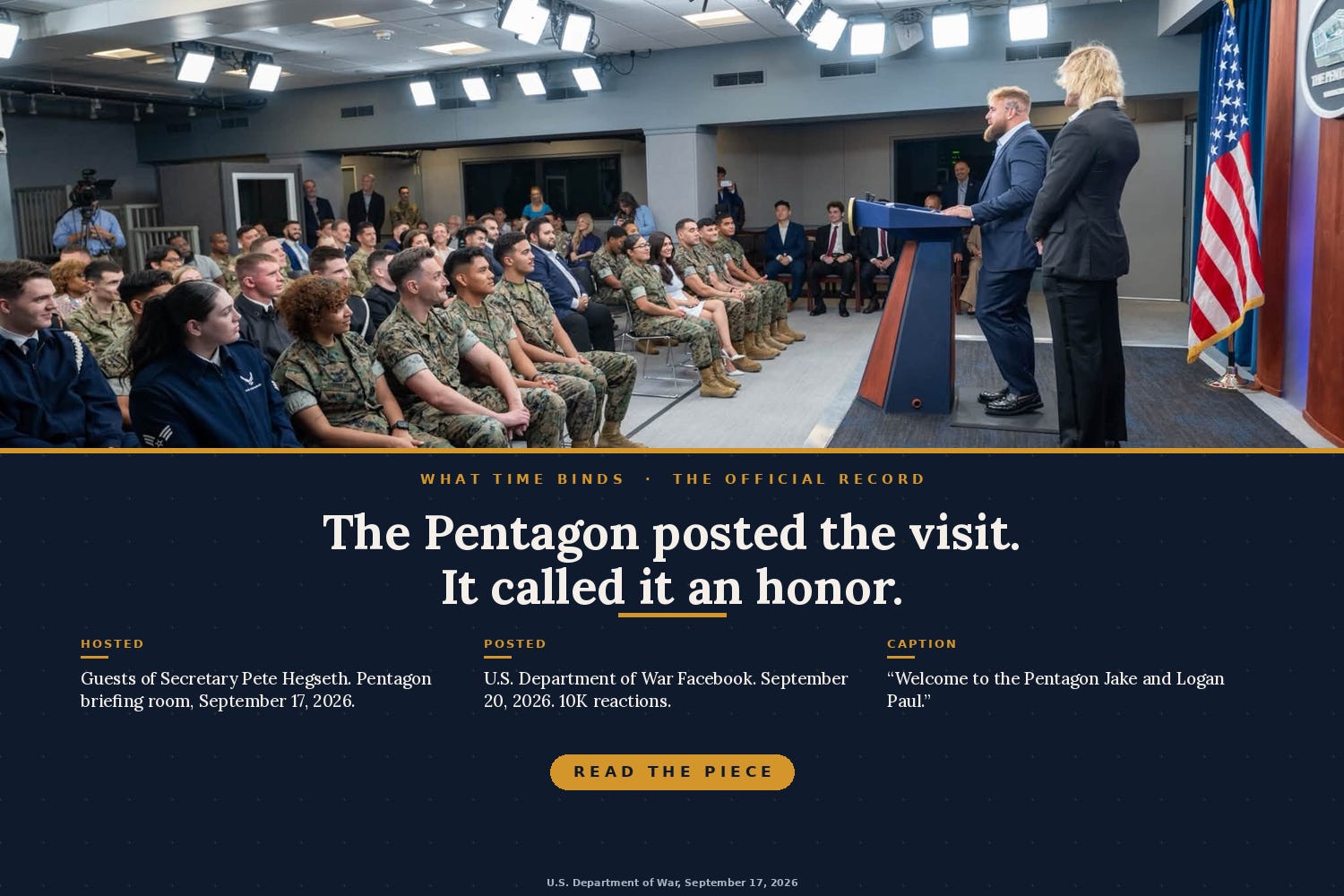
On Thursday, September 17, 2026, Jake Paul walked into the Pentagon briefing room with his brother Logan and their boxing-promotion co-founder Nakisa Bidarian. They toured the building, stopped at the 9/11 memorial, and sat down with Defense Secretary Pete Hegseth. On the same trip Jake Paul met with Treasury Secretary Scott Bessent. Three days later, on Sunday morning, September 20, the official U.S. Department of War Facebook account posted the photos. Ten thousand reactions. Five thousand eight hundred comments. Fourteen hundred shares. Deputy Pentagon Press Secretary Joel Valdez called the visit an honor for the Department. The caption read: “Welcome to the Pentagon Jake and Logan Paul.”
Neither brother has military service. Neither has defense-policy background. Neither has an assignment on this trip the Pentagon has been willing to name. Task & Purpose put it plainly: “It is not clear why the two visited the Pentagon.” What is clear is that a Cabinet secretary and a Treasury secretary sat down with them, and that the Department of War used its official 4.4-million-follower channel to celebrate the visit as institutional business.
I have been watching this drift for months. The Facebook feeds of the Department of War, the Department of Education, and the Department of State have been changing in a specific direction, and the Paul brothers post is the visit that made me stop scrolling and start writing. This essay is what I found when I looked at what those accounts have been posting all year, what the record shows about that shift, and what it means for the public that pays for those accounts to exist.
What I saw
I spent Sunday morning scrolling three federal Facebook pages: the Department of War, the Department of Education, and the Department of State. Here is what is on them today.
Department of War (4.4 million followers). The top seven posts I read, in order.
The Paul brothers welcome, 10K reactions, 5.8K comments, 1.4K shares. “Last Thursday, we welcomed Logan and Jake Paul to the Pentagon to meet with our warriors,” 10K/5.7K/1.2K.
Secretary Hegseth’s SEND ME TOUR morning training with cadets. Hegseth at Texas A&M with the Corps of Cadets, 6.7K/1.8K/304.
Hegseth coining Army pilots at a college football flyover, 38.8K/2.4K/1K. “AMERICA’S SECRETARY OF WAR!!!,” 26K/5.2K/805.
“WELCOME TO AGGIELAND Secretary of War Pete Hegseth,” 34K/5.5K/836.
Not one of those posts names a benefit, a program, or a policy that a service member or a veteran might use. The account runs as one person’s personal channel.
Department of Education (403K followers). Top six posts.
“MAKE COLLEGE FOOTBALL GREAT AGAIN” over a stadium image, tagline “MAKE EDUCATION GREAT AGAIN,” 2.7K/1.7K/165.
“It’s cool to LOVE America,” 1.1K/538/59. “The Trump Administration is PARENTS FIRST!,” 725/312/16.
“Under President Donald J. Trump’s leadership ED is putting students, parents, and their fundamental freedoms FIRST!,” 3.5K/1.5K/179.
“That Friday feeling” over a Trump portrait, 9.5K/5.4K/224. “The constitution made it clear: YOU come first,” 4.1K/1.2K/1.1K.
Six posts. Zero on FAFSA, Title I, IEPs, teacher grants, or student loan servicing. Six campaign-branded slogans on the account a parent uses to find out about their child’s school.
Department of State (4 million followers). The top seven posts are one continuous amplification of a single claim: that President Trump has secured a “historic” Greenland deal.
Fox News clip, 23.4K/1.3K/2.1K.
Newsmax, 5.7K/975/552. Fox again, 13.3K/911/999.
Daily Wire link, 453/151/34.
The Hill, 986/322/74.
Washington Examiner, 267/64/18.
Fox once more, 1.8K/422/176.
One story, seven outlets, most of them right-leaning, on the account the country’s diplomacy speaks through. The top comment on one of those posts: “This agreement was reached in 1951!” On another: “It is the 1951 agreement. TACO.” The public that follows the page appears to know the “deal” is a repackaging of the existing US-Denmark security agreement.
Three pages, three patterns, and one question: what have these accounts stopped doing?
The aerial view
My Sunday scroll is one point on a curve. Pew Research published the curve in June 2026. They looked at 30 federal agency accounts on X across two matched twelve-month windows: Biden’s final year (January 20, 2024 to January 19, 2025) and Trump’s first year of the second term (January 20, 2025 to January 20, 2026).
The median engagement per post went from 197 to 929. That is roughly a fivefold jump. It is not distributed evenly. The Department of Homeland Security went from 57 to 2,268. Immigration and Customs Enforcement, 25 to 1,950. The Department of Labor, 16 to 2,152. The White House account, 2,112 to 8,614. The Department of Government Efficiency account, created in early 2025, runs at about 29,000 likes and reposts per typical post.
Engagement is not the only thing that changed. The word “American” appears twice as often. The word “president” appears twice as often. ICE posts mentioning “criminal” went up fivefold. Department of Energy posts now frequently include “AI,” “dominance,” and “coal.” Several agencies deleted prior-administration posts from public view.
Yes, several agencies deleted prior-administration posts from public view. Federal agencies are supposed to preserve their communications under the Federal Records Act. Deletion is not a design choice. It is a records question. Congress and the National Archives have both.
Three shifts
Every administration promotes its president on the accounts it runs. Obama’s Department of Education posted about Obama. Biden’s HHS posted about the Affordable Care Act push. That is not the finding. The finding is three specific shifts, and they do not describe past administrations.
From service to spectacle. The Department of Education used to post about FAFSA deadlines, Title I formulas, IEP guidance, teacher grant applications, and student loan servicing. A parent whose child needed a special-education plan could find the department there. A student whose loan servicer had changed could find the department there. That page now runs “MAKE COLLEGE FOOTBALL GREAT AGAIN” and “That Friday feeling” over a Trump portrait. The channel that was built with taxpayer dollars to connect citizens to the department they fund now runs campaign copy. Pew Research measured the language change: “American” and “president” appear twice as often across federal agency accounts, and ICE posts mentioning “criminal” jumped fivefold. That is a service channel being repurposed.
From agency to person. The Department of War Facebook page reads as Pete Hegseth’s personal channel. The SEND ME TOUR, the coining ceremonies, the Texas A&M appearance, the influencer visits, the Fox News chyrons about the Secretary. Twenty-three years of service in the Marine Corps taught me the difference between the institution and the officer commanding it. The institution outlives the officer. It has to. When the account reads as one person, the account is teaching everyone who follows it that the person is the institution. That is not administration alignment. That is capture of the agency by its political appointee.
From official voice to partisan amplification. The State Department has posted seven consecutive reposts of a single “Greenland deal” story from Fox News, Newsmax, Daily Wire, Washington Examiner, and The Hill. Any prior administration’s State Department posted its own statement first, in its own voice, on its own frame. Diplomatic communication has a specific register because the audience is other governments and their publics. When State speaks with Fox News’s chyron over its own logo, the message it sends abroad is that Fox News is now its voice. The 24-senator letter Mark Warner sent Russ Vought at OMB on October 7, 2025 named the same pattern on HUD, on the Small Business Administration, on the Justice Department, and on the Agriculture Department: partisan attack banners on the department’s own website, modified out-of-office messages blaming Senate Democrats on the Department of Education.
The three shifts are visible from the outside. That is what the Pew data measures. What follows is what they do to the citizens on the receiving end.
What that does to a public
During my dissertation research on media literacy, I reviewed Joel Dimsdale’s Dark Persuasion: A History of Brainwashing from Pavlov to Social Media (Yale University Press, 2021). Dimsdale, distinguished professor emeritus of psychiatry at UC San Diego, traces the evolution of persuasion techniques from Pavlov’s classical conditioning through Chinese Communist Party thought reform, Korean War prisoner handling, CIA MK-ULTRA, cult isolation practices, and into the age of algorithmic social media. His compressed argument: the techniques evolve; the target holds. The target is the person’s ability to tell what is true from what is being made to feel true.
Dimsdale places social media in that lineage as its current form. Volume. Repetition. Emotional coding. In-group cues. The exclusion of contradictory frames. The techniques Pavlov used on dogs and the CCP used on prisoners, and Jonestown used on believers are, in fundamental terms, the techniques a feed uses on scrolling attention.
That lineage is where the shift I have described belongs. A federal agency’s public channel that stops speaking to the whole public and starts speaking to a partisan base is running a persuasion infrastructure with a taxpayer-funded logo on it. The account trains a following to recognize the department as their team. Everyone else learns to read the department as no longer for them.
The Department of War page has 4.4 million followers. When those followers see Pete Hegseth at Texas A&M, at a football flyover, coining pilots, welcoming influencers, and addressing service members as “our warriors,” the emotional coding they receive is direct: the department is the President’s man, the country’s warriors are ours, and the people questioning this are outside the team. A veteran who did not vote for this President cannot read that page as their department. A parent whose child is Muslim cannot read the Education Department’s “It’s cool to LOVE America” over a Trump portrait as their Education Department. A career diplomat watching a Fox News chyron on the State Department’s own page cannot read that account as the institution they gave a working life to.
The channel is teaching Americans, one scroll at a time, that they no longer share an institution.
The record and the law
The pattern I am describing is under active accountability review. The 24-senator letter Mark Warner led to OMB Director Russ Vought on October 7, 2025 named specific violations of Section 715 of P.L. 118-47 (the appropriations rider that prohibits federal funds from being used for propaganda), plus the Anti-Lobbying Act and the Hatch Act. The letter names HUD’s website banner reading “The Radical Left in Congress shut down the government,” the Department of Education modifying furloughed employees’ out-of-office messages to blame Senate Democrats without their consent, and comparable moves at the Small Business Administration, the Justice Department, and the Agriculture Department. The letter’s key sentence: “agency resources, including websites or emails, should not be used to send overtly political, and in this case, misleading messages.”
On November 10, 2025, 12 senators led by Elizabeth Warren asked the Government Accountability Office to investigate. Their letter added TSA playing partisan videos in airport security lines and the Department of Labor directing employees to post partisan out-of-office messages. It cited federal appropriations law prohibiting “publicity or propaganda purposes” and the Antideficiency Act. Warren’s letter uses the phrase that names the violation cleanly: “announcements appeared to include nothing more than partisan messaging and lacked a connection to official business.”
The public analytical language for what is happening is also on the record. NPR’s January 16, 2026 piece called the pattern a “clicktatorship” and gave the vocabulary its academic voice. Yini Zhang at the University at Buffalo: “Volume is a feature, because they can post very frequently and they can shape agenda.” Renée DiResta at Georgetown named political influencers as part of “that propaganda machine.” Whitney Phillips at Oregon called the style “cosmic drama between ultimate good and evil.”
Pew Research’s June 1, 2026 analysis supplies the numbers. Two Senate letters supply the legal frame. NPR supplies the diagnosis. What none of them yet contains is a compelled institutional response. GAO has not yet reported. OMB has not answered publicly. The Hatch Act complaints filed against agency personnel have not moved to enforcement.
Here is the constraint that survives all of this: the Federal Records Act obligates every agency to preserve its social media as a federal record. The National Archives captures federal agency web content on a rolling basis. The End of Term Web Archive, the joint NARA, Library of Congress, Internet Archive, and university partner project that captures the federal web at every presidential transition, collected the 2024-25 window as this administration took power. Meta’s Content Library, restricted to vetted academic researchers, holds the underlying Facebook posts. Whatever these agencies delete from public view, the record survives outside their control. That is by design.
What this means for the public
If you are reading this, linked from Facebook, you have already seen it. The Department of Education post about “It’s cool to LOVE America” arrived in your feed with the same weight as a friend’s beach photo. The Department of War post welcoming Jake Paul arrived with the same weight as your child’s soccer game. The State Department’s Fox News clip arrived with the same weight as an actual foreign policy statement. The feed does not sort by kind. Everything is content.
That is what makes the pattern hard to see. The Facebook page of the Department of Education carries the department seal. Its captions are signed by the department. A parent who follows the page to learn when the FAFSA deadline is, or to hear about a Pell Grant change, will still find the page there. The page just does not talk about those things anymore. It talks about who is loyal.
The cost of that shift lands on the public whether the public tracks it or not. When a citizen no longer recognizes their department as their own, they stop expecting anything of it. They stop reading its posts as information. They stop bringing complaints there. They stop treating it as an accountability surface. The department becomes something to be endured or dodged, never something owned.
The withdrawal is the achievement of the persuasion infrastructure. Followers can be counted. Reactions can be tallied. What matters is the population that quietly stopped reading the department’s posts as speaking to them.
Three things a reader can do this week.
Save what you see. When a federal agency post reads to you as campaign copy, screenshot it with the URL and the date visible. The Federal Records Act obligates the agency to keep it. Your screenshot is a citizen’s version of the same obligation, in case theirs fails.
Name the shift in plain words when you speak about it. Skip “the department is being political.” That reads as dismissible. Say what you saw. “The Department of Education’s Facebook page posted ‘MAKE COLLEGE FOOTBALL GREAT AGAIN’ this week. It did not post anything about FAFSA, Title I, or student loan servicing.” Facts hold. Adjectives dissolve.
Know that the law being violated has names. Section 715 of P.L. 118-47. Anti-Lobbying Act. Hatch Act. Antideficiency Act. If your senator has not signed a letter yet, ask why. Twenty-four senators signed Warner’s. Twelve signed Warren’s. The rest are on record as having declined.
The department that no longer speaks to you still belongs to you. The record is being kept. The law has names. The path back through the door is knowing both.
The channel that used to tell you when the FAFSA was due now tells you which team the department plays for. Every Monday I take one word an institution bent and show the page it bent on. Subscribe, and the next one is in your inbox, free.
Author’s note. The comments are the appendix: tell me where the record is wrong and I will show the page or fix the line. Paid subscriptions open at 500 readers, and the paid product is Coded Threads, the codebooks built from these comment sections. A pledge now is a vote for that.
Jerry W. Washington, Ed.D., is a Marine Corps veteran of twenty-three years, a combat engineer by trade, an instructor at UC Irvine’s Division of Continuing Education, and the writer of What Time Binds, a record of how institutions bend words and how the page holds them to account.
The senators willing to sign letters to OMB and GAO on this are on the ballot too. Read the ballot the way you read this piece: at vote411.org.
I advise school districts, community colleges, and workforce teams on AI readiness: what the words mean before the tools arrive. Hit reply if you would like to talk.
Source ledger
U.S. Department of War Facebook page: facebook.com/DepartmentofWar
U.S. Department of War Facebook post — Paul brothers visit: full post
Department of War X post — Paul brothers visit: x.com/DeptofWar
U.S. Department of Education Facebook page: facebook.com/ED.gov
U.S. Department of State Facebook page: facebook.com/statedept
Task & Purpose, “Pentagon invites Paul Brothers, YouTube influencers, to speak to troops”: taskandpurpose.com
The Daily Beast, “Hegseth Hosts Reality TV Paul Brothers at Pentagon to Lecture Troops”: thedailybeast.com
Pew Research Center, “Federal agency X accounts are getting far more engagement in the second Trump term than under Biden,” June 1, 2026: pewresearch.org
Sen. Mark Warner et al. letter to OMB Director Russ Vought, October 7, 2025: warner.senate.gov
Sen. Elizabeth Warren et al. letter to GAO, November 10, 2025: warren.senate.gov
NPR, “How the Trump administration is using social media content to govern,” January 16, 2026: npr.org
End of Term Web Archive: eotarchive.org
Joel Dimsdale, Dark Persuasion: A History of Brainwashing from Pavlov to Social Media, Yale University Press, 2021. UCTV lecture: youtube.com/watch?v=bWl8FXhdEio
Federal Records Act, 44 U.S.C. Chapter 31: archives.gov guidance
Section 715 of P.L. 118-47 (anti-propaganda appropriations rider); Anti-Lobbying Act (18 U.S.C. § 1913); Hatch Act (5 U.S.C. §§ 7321-7326); Antideficiency Act (31 U.S.C. § 1341)