



The Laboratory of Dialogue
Every conversation is an experiment in understanding.
Too often, our public discourse devolves into debate for debate’s sake, a contest where winning or appealing to both sides feels more important than truth. Instead, treat dialogue as a shared experiment, turning arguments into hypotheses and disagreements into data.
“Turning your back on the scientific method is the first steel bar in the cage.”

This means we must step beyond ego and assumption. Asking “How do you know?” whenever someone speaks with conviction should force evidence into the conversation and embrace empirical thinking.
As Dewey argued, “people need a scientific method and a ‘disciplined mind’ to both tap into the strength of a group and to come up with logical solutions.” Through this lens, communication becomes a vast laboratory: ideas are tested openly and refined through critique.
Karl Popper stressed that our knowledge is provisional.
In his view, every organism, from spiders to humans, continuously invents and tests solutions. In conversation, we propose ideas and test them thoroughly, refining our understanding. Trust grows when we welcome correction rather than punish it.
The Method of Inquiry
What would true inquiry look like in dialogue? We can follow steps from science. First, clarify the question: define exactly what we’re debating. Second, gather evidence: cite data, examples, or logic. Third, propose tentative answers: treat them as hypotheses, not dogma. Crucially, invite falsification: challenge every idea by testing where it fails. As Popper notes, “Irrefutability is not a virtue of a theory… Every genuine test of a theory is an attempt to falsify it, or refute it.”
To make this practical:
State claims with proof. If you assert something, back it with reasons or evidence.
Welcome challenge. Ask, “What evidence would change your mind?” and be prepared to adjust.
Steelman your opponent. Restate the other person’s argument in its strongest form before responding.
These moves borrow from Mill’s marketplace of ideas, Socrates’ questioning, and Dewey’s reflective inquiry. They echo Popper’s vision of an open society, where knowledge grows by testing and correction.
Towards a Culture of Discovery
If we practice these habits, our shared sense-making blossoms. Conversations become more like inquiry and less like score-settling. We build trust by being transparent about uncertainty: saying “I’m not sure” or “I could be wrong” signals maturity, not weakness. The goal is not false consensus but a clearer map of reality. In the end, knowledge itself is power when wielded with humility.
“Journalism is the application of the Scientific Method to communication.”
We must treat our talk as an experiment, and align our reasoning with the method that built science. This doesn’t require pedantry, but it does demand curiosity tempered by rigor.
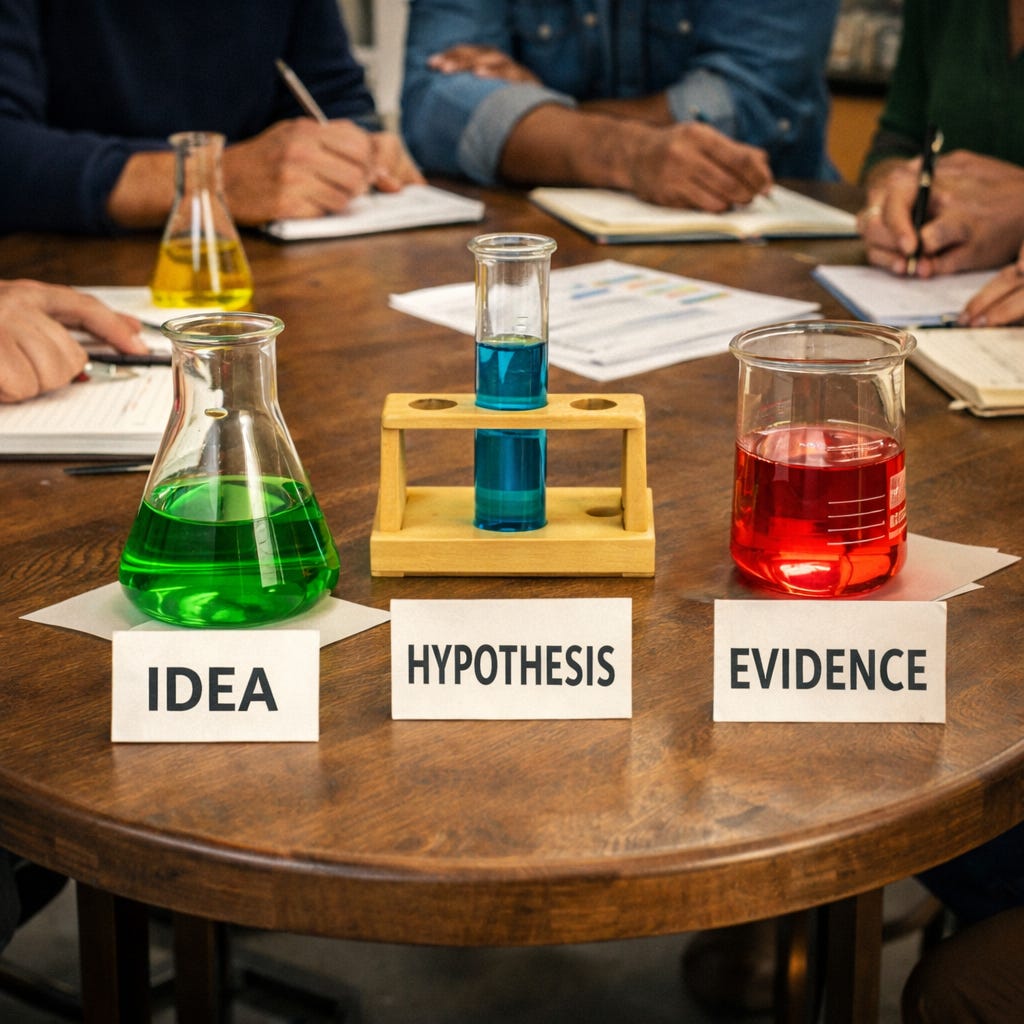
If we learn to speak like scientists – probing, testing, refining – our public discourse will chart a truer course. The prize is a society that reasons and grows wiser, together, not apart.
Inviting falsification seems to be lacking in our culture, and sadly even in the world of science (of which I used to be a part), as well as in education (which I am currently a part). I wonder if this has always been the case or it's something more prominent in modern times.