

Last week, I asked a reader to define DEI before we kept arguing about it.
She’d called Defense Secretary Pete Hegseth’s strike on the Navy promotion list a fair action and cited concerns about DEI as part of her reasoning. The thread was running on three letters that were carrying different content for different people. I wanted to know what she meant.
Her answer ran several hundred words. She told me she’d taught Diversity at the university level. She wrote that equity, the “E” in DEI, was “way too squishy for a definition.” She said she wanted positions filled on merit. Then she gave me examples of what she claimed was DEI in practice.
Three examples stand out.
One. An Extended Opportunity Programs and Services initiative at California Community Colleges, which she described as a program that quietly excludes the children of college-educated white parents and serves as a screen for racial minorities.
Two. Zohran Mamdani, a New York mayoral candidate. She said he was chosen on personality and lacked substance, then asked where the job description for the role had been posted.
Three. An elected official in Seattle, described in similar terms.
She closed by saying she’d worked with people selected through DEI who failed on the job because they lacked experience but checked a box.
I read the comment twice and went to look.
EOP&S eligibility is published on the California Community Colleges Chancellor’s Office website. The qualifying paths are low income plus an educational disadvantage. First-generation status is one path among several. Foster youth qualify. A high school GPA below 2.5 qualifies. Failing to place into college-level math or English qualifies. Race is nowhere in the criteria.
Mamdani ran in a primary and a general election. Voters filled the seat. The Seattle official did the same.
Quotas based on race or sex are illegal under Title VII of the Civil Rights Act. The Equal Employment Opportunity Commission has prosecuted them as violations for decades.
I’m not writing this to win an argument with one reader. I’m writing it because a trained user of a term applied it to facts that her training should have ruled out. That gap is the subject of this essay.
The phenomenon at scale
What I watched in that exchange is something Americans see every day.
In March 2025, the Pew Research Center surveyed 9,482 adults. The question was about disagreement between Republican and Democratic voters. Eight in ten said the two sides not only disagree on plans and policies, but cannot agree on basic facts. The number has held essentially flat since 2016, when Pew first asked it during the Trump-Clinton race.
That topline is grim enough. The follow-up question is where it gets interesting.
Pew asked the eight-in-ten group: why? Why can’t partisans agree on basic facts?
Two reasons were offered. The first: partisans are interpreting the same information differently. The second: partisans are getting different information entirely.
67% said the first reason was major. 53% said the second was major. 40% said both.
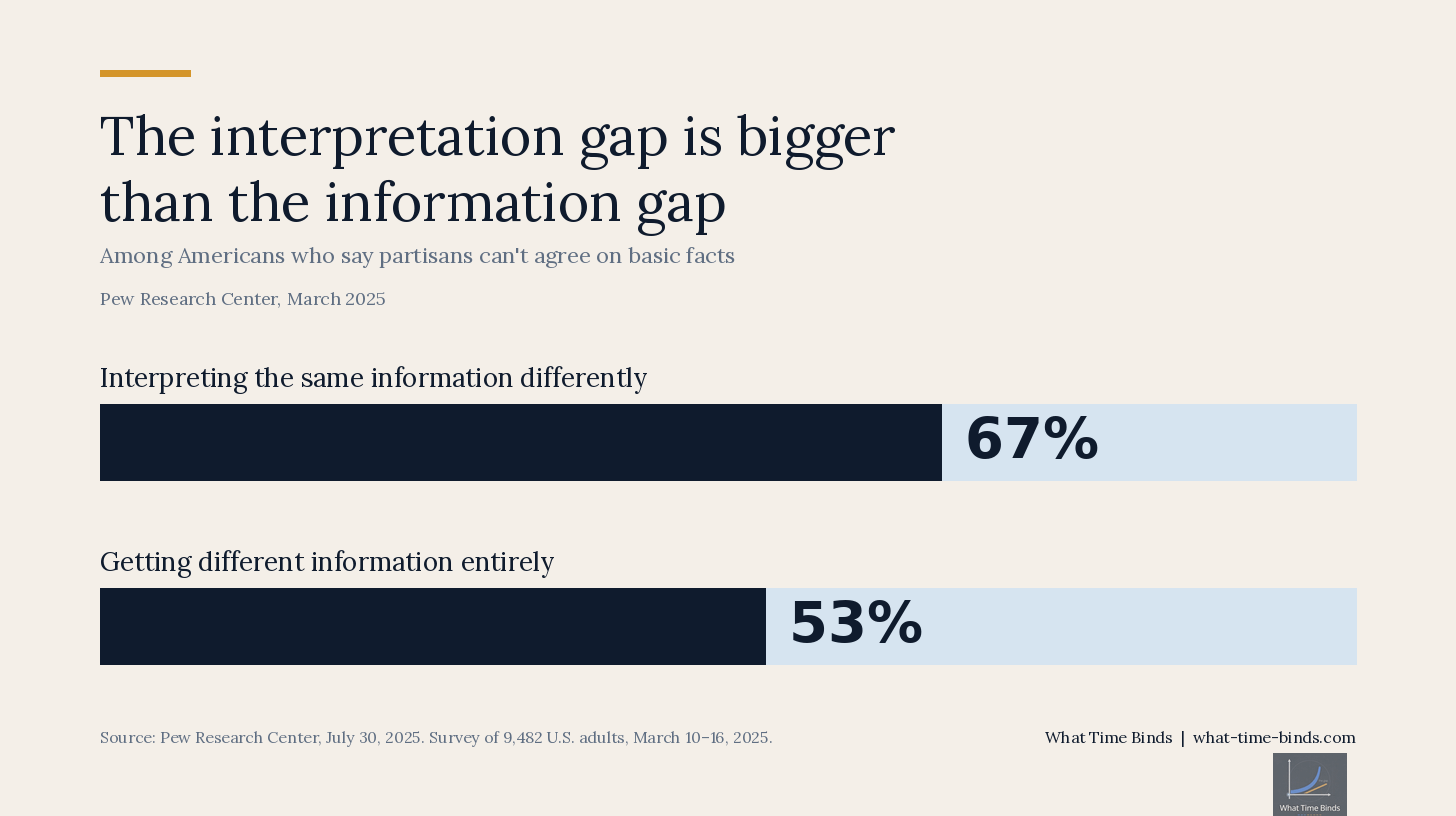
Read that again, because the difference matters. The bubble story (different media sources delivering different facts) accounts for 53%. The interpretation story accounts for 67%. The bigger gap sits between meanings. Media diets account for the smaller gap.
That’s the empirical version of what I just described in the DEI exchange. The reader and I read the same statute, the same policy criteria, the same election results. We extracted different content. Her DEI was a cluster of cultural anxieties about merit and competence. Policy DEI was a set of access measures with quotas explicitly illegal under federal law. Same three letters. Different content.
This phenomenon has a name. I’ve been calling it meaning drift.
The mechanism
Meaning drift is what happens when a word that once named one thing starts to carry many things, often without social awareness that it is happening.
DEI is a textbook case. The acronym was coined to name a set of access programs: programs designed to expand who could enter institutions, programs designed to ensure those who entered were treated as belonging, and programs designed to identify barriers that kept already-qualified people from being seen. The legal regime around the programs is strict. Quotas based on race or sex are illegal. Again, the Equal Employment Opportunity Commission has prosecuted them as Title VII violations for decades.
In the policy world, DEI is the name for those programs.
In the cable-news world, DEI has become a different word. It carries a cluster of meanings the policy version was never designed to support:
Lowered standards
Quotas
Unqualified people getting jobs
Any mention of race or gender
Hiring by identity instead of by merit
The reason the wrong candidate won an election
A general suspicion that the deck is stacked
This is the magnet word at work. A magnet word is a term that pulls anything in its vicinity toward itself. The original referent recedes. The associations expand. After enough time, the word becomes a vessel for whatever the speaker brings to it. Speaker A says DEI and means a federally legal access program with strict guardrails. Speaker B says DEI and means a culture of unearned advancement. They use the same letters. They mean different worlds.
Neither speaker is lying. Both are using the word the way they’ve encountered it. Only, one person is misinformed, and the argument stalls. The disagreement is about which cluster of associations the three letters point at. The policy itself sits below the surface of the conversation.
The Pew chart shows something more uncomfortable than a media-bubble. It shows that when two sides look at the same information, they extract different content from it. Word by word, claim by claim.
DEI’s meaning drift shows up beyond human conversations. Earlier this year, I asked an AI to fact-check a meme connecting Katherine Johnson at NASA with Victor Glover on Artemis II. The research was solid. The interpretation was off. Trained on text where “DEI” usually appears as a pejorative, the AI applied the dominant framing and read the meme as making an accusation about credentials. It took a structural correction to bring it back: competence is individual, preparation is individual, opportunity is institutional. DEI names the third element. The AI accepted the correction. The full exchange is in I Asked an AI to Fact-Check a DEI Meme.
The repair, when it’s possible, requires one step. Pin the word. Define it locally, for this conversation, with the explicit definition declared and the boundaries named. Includes this. Excludes that. With those examples and these others.
In the exchange I described, I tried to pin DEI. I gave the policy definition. I cited the statute. I corrected the EOP&S criteria with the published rules. The reader engaged. She acknowledged some of what I’d said. She offered her experience as a counter-frame.
Days later, on a different post, the conversation reset. The same word came back, doing similar work, anchored to similar examples, with the pinned definition from the earlier exchange nowhere to be found.
Pin a word in one conversation and the word may hold. The next conversation starts with the word un-pinned. The local pin works. Time and distance dissolve it.
That’s meaning drift at structural scale.
The work
I’ve been watching meaning drift for a long time.
I spent 23 years in the Marine Corps as a Combat Engineer. I retired as a Master Sergeant. My early career advanced faster than most. I was promoted meritoriously to Corporal, and meritoriously again to Staff Sergeant. By the time my peers were on the normal track to those ranks, I had been reading my own fitness reports for years.
Every fitness report ran on words the system told me were objective. Words like “professional,” “merit,” “potential,” “loyalty,” and “team player” did most of the work in those documents. None of those words had a fixed definition. Each carried whatever the writer needed it to carry on a given day, and the consequences for the rated Marine were career-shaping.
That’s where the question started. The system ran my life on evaluative language, and no two senior raters defined the key words the same way.
After the Corps, I went to USC Rossier and wrote a doctoral dissertation on the perspectives teachers hold about teaching media literacy. The classroom version of the same problem I had lived in fitness reports: how do you help students sort fake news, misinformation, and disinformation when the words “true,” “reliable,” and “evidence” carry different content for different communities? The recommendations section took up the next question: what happens when generative AI enters the room and starts producing content that drifts even further from its source meanings?
While I was finalizing the dissertation, I published a related book: Simulated Realities: Generative AI and the Remanufacture of Professionalism (2023). The book stepped back to the broader version of the question. What happens when AI starts generating professional communications at scale, and the words those communications use are already drifting in the public square? My argument was that AI was accelerating a process already underway: words that named institutional rules were becoming words that named institutional vibes.
The next piece of the public work is a research project I’ve been running with Dr. Jovanny Suriel, Ed. D. It’s a scoping review of 131 academic sources across eight disciplines: organizational behavior, communication studies, sociology, social psychology, philosophy of language, education, public administration, and information systems. The question driving the review is whether there’s a coherent framework for how teams under pressure can repair meaning when it drifts. The answer is yes. The formal framework will appear in a peer-reviewed publication currently in development.
The dissertation diagnosed the problem in classrooms. The book diagnosed it in AI-mediated professional communication. The review brings the response into formal study.
Then comes the practice. MRCI Consulting brings the repair to organizations that need to coordinate under high stakes when their key terms have started to mean different things to different people. Executive briefs. AI readiness diagnostics. Workshops. Fractional advisory.
I teach project management at UCI Division of Continuing Education. Every quarter, I get a room full of working professionals who came to learn one discipline and end up working through the same word problems they hit in their day jobs. We spend a good amount of time understanding how meaning drift can influence project work and scope.
And I write here, at What Time Binds, where the phenomenon shows up in real time.
Each piece feeds the others. The Marine Corps gave me the question. The dissertation tested it in classrooms. The book extended it to AI. The review pulls the work together for peer review. The practice tests it under pressure. The teaching keeps it honest. The newsletter is where the work meets the public conversation.
What’s left for the reader
The DEI exchange showed it, the Pew data confirmed it, and the AI conversation revealed it in another register. Three letters, three contexts, same drift each time.
Listen for the moment in your week when a word does too much work in a conversation. Notice when you and the person you’re talking to are using the same word for different content. That moment is meaning drift in vivo. It’s available to you in your kitchen, your workplace, your group chat, your timeline, and here on this page..
Watch one of your own conversations this week. The pattern is there. Naming it is the start of repairing it.
Sources: Pew Research Center, “Most Americans say Republican and Democratic voters cannot agree on basic facts,” July 30, 2025 (survey conducted March 10–16, 2025, N=9,482). California Community Colleges Chancellor’s Office, Extended Opportunity Programs and Services eligibility criteria. Title VII of the Civil Rights Act of 1964. U.S. Equal Employment Opportunity Commission enforcement record.
Jerry, this piece does something that most writing about polarization doesn't: it locates the problem at the right level. The media bubble explanation has always felt incomplete, and the Pew data finally puts a number on why. The interpretation gap being larger than the information gap is not a minor finding but rather reframes the whole conversation.
The DEI exchange you walk through is a perfect illustration of what we've been working through together and what strikes me most is that your reader wasn't unintelligent or even wholly uninformed, she had taught the subject (which can be terrifying in a whole other way but not to digress), she had experience. Yet, she still arrived at a definition that the policy itself rules out. That's not ignorance, it's definitely drift, and the question just might be is the drift structural, personal as in self-serving, or something or else.
The magnet word framing is spot on here too b/c once a word starts pulling associations toward itself, the original referent doesn't just get blurred, it gets buried. People aren't arguing about DEI anymore, they're arguing about whatever their version of the word has accumulated over years of exposure. And this is where the work needs to be done b/c you can correct the facts in one conversation and the word shows up un-pinned in the next one. That's the part that makes this so difficult to fix at the individual level, and exactly why the repair has to happen at the organizational and infrastructural level.
That's where I think MRCI does work that nothing else currently does. The scoping review across those eight disciplines is already surfacing something important: the repair strategies that exist are scattered, discipline-specific, and rarely designed for organizations operating under pressure. The framework pulls that together into something that can actually be applied, not just described. The through line from your fitness reports to the dissertation to the book to the review is worth naming clearly, because it shows this isn't a theoretical project. It started in a system that ran your career on words nobody defined, and it hasn't stopped being personal since, and that grounding is what makes the framework credible. It was built at the core of the problem.
Great read!