


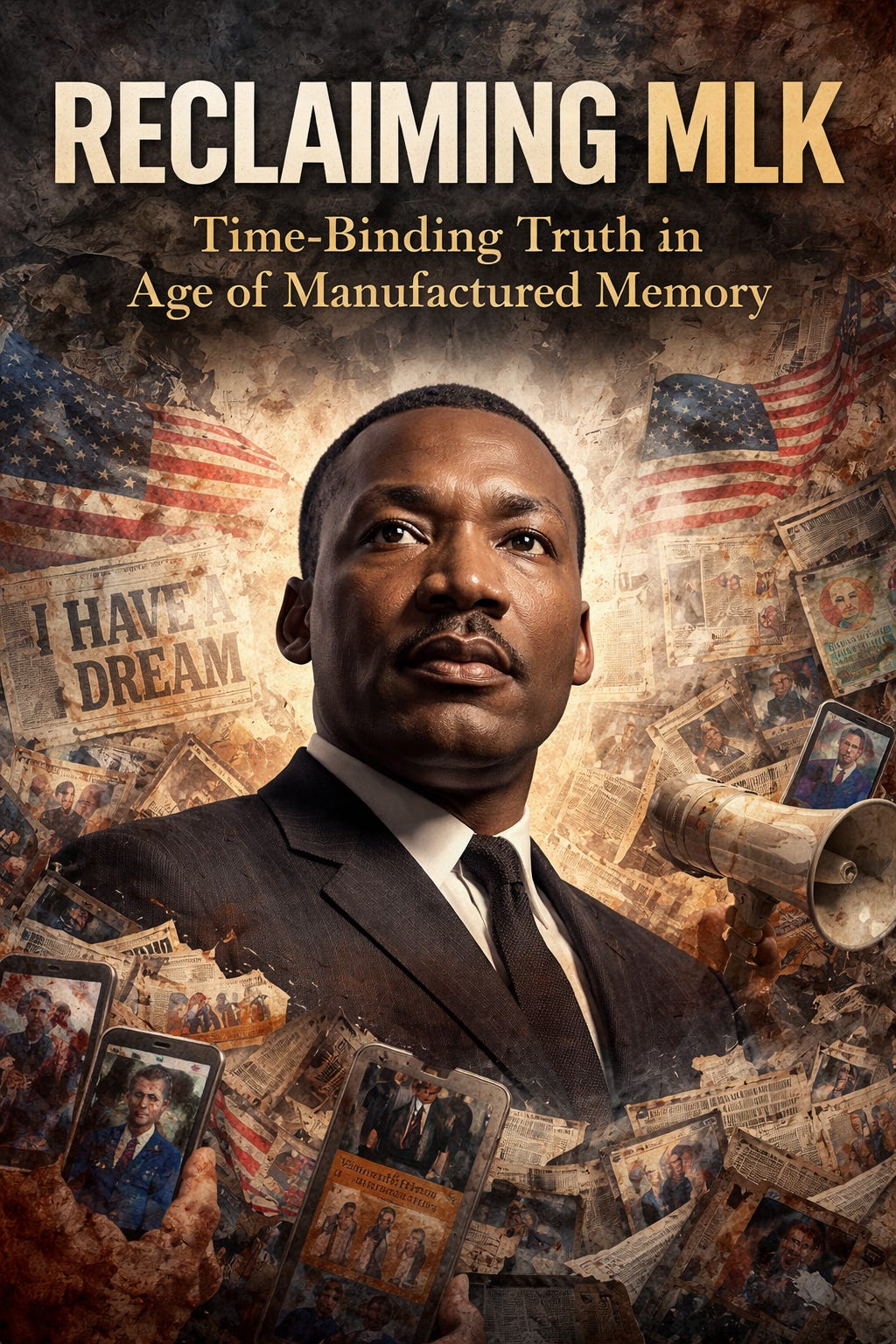
MLK’s Legacy vs. the Memory Wars
Martin Luther King Jr. Day should be a time to reflect on Dr. King’s actual principles and unfinished work. Yet in recent years, the annual tributes often feel like a battleground over his memory. Politicians across the spectrum dutifully quote King’s soaring “I Have a Dream” lines, even as some advance agendas that King himself would have fiercely opposed. Meanwhile, far-right and extremist voices have attempted to reappropriate King’s image and words – twisting a radical legacy into feel-good soundbites or even using King’s day to launder hateful ideologies. As we celebrate MLK Day, it’s crucial to center Dr. King himself in the narrative and to critically examine how his legacy has been shaped, distorted, and weaponized over time. From the late 1960s to the era of QAnon, the public memory of King has been both a contested site of memory and a mirror of America’s broader struggles with truth, history, and justice.
From Radical Visionary to Safe Icon
In his lifetime, Dr. King was far more radical – and controversial – than today’s sanitized tributes imply. Late in the 1960s, as he spoke out against the Vietnam War and launched the Poor People’s Campaign for economic justice, King was denounced by many in power. His April 1967 “Beyond Vietnam” speech at Riverside Church, in which he decried “the giant triplets of racism, extreme materialism and militarism,” was widely condemned. Newspapers and even the NAACP scolded King for linking civil rights with anti-war activism. Polls in 1967 showed King to be one of the most unpopular men in America, seen as an agitator challenging the status quo. King died as a radical apostle of nonviolence and justice – advocating not just integration, but union rights, an end to poverty, and a “radical revolution of values” in America’s political and economic life.
Fast forward to today, and King is almost universally acclaimed – but in a narrowly curated way. The radical content of his message has been sanded down to a few easily digestible quotes. The most common public refrain reduces King’s dream to a vision of colorblind individualism: “not be judged by the color of their skin but by the content of their character.” These words are beautiful – yet stripped of context, they have been wielded as a weapon against the very policies King supported. For instance, conservative activists cite King’s content of character line to attack affirmative action or diversity training, arguing King would reject “pernicious ideologies” like critical race theory. Florida’s governor claimed, “He said he didn’t want people judged by color... he would have opposed [teaching about racism],” using King to justify gagging discussions of systemic racism. King’s impassioned calls for economic justice and anti-imperialism rarely make it into the mainstream MLK Day speeches, which prefer the comforting cadences of “I Have a Dream” divorced from King’s critiques of American power.
This revisionism has deep historical roots. Sociologist Hajar Yazdiha, author of The Struggle for the People’s King, notes that even the establishment of Martin Luther King Jr. Day in 1983 was accompanied by political memory-holing. President Ronald Reagan had opposed the King holiday (and had even vilified King’s activism), yet once Congress forced his hand, Reagan seized the opportunity to reframe King’s legacy. By linking his own legacy to King’s image, Reagan and his allies promoted a “particular version of Dr. King” – one that emphasized personal responsibility, colorblindness, and American exceptionalism over King’s bolder demands for structural change. In effect, they canonized a safe, posthumous MLK who could be celebrated without disturbing the existing power structures. As John Kirk, a historian of the civil rights movement, put it: “King as a person has become a contested site of memory.” What we remember – and choose to forget – about King reflects ongoing battles over America’s past and future.
Weaponizing the Dream in the Post-Truth Era
In recent years, the manipulation of King’s legacy has only accelerated, often in outright Orwellian ways. We’ve seen conservative politicians cherry-pick and misquote King to oppose everything from voting rights legislation to protections for LGBTQ+ youth. A state lawmaker in South Dakota went so far as to misquote King while voting against healthcare for transgender teens. The U.S. House Majority Leader Steve Scalise – who once voted against making MLK Day a holiday – now routinely calls King a “national hero” in the abstract. Trump administration officials and allies have invoked King when convenient: Kellyanne Conway claimed the impeachment of Donald Trump was “not within Dr. King’s vision,” and Mike Pence name-dropped King in arguments for a border wall and against Black Lives Matter protests. Perhaps most egregiously, figures like Mike Huckabee and Sarah Huckabee Sanders insist that King would oppose affirmative action and Black Lives Matter – despite the fact that King literally marched and bled for affirmative action-like programs and criticized “the appalling silence” of moderate whites during Black freedom struggles. As Bernice King (Dr. King’s daughter) bluntly reminded politicians in 2024: “Don’t just quote him. Encourage and enact policies that reflect his teachings.” Her plea underscores how far removed much MLK Day politicking is from the real Martin Luther King.
This bad-faith co‑opting has reduced King, in one writer’s words, to a “depoliticized mascot” – a benign emblem invoked by left and right alike, even the FBI that once hounded him. It’s a cynical kind of memory laundering. By wrapping themselves in King’s most anodyne quotes, politicians seek moral cover for agendas that perpetuate the very injustices King died fighting. The pattern follows a broader playbook of post-truth politics: take a widely respected figure or idea, and distort its meaning until “up” seems “down.” As one Guardian analysis observed, “Dr. King’s dream has been weaponized into his nightmare.”
The appropriation of King’s legacy has even veered into extremist propaganda. A recent PBS NewsHour segment highlighted how MLK Day messaging in some quarters has been tainted with QAnon and white nationalist slogans. Phrases like “Trust the plan” – a QAnon rallying cry – have appeared alongside King’s image on social media, entangling his message of justice with a conspiracy-laden call for blind faith in a secret plot. One online flyer proclaimed, “this MLK Day...trust the plan because we are the storm of the great awakening,” hijacking King’s moral authority to lend credence to fantastical extremist narratives. Even more disturbingly, elements of Nazi-inspired rhetoric have surfaced in official channels under the guise of patriotism. On the weekend of MLK Day 2026, the U.S. Department of Labor posted a video with the slogan: “One Homeland. One People. One Heritage. Remember who you are, American.”. The phrasing unmistakably echoes the Nazi slogan “Ein Volk, ein Reich, ein Führer” (“One people, one nation, one leader”). The Labor Department’s post overlaid imagery of George Washington and wartime propaganda posters, cloaking ultranationalism in Americana. Observers were horrified – “We are governed by proud Neo-Nazis,” journalist Mehdi Hasan remarked. This was not an isolated lapse: it was part of a months-long pattern of federal agencies using white nationalist talking points and aesthetics, from immigration posts celebrating declines in “foreign-born” workers to the Department of Homeland Security pushing recruitment imagery almost exclusively featuring white agents and invoking “Christian nationalism” on official feeds. In short, extremist ideas have been seeping into the mainstream pipeline, even into government MLK Day messaging, under the cover of patriotic sloganeering.
These propaganda campaigns don’t just misremember King – they invert him. “One homeland, one people, one heritage” positions heritage and ethnic unity as supreme values, directly opposed to King’s call for a multiracial democracy grounded in equality and inclusion. It’s a reminder that the far-right’s obsession with “blood and soil” – the idea of an ethnic homeland – is alive and well, repackaged in glossy videos and tweets. As scholar Cynthia Miller-Idriss warns, extremist movements today mainstream their message by blending it into familiar cultural symbols. They co-opt patriotic language, pop culture, even holidays like MLK Day, to smuggle in their ideology. The use of a Nazi-esque slogan by a U.S. agency is a textbook case of this mainstreaming: the hate is hidden in plain sight. It illustrates what Miller-Idriss and other experts note about modern extremism – “extremist ideas come right to you in the spaces where you spend time ordinarily”, normalized through repetition and ritual. If even King’s birthday can be twisted into an occasion for white nationalist winks and QAnon catchphrases, no civic institution or memory is off-limits in the current information war.
Memory, Truth, and the “Ghost Map” of King
What’s at stake in these memory wars goes beyond King himself. It’s about our collective ability to discern truth from lies – to practice what philosophers of cognition call epistemic humility and vigilance in the face of propaganda. Public memory is part of our cognitive infrastructure as a society: the shared knowledge and narratives we use to orient our moral compass. When that infrastructure is sabotaged – when, for instance, King’s story is replaced with a distorted “ghost map” of feel-good myths – our capacity for democratic decision-making is undermined. We navigate social reality using stories of the past as a map; if the map is intentionally wrong, we get lost.
Political theorist Hannah Arendt, analyzing how totalitarian regimes rewrite history, noted that the barrage of official lies does not necessarily make people believe the lies – rather, it makes them doubt all truth. “If everybody always lies to you…the consequence is that nobody believes anything any longer,” Arendt said in 1973. Each new lie forces the regime to rewrite its narrative, until the public is drowning in contradictions. At that point, “people lose faith in the truth” altogether. In such a state of cynical confusion, factual reality (“the sense by which we take our bearings in the real world”) is destroyed. The public, unable to distinguish truth from falsehood, becomes easy prey for whoever presents the most emotionally satisfying story. Manufactured confusion is not a side-effect of propaganda; it is often the goal.
We can see echoes of Arendt’s warning in the current MLK legacy distortion. When blatantly false claims – “King would support this voter suppression bill” or “King would oppose Black Lives Matter” – are asserted with a straight face, the aim is not to have a rigorous historical debate. The aim is to throw sand in our eyes, to make the truth of King’s positions appear murky or subjective. If enough people shrug and say, “Well, everyone uses MLK to back their side – who’s to say what he really stood for?”, then the propagandists have won. The result is a kind of cultural cynicism, where even King’s moral clarity becomes yet another casualty of the “post-truth” fog. And when society can no longer agree on basic historical facts or moral touchstones, the groundwork is laid for what Arendt called the rule of organized lying – a nightmare scenario for democracy.
Memory scholars often talk about “collective memory” as a dynamic process: our society continually reshapes how we remember leaders like King to serve present needs. But when those needs are defined by cynical power-grabs, memory can be turned into a weapon. In the hands of unscrupulous actors, King’s dream is invoked to undermine the very “Beloved Community” he sought. This is why activists in King’s hometown and beyond have launched “Reclaim MLK” campaigns – efforts to remember Dr. King in full, warts and all, and to draw attention to the parts of his message that challenge us today (from reparations to demilitarizing U.S. foreign policy). “We absolutely need to be countering the revisionist history,” Yazdiha argues, “which has been so consequential for rolling back multicultural democracy.” In other words, getting King’s story right is part of defending the integrity of our democracy and the inclusivity of our civic culture.
Time to Grow Up: Bridging the Gap and Binding Time
Recovering the full, radical legacy of Dr. King is part of what one might call the moral and civic maturation of humanity. In the framework of my forthcoming book, “Adulthood of Humanity,” which examines how societies progress (or regress) over time, a key idea is that humans are a time-binding species. We have the unique capacity to pass knowledge and lessons across generations – to bind time – so that each generation can start on the shoulders of the last. This is our “forgotten superpower” as a species. Yet time-binding only works if the knowledge we pass on is anchored in reality. If instead we pass on mythologized half-truths or politically convenient “ghost maps,” we break the chain of genuine learning. We then become, in effect, “time-binding technologists racing ahead of our time-tethered cultures” – wielding advanced tools (like the internet and social media) to spread information, but lacking the wisdom to transmit truth with those tools. This gap – what I call the Korzybskian Gap, the gap between our technological power and our social wisdom – is glaring in today’s information ecosystem. We have global communication networks capable of archiving and sharing all of human history, yet our public discourse often devolves into echo chambers and ghost stories that float free from fact.
To truly honor King and move toward a more mature civic life, we must consciously embrace a time-binding reflex over a space-binding reflex. What does that mean? Space-binding is the mindset of survival in the here-and-now: it’s about tribalism, territory, dominance – the zero-sum scramble for advantage in the immediate present. Much of today’s extremist and authoritarian rhetoric appeals to this side of human behavior. “One homeland, one people, one heritage” is a stark example of space-binding thinking: it invokes an animal instinct to defend one’s in-group and exclude others, treating life as a perpetual turf war. Dr. King, however, appealed to our time-binding capacities. He invoked the deep past and the long future – quoting the prophets Isaiah and Amos, drawing on the founders’ words, and urging America to live up to ideals that would benefit generations yet unborn. King spoke of the “arc of the moral universe” bending toward justice – a profoundly time-bound image of progress over the longue durée. He understood that the struggles of his era were part of a continuum, and that his work would be carried on by those who followed. In essence, King invited America to grow up: to widen its circle of empathy beyond immediate tribal reflexes, and to bind itself to the higher principles that echo through history and reach toward the future.
Today, answering that invitation means closing the gap between our technical abilities and our moral-social development. It means building what we might call cognitive infrastructure for truth – investments in education, media literacy, and civic learning so that citizens can tell fact from fiction, history from propaganda. Media literacy is a defensive toolkit for a “post-truth” age. Researchers in epistemic cognition note that inoculating people against misinformation – through critical thinking exercises, “prebunking” of common falsehoods, and teaching how propaganda works – can significantly boost our collective immunity to lies. Imagine if every school child learned not only the dates and quotes of the civil rights movement, but also how to evaluate competing claims about that history. Such civic education would treat the understanding of King’s life as a case study in navigating truth: examining primary sources (like Letter from Birmingham Jail or Beyond Vietnam) alongside the various interpretations that have sprung up. Grapple with why, for example, state propaganda would try to turn King into a colorblind cheerleader, students gain a visceral lesson in why truth matters. They learn that democracy requires truth-telling – or at least a good faith effort at it – to function, because without a common reality, we cannot govern ourselves.
In broader terms, moving toward what the Adulthood of Humanity framework calls a Type 1 civilization (a wise, globally coordinated society) will require deliberate time-binding practices at all levels. We need to preserve the unvarnished stories of justice movements and carry their lessons learned forward. This might look like a national initiative to digitize and promote King’s less-famous speeches and writings, so that the next generation encounters King in his own powerful words, not just on cereal boxes and TV ads. It might look like institutions committing to “truth and reconciliation” style forums about historical figures – acknowledging the messy complexities rather than allowing mythologies to fester. It certainly looks like calling out distortions when we see them: when a public figure misuses King’s quotes, fact-checkers, scholars, and citizens should not let it slide. In the social media era, lies can travel fast, but timely truth-telling can clip their wings if enough of us engage.
Perhaps most importantly, embracing time-binding means accountability for those who manipulate collective memory. Just as we hold companies to account for toxic waste, we must hold leaders accountable for toxic narratives. When a federal department posts Nazi-derived slogans, public outrage and oversight should follow – and indeed, in the 2026 example, journalists and watchdogs immediately sounded the alarm. This accountability is part of what Bernice King called “corrective justice work”: not only correcting the record on her father’s positions, but demanding that those who evoke his name live up to his values. It’s heartening that civil society is pushing back – whether through op-eds, fact-checks, or activism – but it’s an endless fight, one that each of us has to take up in our communities and online spaces.
“A Nation That Has a Soul”
Dr. King once said, “A nation that continues year after year to spend more money on military defense than on programs of social uplift is approaching spiritual death.” Those were uncomfortable words, largely omitted from the cheery MLK Day montages. To center King in our commemorations, we must be willing to face such discomforts. King challenged America to be better – to become, in effect, an adult nation guided by moral truths, rather than a child chasing the shiny objects of power and prejudice. Recovering King’s full legacy is part of our civic maturation. It requires us to bridge the gap between myth and reality, between the “ghost maps” of propaganda and the true terrain of history. It means binding ourselves to the time-tested principles of justice, rather than the fleeting passions of tribalism.
On this MLK Day, then, let’s resist the safe, decontextualized soundbites and instead engage with King’s actual words – even the challenging ones. Let’s remember that he was not a saint carved in stone, but a complex man who believed in productive tension, in disturbing the peace to achieve a greater peace. Let’s teach our children why he was considered dangerous by those in power, and why that fact is significant. We should honor not just the man, but the truth – and we inoculate the next generation against the facile lies that seek to turn a revolutionary into a mascot.
Dr. King famously warned against the “appalling silence” of good people in the face of injustice. Today, an appalling silence – or perhaps a confused murmur – can arise when we let others rewrite our shared history. Breaking that silence means speaking up for historical truth. It means insisting that Martin Luther King Jr. was not a prop or a pliable symbol, but a prophetic voice we still desperately need to listen to. In a time of rampant disinformation and democratic erosion, telling the truth about King is one way to bend the moral arc back toward justice. It’s a long arc, to be sure, but as time-binders, we have the privilege – and the responsibility – to keep it bending.
Happy MLK Day – and let’s make it mean something real.
A fantastic reclamation, sir. A great read I'll carry forward and share.