


Update, Oct. 13, 2026: Before a tournament on Oct. 10–11, a University of Maryland club tennis document put two Klan hoods on the state flag’s red-and-white quarters. In the Civil War era, Marylanders who sympathized with the South adopted that red and white as their colors. The state’s own flag history says so. No one has established whether the graphic’s maker knew that. What follows is my December essay on how an inherited map keeps steering people who never chose it.
When I published my Medium essay in May 2025—“Why Many Americans Still See Race as Inborn”—I wasn’t trying to win an argument on the internet. I was trying to understand a stubborn pattern: why something can be scientifically flimsy and still feel like common sense to millions of people.
That question matters to me for one reason: it sits right in the middle of my life’s work. I study how humans build meaning, how we inherit “maps” of reality, and what it costs (psychologically, socially, institutionally) when those maps stop matching the terrain.
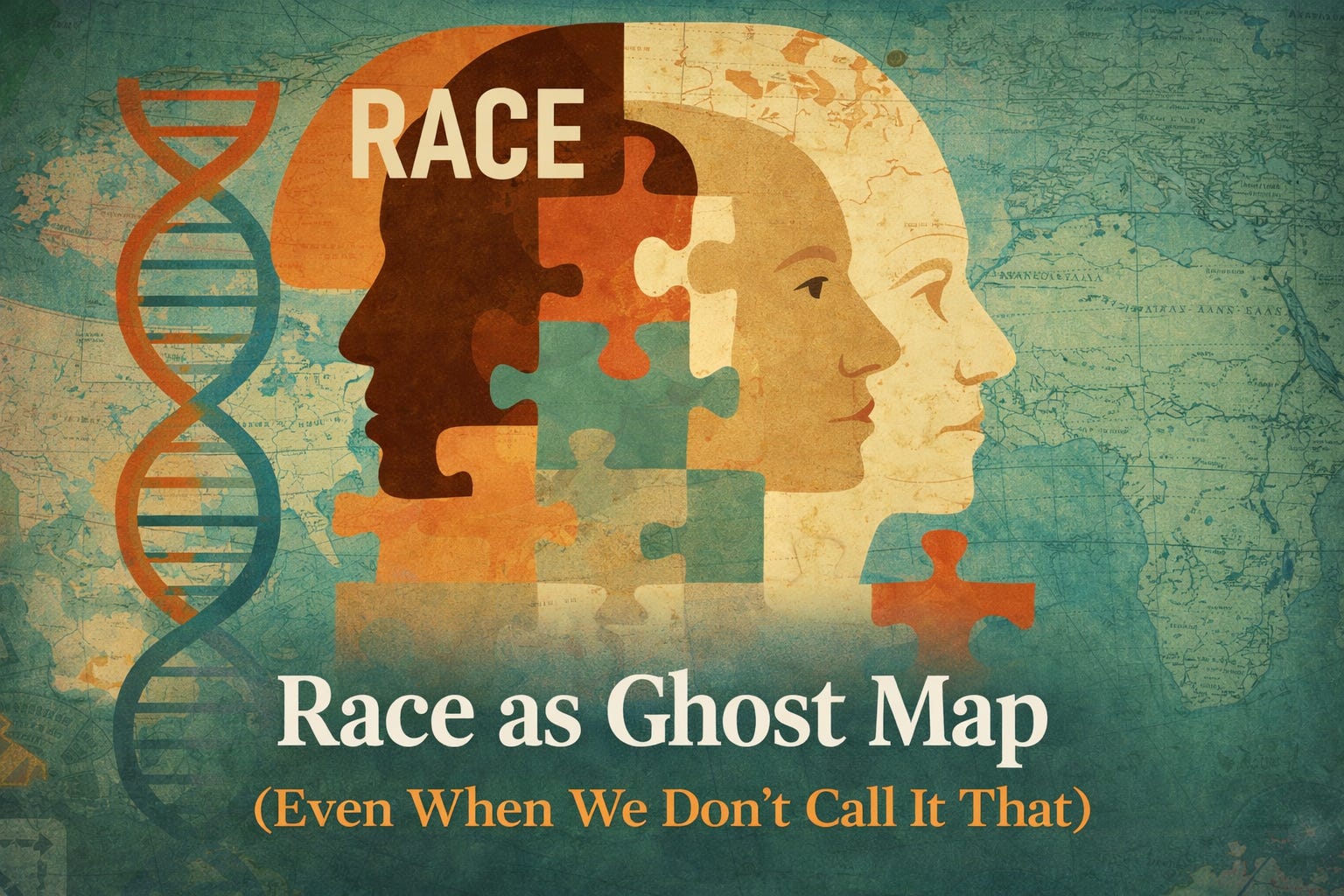
In the work for my forthcoming book, I use a term for that mismatch: Ghost Maps—outdated mental models that keep steering us long after the world has changed.
I didn’t use that phrase in the Medium piece. But the whole essay is Ghost Map work.
Because “biological race” is one of the most persistent Ghost Maps in American life.
A map that feels like reality
If you grew up in the United States, you did way more than learn about race—you learned through race.
You saw it in forms, categories, census boxes, school demographics, “ethnic hair” aisles, neighborhood borders, family warnings, TV casting, hiring signals, and the quiet social math of who belongs where. Even people who reject racism often still carry an inherited assumption that race is something you’re “born with,” fixed in the body like eye color.
That’s the trick of a Ghost Map: it doesn’t announce itself as a theory. It arrives as a backdrop.
And once it’s installed early, once it becomes part of identity, belonging, status, and safety, it can become emotionally non-negotiable. Evidence doesn’t land as “new information.” It lands as a threat.
So when modern genetics says, “These racial categories don’t map neatly onto human variation,” a lot of people don’t hear a scientific correction. They hear: You’re trying to erase what I am.
That reaction carries weight, and it isn’t random. It’s patterned. It’s predictable. It’s social learning.
How the Ghost Map keeps replenishing itself
In the Medium essay, I laid out several mechanisms that keep racial essentialism alive. Looking back, I see them as the maintenance system of the Ghost Map—the small reinforcements that keep the old abstraction feeling “real.”
1) Genetics gets misread through visible traits
Humans are pattern-making machines. We see skin tone and hair texture and assume they point to deep internal divisions, like the body is sorted into discrete biological types. Add a misunderstood example (like sickle-cell), and people treat it as proof of racial essence, even when the real story is geography, ancestry, and historical disease exposure—not “Black genes.”
2) Ancestry testing invites category thinking
DNA tests can unintentionally train people to think in percentages that feel like boundaries: 60/30/10 becomes a story about “what you really are.” But ancestry estimates are probabilistic, and human variation moves gradually across populations. The test may be fine; the interpretation often isn’t.
3) Identity and ideology reward certainty
When your political tribe, religious community, or family narrative treats racial categories as natural, stable, and meaningful, the Ghost Map isn’t just an idea—it’s social membership. People protect it because it protects them.
4) Segregated lives preserve stereotypes
If your world is racially separated—by neighborhood, school, friend group, church, work—then “the other” stays abstract. Abstract people are easy to essentialize. Concrete relationships complicate the map.
5) History keeps whispering “bloodlines”
Blood quantum rules. One-drop logic. “Pure heritage” talk. Nationalist myths. These aren’t just old stories; they’re identity scaffolding. They keep the category system stocked, even when the scientific frame collapses.
None of this requires a person to wake up and say, “I would like to believe false things today.” It just requires living inside an inherited meaning system that has been normalized for generations.
That’s how Ghost Maps survive: not by logic alone, but by repetition, incentives, and emotion.
Race and racism: the map and the machine
Race as a Ghost Map is the cognitive problem—an outdated abstraction treated as objective reality.
Racism is what happens when that abstraction becomes institutionalized—when the map gets wired into housing policy, schooling access, healthcare delivery, policing patterns, lending, hiring, and the informal rules of who is presumed competent, dangerous, or deserving.
The Ghost Map grows and does more than misdescribe human variation. It organizes and builds power.
And that’s why I wrote the Medium essay the way I did: with a “no judgment, just understanding” posture. Not because the belief is harmless—it isn’t—but because shaming people rarely updates maps. It usually hardens them. Ghost Maps thrive in defensiveness.
If we want different outcomes, we have to get better at the craft of updating.
Updating a Ghost Map is a literacy skill
In my book framework, one of the central challenges of modern life is that our environments change faster than our internal models do. That gap produces predictable distortions—misreadings, tribal certainty, and “common sense” that no longer corresponds to reality.
So the simple question is “Why do people believe race is biological?”
And the deeper question is: What would it take for a society to become skilled at revising inherited abstractions—especially the ones tied to identity and status?
That’s where media literacy and epistemic discipline come in—the habits that help us test claims, trace sources, notice incentives, and tolerate uncertainty long enough to learn. This sits right alongside my academic work on media literacy education, teacher efficacy, and the post-truth environment.
In my book language, this is part of building a Cognitive Immune System—the ability to encounter persuasive narratives without being captured by them.
A simple way to interrogate your own “race map”
If you want a practical starting point, try these questions—not as a debate tactic, but as self-audit:
What do I think race explains?
Health? Behavior? Intelligence? Culture? Crime? Attraction? Talent?
Notice when “race” becomes an all-purpose answer.Am I confusing ancestry with race?
Ancestry is real lineage and history. “Race” is a category system built differently across countries and time periods.Where did I learn my default assumptions?
Family stories? School? Church? Neighborhoods? Movies? Military culture? Academic training? Social media?What emotional signal shows up when the map gets challenged?
Anger? Shame? Defensiveness? Dismissal?
That reaction is data. It tells you where identity is fused to the abstraction.What would I lose if the old map were false?
Status? innocence? a clean story about your group? a sense of certainty?
Ghost Maps cling hardest where the psychological payoff is highest.
This is about learning how to update without collapse.
Why I’m bringing this to Substack now
I’m writing here because this is what my larger project is really about: how a time-binding species gets trapped by outdated maps—and how we build the cultural maturity to revise them before they keep harming people.
Race is one of the clearest examples because it sits at the intersection of science, identity, institutional history, and everyday life. It’s a category system that feels biological, even when the genetic story refuses the boundaries. And the consequences of keeping the old map are no longer theoretical—they show up in policy, in outcomes, and in the quiet assumptions we pass to our kids.
If you read my Medium essay back then, you were watching me interrogate a Ghost Map in real time. I just didn’t name it that way.
Now I am.
If you want to add to the conversation, I’d love to hear this:
When was a moment you realized your “race map” didn’t match the terrain—either through science, relationships, or lived experience?
Read the ballot the way you read the record. vote411.org
Jerry W. Washington, Ed.D., is a Marine Corps veteran of twenty-three years, a combat engineer by trade, an instructor at UC Irvine’s Division of Continuing Education, and the writer of What Time Binds, a record of how institutions bend words and how the page holds them to account.