


Special Wednesday drop — July 15, 2026. WTB editorial.
Editor's note. This is a special drop. WTB's Wednesday slot normally carries a What Do You Mean? Field Guide entry, and one still lands today at 8:00 AM Pacific: WDYM: DEI. The reason both run today is that yesterday morning's House Oversight hearing on DEI produced the same rhetorical move I spent the previous 72 hours answering across three separate commenters on my own Facebook thread. Each of them argued as if the argument were in good faith. None produced evidence. The pattern repeats at every scale. The correction is the same at every scale. This essay carries the argument. The WDYM carries the take-home tool.
Video referenced: Reflect Politics, Menefee questioning Michael Shires, YouTube:
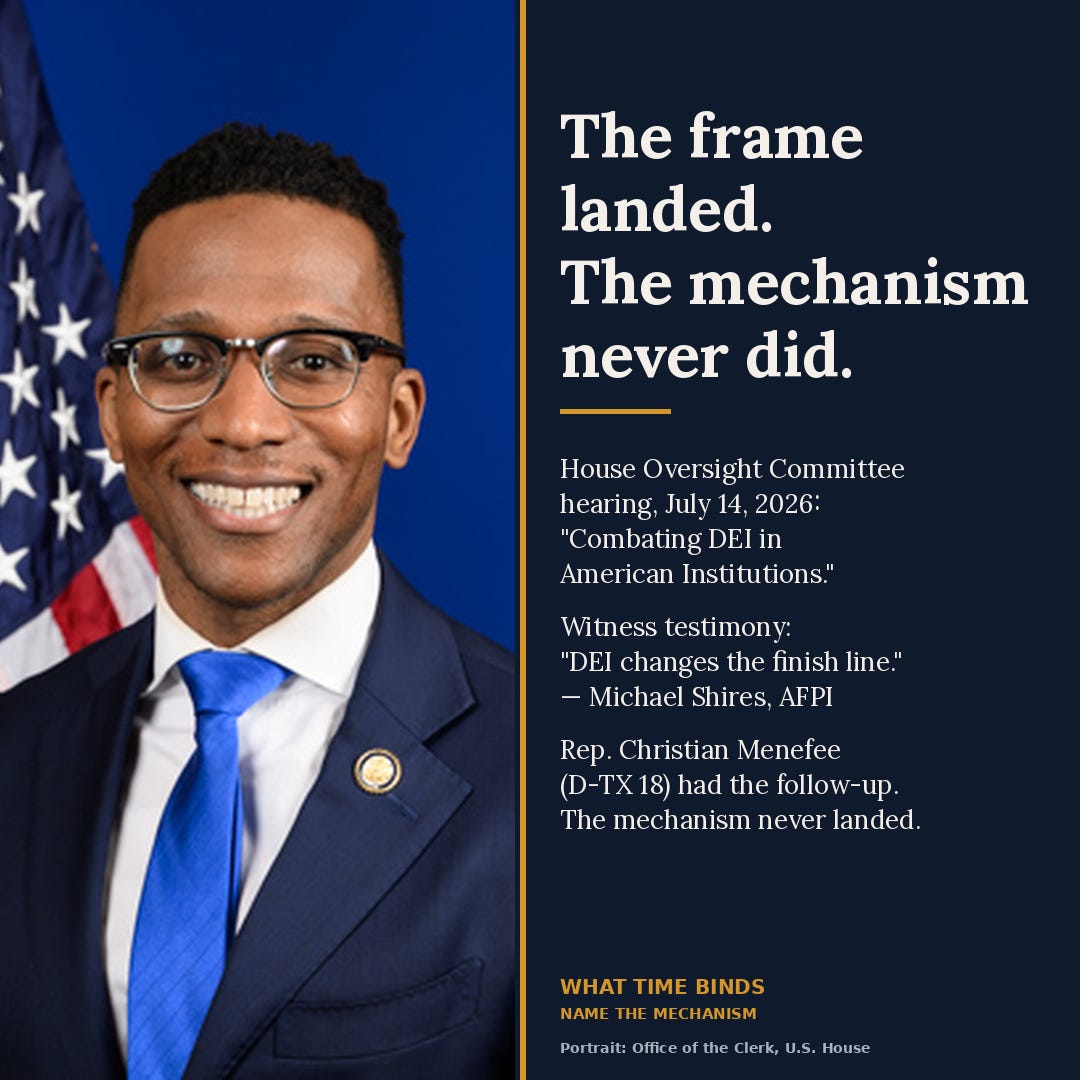
Christian Menefee had Michael Shires teed up.
The Texas Democrat, sworn in five months ago to Sylvester Turner’s old seat, was asking the America First Policy Institute witness whether a random Black person and a random white person, applying for the same job or the same home loan, met the country on the same playing field. Shires walked into the answer.
“The solution to that is to remove the obstacles. It’s not to change the finish line. And DEI changes the finish line. Whereas the federal laws against discrimination are there to remove the obstacles.”
That was yesterday, Tuesday, July 14, 2026, at 10 a.m. Eastern, before the House Committee on Oversight and Government Reform, Task Force on Defending Constitutional Rights and Exposing Institutional Abuses, chaired by Brandon Gill. Hearing title: Combating DEI in American Institutions. Menefee had the follow-up. He didn’t ask it.
He pivoted to the disparate-outcomes data. Median wealth of $285,000 for a white household versus $45,000 for a Black household. Fifteen cents of Black family wealth for every dollar of white family wealth. Black-white unemployment gaps at every level of education. All of that belonged in the record.
The pivot supplied the empirical ground under Menefee’s opening metaphor about lanes with hurdles. It did not touch the frame. Shires walked out with DEI changes the finish line intact in the C-SPAN feed and the YouTube clip.
The question Shires needed to answer, and Menefee needed to ask, was one Menefee already knew how to ask. Which mechanism?
The talking point at the hearing was the talking point on my thread
Three days before Menefee questioned Shires, I posted a photograph Harmeet Dhillon shared of her Department of Justice Civil Rights Division team. She captioned it civil rights warriors. I paired the image with a two-sentence caption. Look at the room. Then look at what the division does now.
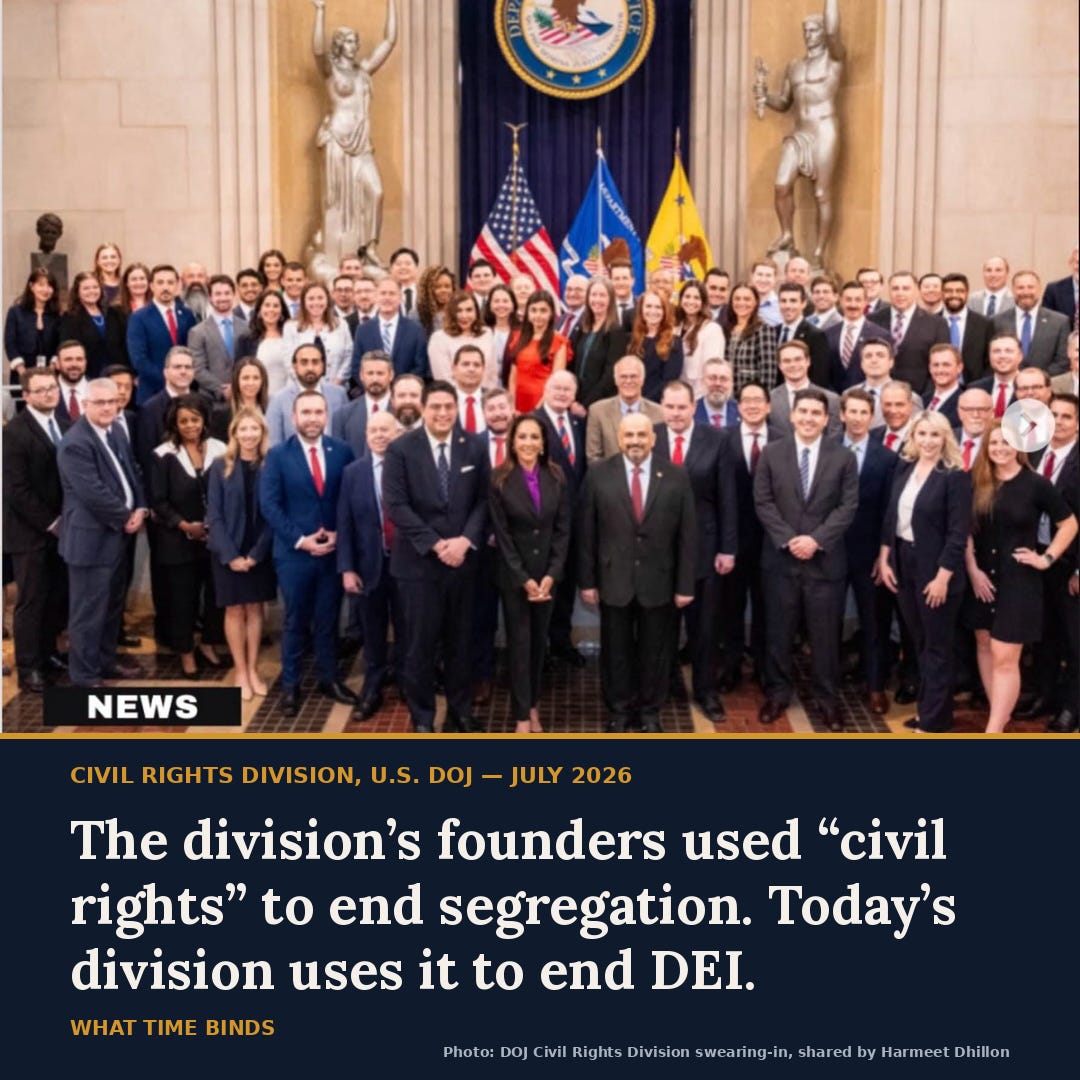
Three commenters showed up over the next 72 hours running variations of one argument. Different sophistication. Same shape.
Thomas D. Guastavino opened. “Does the author know DEI is a form of segregation?” A question with a verdict inside it. Across nine turns, I asked four times for the statute, regulation, or court ruling that defines DEI as segregation. He produced none. He produced other things: his opinion, his frustration, his invocation of the vast majority. He rotated the axiom without ever supplying the citation. The reason for his belief.
Tom Kelly picked up the same claim at a different register. “Dei violates the 14th amendment.” Pressed to explain, he narrowed to “It violates equal protection clause.” Pressed to cite, he retreated to “appellate level but no Supreme Court rulings yet” — an implicit concession that no controlling ruling exists. Pressed further, he substituted a prediction for a holding: “the supreme courts ruling on similar issues will likely lead to unfavorable ruling for Dei.” Pressed further still, he asserted convergence: “I think you and I likely are close in our positions.” At the end, he cited the corporate rollbacks of 2024–2025 as evidence: Ford, Harley-Davidson, John Deere, Lowe’s, Boeing, Meta. All real. All attributable to Robby Starbuck campaigns and Trump’s Executive Order 14173, signed January 21, 2025. None were court rulings. His closing line conceded the whole exchange: “My company disbanded because of potential litigation risk.” Litigation risk is a business decision about lawsuit exposure. It is a different thing from a court holding that the practice was unlawful. Kelly crossed the two without noticing.
Ryan McCoy took the third register. Good-faith, curious, willing to specify. “Sadly some people that got an interview but didn’t make the cut used DEI to force them to get hired because the demographic wasn’t diverse enough according to DEI. So yes in some cases it was weaponized.” No named case. No named employer. No cited EEOC filing. The position is old enough to have a shape. Name a legal protection. Assert it has been weaponized. Produce the harm through unnamed anecdote. Title IX has been through it. ADA has been through it. DEI is going through it now.
Three commenters. Three registers. One missing piece in every case: which specific DEI program, at which employer, produced the harm they were describing.
Each argued as if the argument were in good faith. Guastavino invoked the vast majority like a jury endorsement. Kelly asserted convergence after every retreat: “I think you and I likely are close in our positions.” McCoy opened with genuine curiosity and, pressed for a specific filing, produced none. Good faith performed. Evidence never delivered. Seventy-two hours of that across three commenters, one photograph, and a two-sentence caption. Then Tuesday morning, the same performance at the House Oversight microphone.
The shape
The shape is old. Categorical claim, no mechanism. Under pressure, one of three retreats. Retreat to a smaller subset (”appellate level”). Retreat to a prediction (”the Court will likely rule”). Retreat to institutional behavior (”companies are dropping it”). Each retreat carries the confidence of a citation. None of them is a citation.
Meaning refusal has a signature. The signature is a category that argues for itself. Guastavino’s segregation argues for itself if you don’t ask what it means. Kelly’s 14th Amendment argues for itself if you don’t ask which case. McCoy’s weaponized argues for itself if you don’t ask which filing.
Shires ran the same shape at the House Oversight microphone. DEI changes the finish line argues for itself if you don’t ask which program.
Back to the hearing
Menefee could have asked Shires which DEI program he had in mind. Which employer. Which mechanism. Barrier analysis under 29 CFR 1608? ADA accommodations? Section 503 disability outreach? VEVRAA veteran hiring? Employee resource groups? Unconscious bias training? Standardized evaluation rubrics? EEOC’s MD-715 barrier reviews for federal employers? Or the mechanism Shires was probably pointing at, race-decisive hiring, which has been illegal under Title VII disparate-treatment doctrine since 1964 and cannot be a plausible current example of what he was describing?
He asked none of them.
The pivot to outcomes data was strong in isolation. What it did not do was contest the frame. Shires walked out with the sentence DEI changes the finish line intact in the record. The frame stands unchallenged at the level of mechanism because nobody in the room named the mechanism.
What DEI actually consists of
DEI is a portfolio.
Statutory floor: Title VII of the Civil Rights Act of 1964 (race, color, religion, sex, national origin), the ADA (1990), VEVRAA (1974), Section 503 of the Rehabilitation Act (1973), the PWFA (2023), EEOC barrier analysis under 29 CFR 1608 and 41 CFR 60, and EEOC Management Directive 715, which requires federal employers to identify barriers to equal employment opportunity through data-driven review.
Institutional practices on top of that floor: outreach and pipeline programs, mentorship and sponsorship, employee resource groups, unconscious bias training, standardized evaluation rubrics, climate surveys, return-to-work programs for veterans and parents.
None of that changes the finish line.
Barrier analysis reviews a screening rule that produces disparate outcomes. If the rule is job-related, the rule stands. If it cannot be justified as job-related, the rule was measuring something other than job fitness. The finish line stays where it was. The question underneath is whether it was placed there for the reason the employer claimed.
ADA accommodations remove disability-specific barriers. A qualified applicant with a disability meets the same standard as any other qualified applicant. A hurdle lifted from one lane. The same finish line for everyone.
VEVRAA and Section 503 direct recruitment toward veterans and people with disabilities. Outreach expands who applies. Selection is a separate act, governed by separate rules.
Standardized rubrics change how the evaluator scores. What counts as passing stays constant. A finish line judged by a consistent measure across candidates is closer to a finish line than one judged by whatever measure each evaluator brings to the room.
Griggs v. Duke Power, decided in 1971 and codified in the Civil Rights Act of 1991, established that a facially neutral screening rule with disparate impact requires the employer to prove the rule is job-related and consistent with business necessity. Kelly named 1991 as the year the finish line moved. He was pointing at the codification of Griggs. Griggs does not lower the standard. It forces the employer to prove the standard measures the job.
What “change the finish line” would actually mean
To point at a DEI mechanism that would change the finish line, you have to point at one of three things: hard numerical quotas, race or another protected class as a decisive factor in a specific hiring decision, or race-conscious plus-factors in university admissions.
Hard quotas in hiring: illegal since United Steelworkers v. Weber (1979). Federal contracting set-asides: strict scrutiny since Adarand v. Peña (1995). State and local set-asides: strict scrutiny since City of Richmond v. Croson (1989). Race as a decisive factor in a specific hiring decision: illegal under Title VII disparate-treatment doctrine for sixty-two years. Race-conscious plus-factors in admissions: legal from Bakke (1978) through Grutter (2003), overturned by Students for Fair Admissions v. Harvard (2023) for both public and private universities receiving federal funds.
Every item is either already illegal or narrowly restricted for admissions since 2023. Almost none of it is what a current DEI program is actually doing.
When Shires said DEI changes the finish line, he was pointing at a category defined by mechanisms that were mostly illegal already. When Kelly said DEI violates the 14th Amendment, he was pointing at cases that address specific doctrinal areas (admissions, contracting, school assignment) and treating them as if they had ruled on the whole portfolio. When Guastavino said DEI is segregation, he was collapsing law-mandated racial exclusion under Jim Crow with voluntary access-widening under Title VII.
Three sophistication levels. One argument. The mechanism missing from all three.
Repair
DEI is a magnet word. Three definitions travel under it. Segregation. Unconstitutional preference. Weaponized advantage. When speakers use the word without pinning which definition they mean, the debate feels substantive and resolves nothing. Everyone can argue about a different thing while agreeing the word matters. The referent isn’t shared.
The pin. DEI as it exists in current law and institutional practice is a portfolio: statutory obligations under Title VII, ADA, VEVRAA, Section 503, PWFA, EEOC barrier analysis, and voluntary practices, including outreach, mentorship, employee resource groups, bias training, and standardized evaluation. Race-decisive decisions and hard quotas are the illegal edge case, not the portfolio.
Includes: barrier analysis, disparate-impact enforcement under Griggs, ADA accommodations, VEVRAA outreach, mentorship, standardized rubrics, employee resource groups, pregnancy accommodations under PWFA.
Excludes: hard numerical quotas (illegal in employment since 1979, in admissions since 2023), race as a decisive factor in a specific decision (illegal since 1964), race-conscious plus-factors in admissions (illegal since 2023).
Example. A federal contractor conducting a barrier analysis of its hiring pipeline under 41 CFR 60 to identify neutral policies that produce disparate outcomes. That is DEI.
Non-example. An employer refusing to hire white applicants. That is a Title VII violation. Title VII has said so for sixty-two years.
Repair Protocol
When you hear DEI changes the finish line or DEI is discrimination or DEI violates the 14th Amendment, name the missing mechanism first. Argue outcomes after.
Six prompts and scripts:
1. Which DEI program? “Which specific DEI practice are you describing? Barrier analysis? ADA accommodations? Veteran outreach under VEVRAA? Employee resource groups?”
2. Which employer? “Which employer ran the program you have in mind? Which mechanism in that program produced the outcome you’re describing?”
3. Which citation? “Which statute, regulation, or court ruling defines the practice you’re describing as unlawful?”
4. Which case? “Which Supreme Court case held that DEI, as institutional practice, violates the 14th Amendment? SFFA v. Harvard addressed admissions. Croson and Adarand addressed set-asides. Which case addressed DEI?”
5. Which filing? “Which EEOC filing, state civil-rights complaint, or federal court case documents the weaponization you’re describing?”
6. Which mechanism moves the finish line? “If the finish line has moved, name the mechanism that moved it. Barrier analysis? Accommodations? Outreach? Or the mechanism that would move it, hard quotas, which have been illegal since 1979?”
When the answer arrives, engage the specific answer on its merits. When the answer does not arrive, the silence is the argument. File the silence next to the claim. Let the reader see both.
Back to the room
Menefee closed with a sentence worth keeping. “If the government was part of the problem, the government now has part of the solution.”
The room needed one more question underneath it. Which government program are we talking about, Dr. Shires? Which mechanism in that program moves the finish line, as opposed to removing the obstacles?
Shires would have had to answer or refuse to answer. Either outcome would have been on the record. The refusal would have become the argument. An answer would have been checkable against the statute.
The frame DEI changes the finish line stands in the C-SPAN feed and the YouTube upload because nobody in the room asked the question that would have moved it.
The question is still available. It is available to Menefee the next time he questions a witness on the subject. It is available to the reporter covering the next hearing. It is available to any of us who see the frame land in a Facebook thread or a family text message.
Name the mechanism. Everything else follows from that.
Author’s note. Twenty-three years in the Marine Corps taught me that rules of engagement get written, briefed, and rehearsed before contact. You do not enter a room without knowing what you can and cannot do, and you do not describe what happened in the room without naming the specific action that made it happen. Three days on a Facebook thread and one morning of C-SPAN produced four speakers asserting DEI is unlawful without naming a single unlawful mechanism. The frame is the same at every scale. The correction is the same at every scale.
Read the WDYM companion at 8:00 AM Pacific and the whole series at what-time-binds.com. If you want the next essay in your inbox, subscribe. This is where the record gets built: slower than a viral clip, and it holds up on second reading.
Sources
House Committee on Oversight and Government Reform, Task Force on Defending Constitutional Rights and Exposing Institutional Abuses, hearing Combating DEI in American Institutions, July 2026.
Congressman Christian Menefee (D-TX-18), sworn in February 2, 2026, following the death of Rep. Sylvester Turner. Former Harris County Attorney (2021–2026).
Dr. Michael Shires, Vice Chair of Education Opportunity and Higher Education, America First Policy Institute. Previously Chief of Staff, University of Austin (UATX). 23 years at Pepperdine School of Public Policy.
Cases cited: Griggs v. Duke Power (1971), Regents of the University of California v. Bakke (1978), United Steelworkers v. Weber (1979), City of Richmond v. J.A. Croson (1989), Adarand Constructors v. Peña (1995), Grutter v. Bollinger (2003), Students for Fair Admissions v. Harvard (2023).
Statutes: Title VII of the Civil Rights Act of 1964; Rehabilitation Act of 1973 §503; VEVRAA of 1974; ADA of 1990; Civil Rights Act of 1991; PWFA of 2023.
Regulations: 29 CFR 1608 (EEOC affirmative action guidelines), 41 CFR 60 (OFCCP contractor obligations), EEOC MD-715 (federal employer barrier analysis).
Executive Order 14173, Ending Illegal Discrimination and Restoring Merit-Based Opportunity, January 21, 2025.