


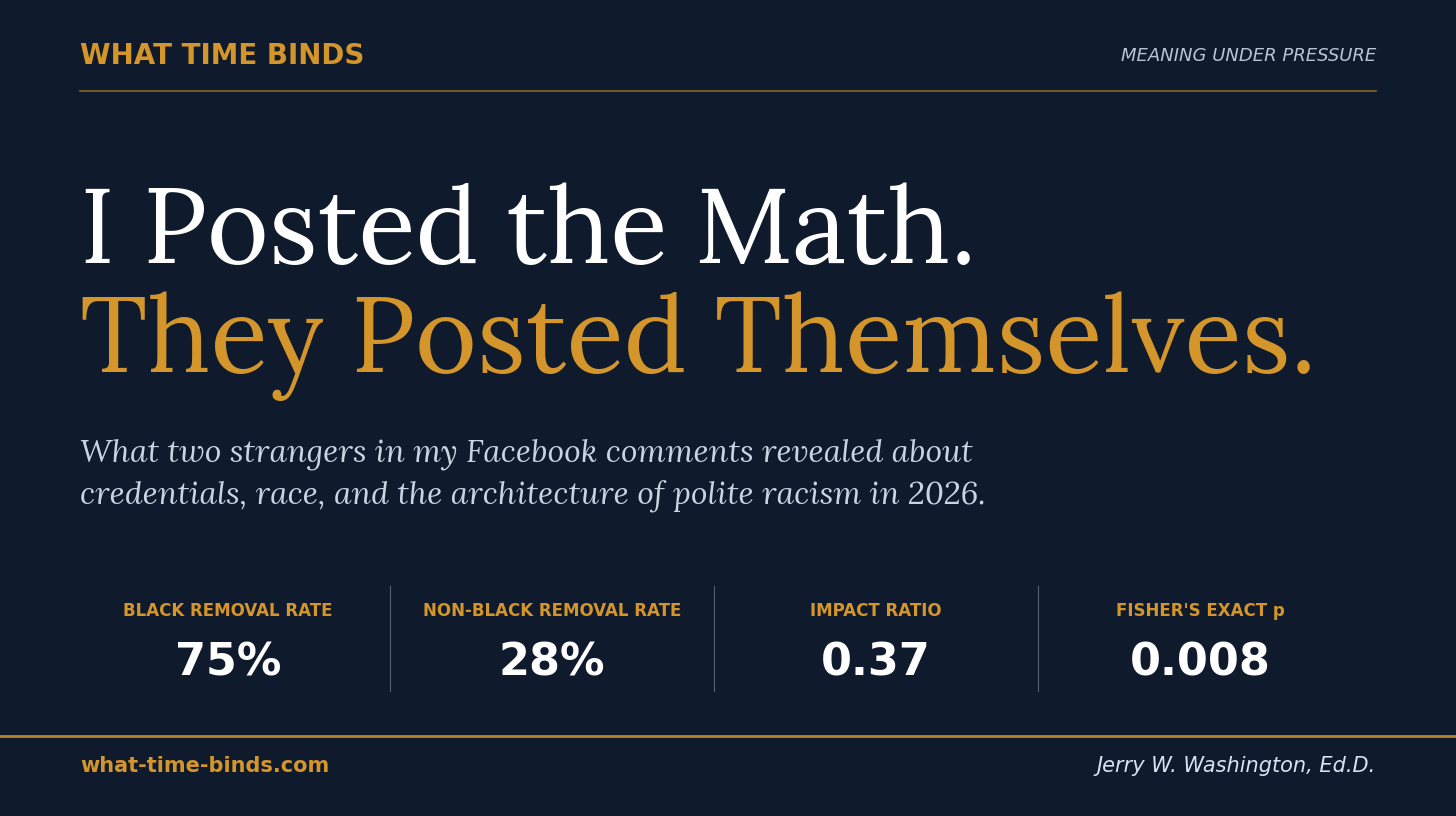
Saturday morning, I posted a chart and a paragraph on Facebook. The chart said something simple: under the second Trump administration, Black officials at independent multimember federal agencies have been removed at 75 percent. Non-Black officials in comparable positions have been removed at 28 percent. The impact ratio is 0.37, less than half the EEOC’s 0.80 threshold for adverse impact. The disparity is also statistically significant: Fisher’s exact test gives a p-value of 0.008. If firings were race-blind, this pattern would appear by chance about eight times in a thousand.
I named eight people: Carla Hayden, CQ Brown, Willie Phillips, Charlotte Burrows, Gwynne Wilcox, Alvin Brown, Robert Primus, Lisa Cook. All Senate-confirmed. All removed before their terms ended. Sources for each removal are at the end of this piece.
How the math was run
The analysis covers Senate-confirmed officials at independent multimember federal agencies removed by the second Trump administration: a pool of 12 Black officials and 50 non-Black officials in comparable positions. The observed removals were 9 Black and 14 non-Black. Four standard tests were applied.
Four-fifths rule (impact ratio): 0.37. The EEOC’s threshold for adverse impact is 0.80. This pattern is less than half the threshold.
Two-proportion z-test: z = 3.03, p = 0.0025.
Fisher’s exact test: two-sided p = 0.008. If firings were race-blind, this pattern would appear by chance about eight times in a thousand.
Binomial test: p = 0.022.
The EEOC has a quick test for spotting when a workplace decision is hitting one group much harder than another. You take the rate at which one group is affected and divide it by the rate at which the other group is affected. If the result falls below 0.80, the EEOC treats that as evidence of disparate impact. In this case the result is 0.37 — less than half the threshold. Stated another way, Black officials are being removed at 2.7 times the rate of non-Black officials.
All four tests return the same verdict. Sensitivity analysis varying the pool definition by plus or minus three officials in either direction does not change the result. DM me for the spreadsheet.
The first comment landed within the hour, under Tim’s name and photo:
“This makes perfect sense, They commit the vast majority of crimes, so the stat makes sense.”
That comment is the article.
The comments
Tim came back with the 13/53 statistic. “Approx 13 % of the population commit about 53% of the crimes, and you know who those 13% are. Prove me wrong and i will eat crow.”
I walked through the technical issues. The figure is FBI Uniform Crime Reporting arrest data for homicide, specifically, drawn from arrest counts rather than crime commission, and circulates without the corollary that more than 90 percent of those homicides are intra-racial. Total arrest disparities across all crime categories run closer to 26 percent, not 53. Then I named the category error. The firings under analysis were of Senate-confirmed senior federal officials, not random members of the general Black population. Carla Hayden held a doctorate and ran the Library of Congress for nine years without scandal. CQ Brown spent forty years in uniform and made four-star rank. The crime statistic, even at face value, has no analytic relationship to whether they should have been fired by email or phone call.
Tim yielded. Returned later with a real legal question: whether independent agency officials serve at the pleasure of the President. They do not, with the qualified exception of the Joint Chiefs Chairman. Humphrey’s Executor v. United States has been Supreme Court precedent on independent agency removal protections for ninety years. Time returned again with a “fellow veteran” frame and an invitation to break bread in South Carolina. Returned a fourth time when I declined to treat the invitation as separable from his stated belief about Black people. He still believes the statistic. He said so directly, on the record. The cordial welcome was offered without any examination of the priors that would make the welcome impossible.
When I declined the welcome and announced I was done, the frame shifted again. The walkthrough of case law became “tortured language.” My disengagement became running “home from the facts.” A vague “DOJ report on crime by ethnicity, 2025 version” arrived as the new authority. Then a demand for an apology.
Joe took a different approach. His contributions to the thread are no longer publicly visible at the time of this writing. The exchanges below are reconstructed from contemporaneous notes.
He arrived with a slogan from Thomas Sowell: “Diversity of input = Diversity of outcome/Equality or Equity of outcome = Tyranny.” I noted that Sowell’s argument is about population-level outcomes from millions of individual choices, not eight firing decisions made by one person. The “tyranny” framing also collapses measurement of outcomes into enforcement of outcomes. Measurement is what the chart did. Enforcement is what Sowell’s argument prohibits. The chart did not cross that line.
Joe escalated into the proxy argument: Trump fired people who oppose MAGA’s agenda, Black people vote Democratic, therefore the disparate impact is rational and non-racist. According to Joe, “Black people should have been disproportionately fired.”
I cited Griggs v. Duke Power Co., 401 U.S. 424 (1971), and Hunter v. Underwood, 471 U.S. 222 (1985). Hunter was 8-0. Alabama disenfranchised people convicted of “moral turpitude” crimes, a facially race-neutral criterion. The Supreme Court struck the law down because the legislature had chosen the criterion specifically because it would primarily affect Black voters. Joe’s argument was the same architecture: select on a proxy because it correlates with race, then claim race was not the criterion. The proxy also did not fit the data. CQ Brown was originally nominated by Trump for Pacific Air Forces commander in 2018. Carla Hayden was confirmed 74-18 in 2016 with substantial Republican support. Race was and is the through-line.
Joe answered with another formulation of the same position, plus a coda: “Vote for and support Republicans if you want to be included in a Republican Administration.” I cited Elrod v. Burns, 427 U.S. 347 (1976), Branti v. Finkel, 445 U.S. 507 (1980), and Rutan v. Republican Party of Illinois, 497 U.S. 62 (1990). Conditioning federal employment on political party affiliation violates the First Amendment for any position that is not genuinely policymaking. The Pendleton Civil Service Reform Act of 1883 codified the broader principle 142 years ago. The whole structure of independent agencies, civil service protections, and merit-based federal hiring exists to prevent exactly what Joe was endorsing. I explained this explicitly.
Joe’s final move: he had “understood and countered my neo-Marxist perspective with a rational response.”
Two strangers, on one thread, with different registers, and the same architecture.
Let me explain what’s going on here
Eduardo Bonilla-Silva, in Racism Without Racists, identified four rhetorical frames that allow racial inequality to be defended without using racial slurs. He called the system color-blind racism. The four frames are abstract liberalism, naturalization, cultural racism, and minimization. I deal with this in almost every interaction.
Tim’s thread was minimization with a cultural-racism kicker. Minimization: “It has nothing to do with you and i breaking bread.” The statistical claim is held to be a neutral observation about a population, with the personal interaction isolated from it. Cultural racism: “In my humble opinion the number one problem facing Black Americans is fathers absent.” The pattern is attributed to a group cultural deficit rather than to structure or policy.
Joe’s thread was abstract liberalism with a cultural-racism backbone. Abstract liberalism: equity-of-outcome violates principles of individual freedom and merit, therefore any policy that produces disparate impact is the legitimate result of free choice and rational selection. Cultural racism: Black voters chose to support Democrats, so Black officials being fired by a Republican administration is the consequence of a group choice rather than a racial decision.
Bonilla-Silva published Racism Without Racists in 2003. The frames have not changed across editions. Neither have the speakers. Tim and Joe were running scripts written before their Facebook accounts existed.
Me being critical in my thinking
This is where I have to be precise about credentials. I served twenty-three years in the Marine Corps. I retired as a Master Sergeant. I hold a doctorate in Organizational Change and Leadership from USC Rossier School of Education. I teach at the University of California, Irvine, Division of Continuing Education. I have published research on AI governance and democratic accountability. My byline is on this newsletter and on my Facebook About Me. None of that information was hidden during the exchange. Tim and Joe could have read it. Both engaged anyway.
What I described in those comments was federal employment law. Griggs v. Duke Power Co. is the foundational disparate impact case taught in every employment discrimination course in the country. Hunter v. Underwood was unanimous. Humphrey’s Executor v. United States has been Supreme Court precedent for ninety years. Elrod, Branti, and Rutan together establish a doctrine taught in every constitutional law class. None of these citations were obscure. None of them were Marxist.
The label “linguistic gymnastics” was performing a specific rhetorical function: marking the analysis as illegitimate so it could be left unanswered. The label “neo-Marxism” was doing the same work in a different register. Christopher Rufo, the activist who built the “critical race theory” wedge, stated his strategy publicly in March 2021: brand the term, freeze its negative perception, and turn it toxic. The “neo-Marxism” label is downstream of that work. James Lindsay built a parallel apparatus around “cultural Marxism.” The labels are interchangeable. The function is the same: a small machine for converting expertise into something easier to ignore.
The credentials are supposed to do work in this kind of exchange. They are supposed to translate, in the social grammar of the audience, into a presumption that the analysis is competent. That is the implicit deal Black professionals are offered. Get the doctorate. Earn the rank. Build the publication record. Then your analysis will land.
The exchange showed what the deal actually delivers. The credentials were known. The analysis was correct, with cited cases and named statutes. Both men dismissed it anyway. The labels are widely available. They are mass-produced.
Credentials cannot protect against this. The labels operate after the credentials are seen.
What the post did
The post that triggered this thread reached over 3,100 views in two days, with 1,900 unique viewers. Ninety-two percent of viewers were not in my network. The chart was shared twenty-five times. The math suggests the chart did not have to be explained to readers. They recognized what it was. Black professionals, women in STEM, immigrants in academia, anyone who has watched their credentials evaporate the second the audience registered who was speaking. The recognition was immediate. The reach is the recognition.
This is what the public conversation looks like in May 2026. A retired Marine and a sitting university instructor posts statistically valid math about racial disparities in federal hiring. The math gets called gymnastics. The case law gets called Marxism. The cordial veteran-to-veteran invitation arrives with the priors intact. The sophisticated political reformulation arrives with the priors elaborated.
The thread shows the comment section operating as designed. Tim and Joe were the system reproducing itself in real time, with their names attached.
The thread also showed the counter-mobilization. A reader named Renee, not in my network, arrived with her own citations. She named Tim’s tropes directly. She challenged a separate commenter who implied the fired officials had lacked proficiency. She linked to the CBS Miami summary of the CDC’s father-involvement study and to the FBI’s Uniform Crime Reports table on arrests. She was not the only one. Readers arrived with the analysis already done and prepared to defend the record. The recognition does not stop at recognition. Some of it organizes.
I will keep posting the math. I will keep building the record. I will keep showing my work. The post on Saturday was the disparate impact analysis. This article is the analysis of the responses to the analysis. The next article will be the analysis of the responses to this article. The work continues because the architecture is doing its job, and the only way to wear down the architecture is to keep showing it to people in real time.
The receipts are public, the names are real, and the math is the math. The next round will arrive on schedule.
Jerry W. Washington, Ed.D., is a retired Marine Corps Master Sergeant, instructor at UC Irvine Division of Continuing Education, and publisher of What Time Binds. His research focuses on AI governance, democratic accountability, and meaning under institutional pressure.
Sources & Further Reading
The original post
The removals
Dr. Carla Hayden — Librarian of Congress (fired May 8, 2025)
NPR, “President Trump fires Librarian of Congress Carla Hayden“ (May 9, 2025)
NPR, “Librarian of Congress firing is latest move in upheaval of U.S. cultural institutions“ (May 9, 2025)
Library Journal, “Librarian of Congress Carla Hayden Is Fired“ (May 12, 2025)
PBS NewsHour, “Carla Hayden on her time as a pioneering librarian of Congress and getting fired by Trump“ (July 8, 2025)
Gen. Charles Q. “CQ” Brown Jr. — Chairman, Joint Chiefs of Staff (fired Feb. 21, 2025)
NBC News, “Trump fires Chairman of Joint Chiefs of Staff CQ Brown“ (Feb. 21, 2025)
NPR, “Trump fires chairman of the Joint Chiefs of Staff Gen. Charles Q. Brown Jr.“ (Feb. 21, 2025)
DefenseScoop, “Trump removes Gen. Brown as chairman of the Joint Chiefs of Staff, announces nominee to replace him“ (Feb. 21, 2025)
Willie L. Phillips — Federal Energy Regulatory Commission (resigned at White House request, April 22, 2025)
Utility Dive, “Phillips exits FERC, leaving a seat for Trump to fill“ (April 23, 2025)
E&E News (Politico), “Phillips’ departure tees up FERC Republican majority“ (April 23, 2025)
FERC, “Chairman Mark C. Christie’s Statement on the Resignation of Commissioner Willie L. Phillips“ (April 22, 2025)
Charlotte A. Burrows — EEOC Commissioner and former Chair (fired Jan. 27, 2025)
Sullivan & Cromwell LLP, “President Trump Removes EEOC and NLRB Officials“ (with continuing case updates)
Katz Banks Kumin LLP, “Statement of Former EEOC Chair Charlotte Burrows“ (Jan. 28, 2025)
Seyfarth Shaw LLP, “Trump Fires EEOC Commissioners, Testing Constitutional Limits on Presidential Power Over Independent Agencies“ (Jan. 29, 2025)
Gwynne A. Wilcox — National Labor Relations Board (fired Jan. 27, 2025)
Civil Rights Litigation Clearinghouse, “Wilcox v. Trump (NLRB)“ (full docket and filings)
Sullivan & Cromwell LLP coverage above tracks the parallel NLRB litigation
Alvin Brown — National Transportation Safety Board (fired May 2025)
CourtListener, “Brown v. DeLeeuw, 1:26-cv-01249 (D.D.C.)“ (full docket)
Democracy Forward, “Unlawfully Fired Independent Board Members Take Legal Action Against Trump-Vance Administration’s Race Discrimination“ (Dec. 4, 2025; the amended filings adding race-discrimination claims)
Robert E. Primus — Surface Transportation Board (fired Aug. 27, 2025)
Democracy Forward, “Surface Transportation Board Commissioner Challenges Unlawful Firing“
ABC News / AP, “Fired Surface Transportation Board member sues Trump over his dismissal ahead of rail merger review“ (Oct. 1, 2025)
Washington Times, “Robert Primus sues Trump over dismissal from Surface Transportation Board before rail merger review“ (Oct. 1, 2025)
Dr. Lisa D. Cook — Federal Reserve Board of Governors (firing attempted, blocked)
Coverage of Trump v. Cook and the litigation pending before the Supreme Court can be tracked through SCOTUSblog and through the Sullivan & Cromwell update linked above.
Litigation cited or referenced
Brown v. DeLeeuw / Brown v. Trump, No. 1:26-cv-01249 (D.D.C., filed April 14, 2026). CourtListener docket. Amended complaint adding race-discrimination claims filed Dec. 4, 2025.
Primus v. Trump (D.D.C.). Background and complaint at Democracy Forward.
Trump v. Wilcox, 605 U.S. ___ (2025). Supreme Court stay order, May 22, 2025 (PDF).
Constitutional and statutory authority
Humphrey’s Executor v. United States, 295 U.S. 602 (1935) — Congress may insulate officers of multimember independent agencies from at-will presidential removal.
Griggs v. Duke Power Co., 401 U.S. 424 (1971) — Disparate impact doctrine: practices fair in form but discriminatory in operation are unlawful absent business necessity.
Hunter v. Underwood, 471 U.S. 222 (1985) — A facially neutral rule adopted with discriminatory intent and producing a racially disparate effect violates the Equal Protection Clause.
Elrod v. Burns, 427 U.S. 347 (1976) — The First Amendment forbids dismissing public employees in non-policymaking roles for partisan reasons.
Branti v. Finkel, 445 U.S. 507 (1980) — Refines the Elrod standard: the question is whether party affiliation is an appropriate requirement for the effective performance of the office.
Rutan v. Republican Party of Illinois, 497 U.S. 62 (1990) — Extends Elrod/Branti protection to hiring, promotion, transfer, and recall decisions.
National Labor Relations Act, 29 U.S.C. § 153(a) — NLRB members “may be removed by the President, upon notice and hearing, for neglect of duty or malfeasance in office, but for no other cause.”
Pendleton Civil Service Reform Act of 1883, ch. 27, 22 Stat. 403 — Replaced the spoils system with merit-based federal employment.
Method and data
EEOC Uniform Guidelines on Employee Selection Procedures, 29 C.F.R. § 1607.4(D) — The four-fifths (80%) rule and its companion tests of statistical significance.
On the rhetoric
Eduardo Bonilla-Silva, Racism Without Racists: Color-Blind Racism and the Persistence of Racial Inequality in America (Rowman & Littlefield, 6th ed. 2022). The four frames — abstract liberalism, naturalization, cultural racism, minimization — are introduced and developed throughout, especially Chapter 3.
Christopher F. Rufo, post on X (formerly Twitter), March 15, 2021: “We have successfully frozen their brand—’critical race theory’—into the public conversation and are steadily driving up negative perceptions. We will eventually turn it toxic, as we put all of the various cultural insanities under that brand category.”
James Lindsay, Cynical Theories (Pitchstone, 2020), and Lindsay’s later usage of “cultural Marxism,” documented and traced in the Southern Poverty Law Center’s profile of the term.