

A Thanksgiving special edition
On Oct. 3, 1789, in New York, President George Washington signed the first national Thanksgiving proclamation under the Constitution. He set the day for Thursday, Nov. 26. Both houses of Congress had asked him for it, and the proclamation repeats their reason. Americans should thank God for many favors, it says, “especially by affording them an opportunity peaceably to establish a form of government for their safety and happiness.”
Peaceably. Washington's Thanksgiving gave thanks for a government that state conventions had voted into being. Washington added thanks of his own “for the peaceable and rational manner” in which Americans had set up their constitutions.
The proclamation fits on one page. Read it at the Avalon Project and find the word yourself.
Today is Nov. 26 again.
The sentence
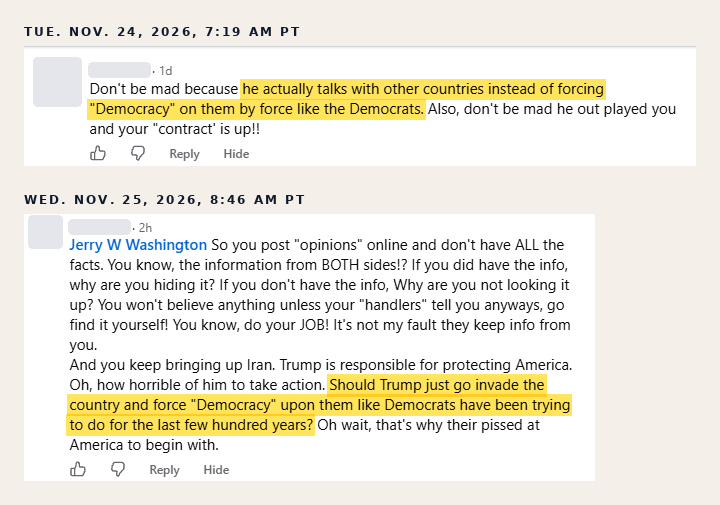
This week a reader answered one of my posts with a sentence that I had to deconstruct. He wrote it two ways.
Tuesday morning: “he actually talks with other countries instead of forcing ‘Democracy’ on them by force like the Democrats.”
Wednesday morning: “Should Trump just go invade the country and force ‘Democracy’ upon them like Democrats have been trying to do for the last few hundred years?”
I'm leaving his name off. The sentence is the subject, and it deserves a slow read. In the first chapter of my book, Ask for the Page, I called this the two-level reading: read a sentence at the level of words, then at the level of facts.
The level of words
Read alone, the Wednesday version asks a question that carries its own answer. “Just go invade” offers invasion as the only other choice, and an easy one. Talks, sanctions and deterrence drop out of the discussion.
Then the words collide. Democracy means a people choosing who governs them. “Force” aimed “upon them” points at the very people the word says should hold the power. Force can remove a ruler. It can't make a people choose.
The quotation marks try to slip out of that. If what gets forced isn't real democracy, the complaint is about a false label, and the sentence stops being about democracy.
“Like Democrats” hands a war to a party. Presidents order wars, Congress authorizes them, and both parties have done both.
“For the last few hundred years” outruns the record. The United States turned 250 this year.
The Tuesday version sets talking against force, one or the other, and says force twice. Repetition stands in for a reason. Put the two side by side and the structure shows. The charge against Democrats stays fixed while the defense of the president moves. On Tuesday he talks. On Wednesday, the reader writes, he is “responsible for protecting America.”
The level of facts
On Feb. 28, 2026, President Trump announced that the military had begun “major combat operations in Iran.” He told Iranians, “When we are finished, take over your government,” and promised that “the hour of your freedom is at hand” (AP via PBS).
Force aimed at a change of government, in freedom's name. By the reader's Tuesday terms, force instead of talks, that is forcing “Democracy.” The sentence describes the president it defends.
The reader added that forcing “Democracy” is “why their pissed at America to begin with.” The record behind that anger contradicts that statement. In August 1953, the CIA helped plan and carry out the coup that ousted Iran's elected prime minister, Mohammad Mossadegh. The agency formally acknowledged its role in documents released in 2013 (National Security Archive). The Shah ruled until the 1979 revolution (Al Jazeera). Eisenhower was president (Miller Center). That year, America helped remove an elected government.
War in freedom's name belongs to both parties. On April 2, 1917, Woodrow Wilson, a Democrat, asked Congress to declare war on Germany and told it, “The world must be made safe for democracy” (National Archives). On March 17, 2003, George W. Bush, a Republican, told Iraqis on the eve of war, “The day of your liberation is near” (Public Papers of the Presidents). Swap the party and the act stays the same. Only the word changes.
The two hard cases
A reader who knows history will answer with one word: Japan. Or Germany. Those are the hardest cases for my point, so here it is, pinned.
The pin: democracy is a people choosing who governs them, by free vote. No army can make that choice for them.
What it includes: force can defeat a regime, end a war, guard the polls and defend a result.
What it cannot be read to say: that democracy never follows a war, that force is never justified, or that the occupiers stood aside.
The question it hands you: whatever case someone offers, ask what the force did and who cast the votes.
In Japan, the occupation did the first part. On Feb. 13, 1946, General Douglas MacArthur's staff rejected the Japanese government's draft constitution and handed over their own (National Diet Library). Then Japanese voters, women among them for the first time, elected a new House of Representatives on April 10, 1946. That House amended the draft and passed it 421 to 8 on Aug. 24. The appointed House of Peers revised it again, the Privy Council approved it, and it was promulgated Nov. 3, 1946 (National Diet Library).
In West Germany, the military governors handed the state premiers the Frankfurt Documents on July 1, 1948, calling for a constituent assembly (bpb). Its 65 members came from the elected state parliaments. That Parliamentary Council adopted the Basic Law 53 to 12 on May 8, 1949 (bpb). The military governors approved it, and every state parliament except Bavaria's ratified it (State Department history). On Aug. 14, 1949, 78.5 percent of eligible West Germans voted for the first Bundestag (Federal Agency for Civic Education).
The occupiers did the first step in both countries, and they kept a hand in after it. Elected members still had to vote each constitution in, and both still govern. Anyone who says MacArthur imposed Japan's constitution is half right. The other half is the vote.
Open the 1946 record and the 1949 election yourself, and write down who cast the votes.
Force can guard a vote, and only a people can cast one. On Mondays I publish the next chapter of Ask for the Page, on Wednesdays a Field Guide and on Fridays the Binding, and sometimes I write a special edition like this one. Subscribe and the next one is in your inbox, free.
Lincoln's answer
Lincoln faced the question from the other side. On July 4, 1861, nearly three months into the war, he sent Congress his case for it. Americans now had to show the world, he wrote, that “ballots are the rightful and peaceful successors of bullets,” and that “when ballots have fairly and constitutionally decided, there can be no successful appeal back to bullets” (National Park Service). He used force to defend a vote that had already been cast.
Mississippi put its reason for leaving in writing: “Our position is thoroughly identified with the institution of slavery” (Avalon Project).
On Oct. 3, 1863, Lincoln set the last Thursday of November as a national day of thanksgiving, “in the midst of a civil war of unequaled magnitude and severity” (American Presidency Project). That Thursday was Nov. 26, 1863. The second November 26th.
The holiday, read twice
Thanksgiving draws its own fight every year, and each side keeps one row of the record. Read the school version fast: Pilgrims and Indians at one table. Then read the rows.
In 1614, an English captain, Thomas Hunt, kidnapped Tisquantum and other Wampanoag men and boys and sold them into slavery in Spain. When Tisquantum got home in 1619, an epidemic had killed nearly everyone in his village, Patuxet. Plymouth was built on Patuxet (Pilgrim Hall).
On March 22, 1621, Ousamequin, the Massasoit, made peace with Plymouth, and each side promised to defend the other. He wanted help against the Narragansett. The English had lost nearly half their number that winter, 50 of 102 (Library of Congress).
That December, Edward Winslow wrote the only eyewitness account of the harvest gathering that survives. Massasoit came “with some ninety men,” Winslow says, stayed three days, and his men killed five deer. Winslow never calls it a thanksgiving (Plimoth Patuxet).
In May 1637, English soldiers from Connecticut, with Narragansett and other Native allies, attacked the Pequot fort at Mystic, set it on fire and killed hundreds of people. Gov. John Winthrop's journal records a day of thanksgiving in all the churches on June 15, “for the victory obtained against the Pequods, and for other mercies,” and another on Oct. 12, “for our victories against the Pequods, and for the success of the assembly,” a church synod (Winthrop's Journal, pp. 220, 222 and 238).
Ratification was peaceable, and it left people out. When it divided seats in Congress, the Constitution counted “three fifths of all other Persons” and excluded “Indians not taxed” (National Archives). In 1790, the Seneca leaders Cornplanter, Half-Town and Great-Tree told Washington, “When your army entered the Country of the Six Nations, we called you the Town-destroyer” (Founders Online).
In 1841, Alexander Young printed Winslow's account with a footnote: “This was the first Thanksgiving, the harvest festival of New England” (Plimoth Patuxet). Lincoln's 1863 proclamation mentions no Pilgrims and no Native people.
In 1970, Wamsutta Frank James, Aquinnah Wampanoag, was asked to speak at the 350th anniversary of the Pilgrims' landing. Told his remarks were too inflammatory, he gave them on Cole's Hill in Plymouth instead, on Thanksgiving Day. Every Thanksgiving since, Native people and their supporters have gathered there for the National Day of Mourning (Pilgrim Hall). Its organizers, United American Indians of New England, call it “a day of remembrance and spiritual connection” (UAINE). Today's is the 57th. The Wampanoag are still here.
One camp keeps the feast and drops the war. The other keeps 1637 and calls it the origin, and a 2021 fact check found little evidence for that line (Snopes). Read every row.
What it meant in 2003
In March 2003 I was a staff sergeant with Marine Wing Support Squadron 371. We drove out of Kuwait and into Iraq in a war named Operation Iraqi Freedom.
In 2003, to me, democracy meant giving people a choice. To be frank, I really wasn't thinking about democracy as a concept at the time. I was thinking about giving the Iraqi people freedom. I really believed Saddam was doing something wrong, and that the Iraqi people needed to be liberated.
My thinking has developed since. I still believe democracy, and what we have built here in America, gives people the most freedom. I could be wrong about that, and it could use more thinking on my part.
What I can say with the record in hand is narrower. Freedom was the word on the operation. Choice is the word in the definition. Force can clear a road to the choice. The choosing belongs to the people who live there.
The dinner table
It was 1994, maybe 1995: my wife's and my first Thanksgiving in our new apartment. We had no furniture yet, almost nothing at all. Dinner went on a blanket on the ground. Our guests were fellow Marines who hadn't gone home for the holiday. Our car had broken down, so we walked to the local Ralphs, and I carried the turkey all the way home. But we were able to cook it, and we put together a very nice Thanksgiving dinner for my fellow Marines. I remember it very well.
Today, families will sit down together, and at some tables someone will say a sentence like the one in my comments. Here is the habit I'd hand you for that moment. It needs no speech and no fight.
Read the words. Check the facts. Swap the actor: if the other party did exactly this, what would you call it? Then ask one question, kindly: “Which is it?”
Try it on his sentence before you try it on a cousin.
Thanks
So here is my thanks, on the third November 26th.
Thanks for the vote. Three weeks ago, about 49 percent of eligible Americans voted. Only 2018 drew more in over a century, by the University of Florida Election Lab's estimate (Capital News Service via The Daily Record). The last midterm to top them both came in 1914. That year, the 19th Amendment was six years away, and the Voting Rights Act was 51 years away. This November, a far wider electorate settled who governs, by ballot.
And thanks to the reader whose sentence sent me back to a 1789 proclamation. Read your next ballot the way you read his sentence: the words first, then the record. Check your registration and your ballot at vote411.org.
The comments are the appendix: tell me where the record is wrong and I will show the page or fix the line. Paid subscriptions open at 500 readers, and the paid product is Coded Threads, the codebooks built from these comment sections. A pledge now is a vote for that.
Jerry W. Washington, Ed.D., is a Marine Corps veteran of twenty-three years, a combat engineer by trade, an instructor at UC Irvine's Division of Continuing Education, and the writer of What Time Binds, a record of how institutions bend words and how the page holds them to account.