


Looking back at my 2019 writing from LinkedIn below, it’s clear how earnest I was about living authentically. I insisted that language and meaning are fluid and that authenticity means constantly updating beliefs as contexts shift. As Rick Furtak observes, the ideal is “for a person to live truthfully, rather than…existing in a state of falsehood.”
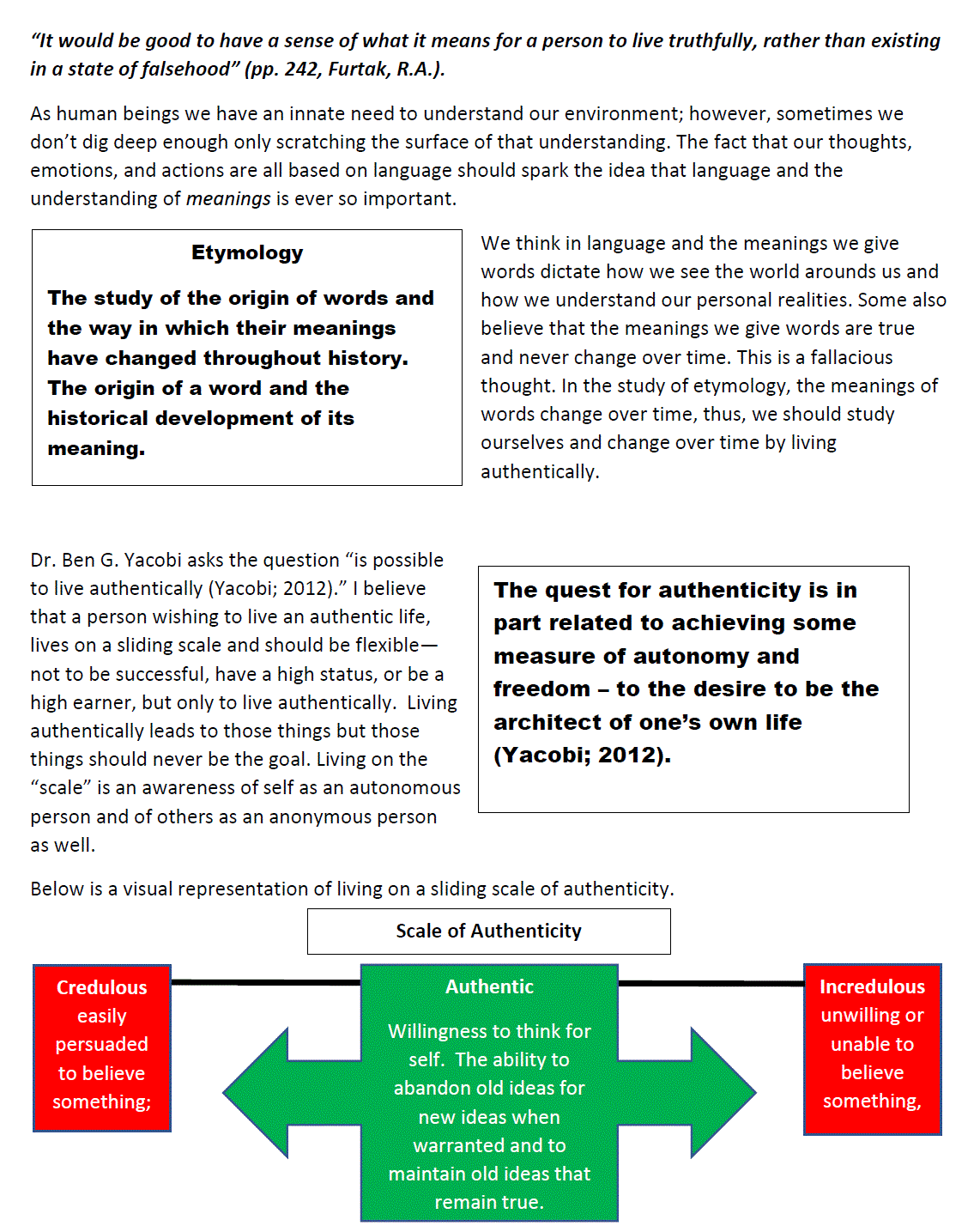
In other words, authenticity was framed as an individual virtue of belief‑updating. I noted that words compress centuries of trial and error into sentences and urged a kind of personal map‑checking against reality.
In 2019, this felt like a personal ethic – a pledge to lean away from both gullibility and reflexive skepticism. You could see Alfred Korzybski’s insight that “the map is not the territory,” treating new evidence as a cue to redraw one’s cognitive map, working in my thinking.
Underbuilt Assumptions
However, this early model glossed over key constraints. It assumes people have the leisure and safety to revise their maps, ignoring who actually has bandwidth to do that work.
In reality, scarcity and power shape cognition. For example, behavioral economists find that worrying about a $1,500 car repair can permanently cut performance on cognitive tests – effectively stealing roughly ten IQ points while the stress lasts. This “bandwidth tax” of poverty or overload can make even smart people oscillate between panic and denial.
Likewise, a recent neuroimaging study finds children in high-inequality U.S. states have thinner prefrontal cortices – “signs of stress etched into their neural tissue” – even controlling for family income. In effect, inequality behaves like a cognitive toxin, subtly rewiring brains for short-term survival rather than long-term planning.
My 2019 frame also underplayed incentives and networks that lock beliefs in place. The simple “credulous vs incredulous” axis misses how elites can exploit confirmation bias. Powerful actors often profit when the public stays willfully ignorant or outraged.
The modern media ecosystem amplifies this: our “global brain” rewards outrage over nuance. “Every smartphone…is a node in a larger system” where “a rumor born in one living room can reach millions of phones before a public health department has finished drafting a press release.”
Filter bubbles and “ghost maps” of conspiracy theories thus feel more engaging, while sober facts go unheard. Simply advising “be authentic” or “question everything” won’t cut through this architecture. It ignores that even educated people are subject to a “Neuro-Semantic Prison” of overwhelm, and that without scaffolding, our attention is prey to the loudest signals.
Adulthood of Humanity
A Systems View
By contrast, the Adulthood of Humanity (AoH) perspective treats authenticity as a civilizational design problem. In my AoH research, we can scale up from one nervous system to the whole system of minds and institutions. First, we treat words as fallible maps: our mental representations are always abstractions.
Learning scientists call the remedy epistemic cognition – teaching people to think about how they know what they know. In a mature society, schools and media would train us to ask “What’s the evidence?” as reflexively as we ask “What’s the time?”.
Second, AoH identifies structural supports. My chapter 4 argues that attention and time-binding capacity are critical infrastructure. Modest design changes – protected time to think, psychological safety for inquiry, reliable tools – are needed to treat each brain like a brain, not a zoo animal. For individuals, practices like “critical ignoring” help: deliberately tuning out low-value content exercises the mental muscle to guard our finite bandwidth.
On an institutional level, an “adult” civilization would extend our prefrontal cortex: imagine public libraries, parks, stable jobs, and truthful media treated as extensions of the brain, not luxuries. In short, authenticity becomes a public project: a culture of epistemic humility and media literacy, supported by policies that slow down short-term hustle.
From Slogans to Scaffolding
What I now see is that living truthfully is not a heroic individual choice but a collective design challenge. It demands “scaffolding” rather than slogans: curricula and rituals that reward fact-seeking, regulations that penalize disinformation, and safety nets that free up cognitive slack.
In AoH terms, we must grow Time-Binding Wealth – robust knowledge commons, education, and trust – instead of only chasing short-term gains. Only in that environment does “to thine own self be true” have real meaning.
In practice, this means less focus on personal virtue-signaling and more on building an epistemic infrastructure: fewer viral mantras about authenticity, and more budgets for libraries, cognitive science, and reliable data.
That is what living truthfully looks like in a complex world – not just clarity of intention, but a clear path to collective understanding.