

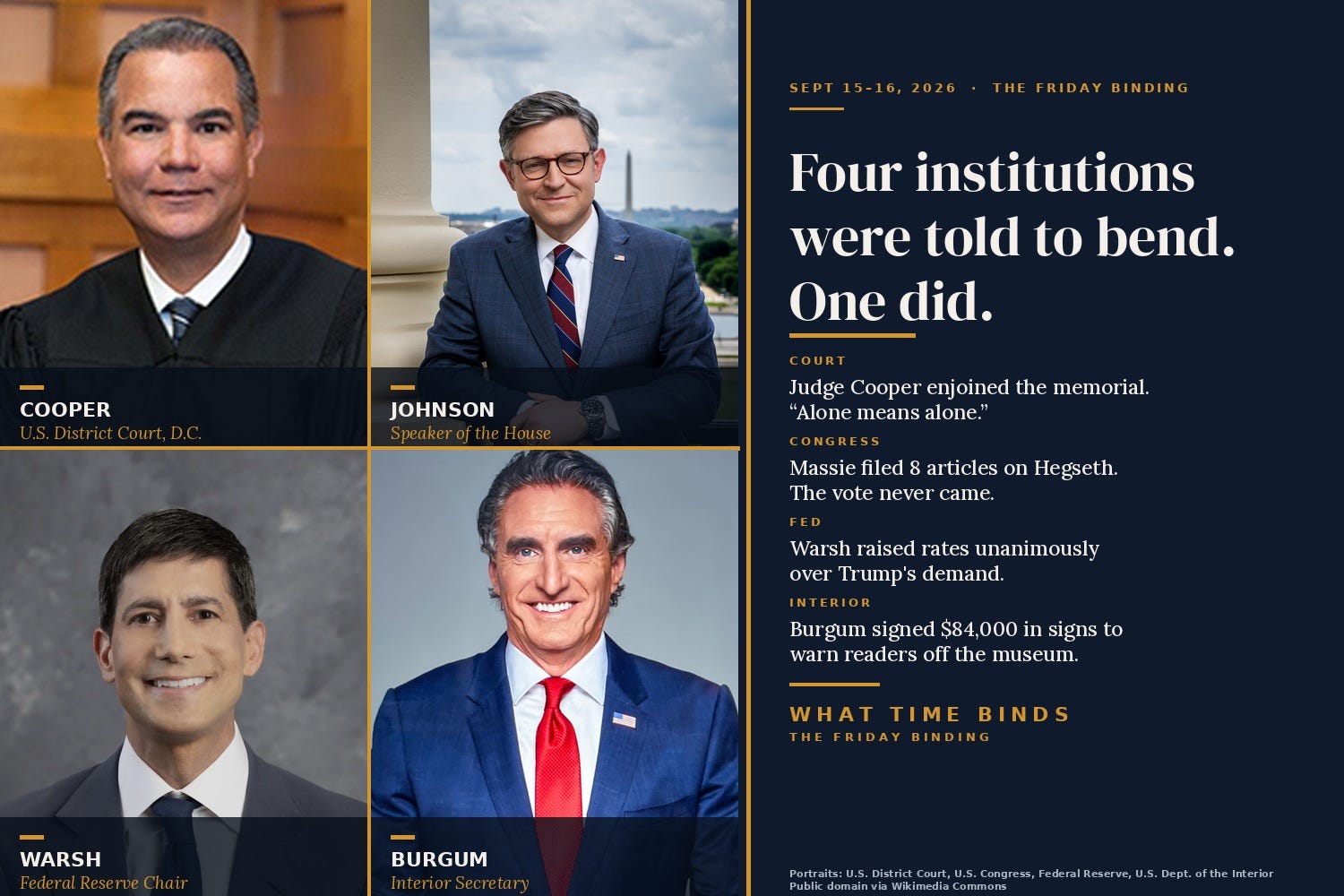
Between Monday, September 14th and Wednesday the 16th, four American institutions were told what to do by the executive branch. Three of them opened the rulebook and answered from it. One of them had its rulebook rewritten in silence and answered from a memo.
That is the week.
Here are the picks that helped me understand the pattern. Four Substack peers on four separate beats, and one primary source with the letter and the dollar figure the reporting rests on. A bonus read sits at the end, a contrarian claim about the Fed I want you to think about before you cheer.
The throughline question the picks share: whose charter got read, and whose got rewritten.
This week’s picks
1. Tim Miller, Jonathan V. Last, and Andrew Egger, “Thomas Massie Has a Nasty Surprise for Pete Hegseth.” The Bulwark, September 15, 2026.

The subhead is four words. Good show, long show. That is Miller, Last, and Egger telling their subscribers to sit down.
Massie had just filed eight articles of impeachment against Pete Hegseth. He walked to the floor of the House with a 34-page resolution and read it aloud. It took him over an hour.
The charges are specific enough that they cannot be waved off. Initiating an armed conflict with Iran without a declaration of war. Defying the war powers resolution Congress passed on the same conflict in June. Retaliating against Sen. Mark Kelly for reminding service members of their standing right to refuse an unlawful order.
When Order Becomes Oracle

Six months ago I wrote that the word ORDER was doing something dangerous inside the U.S. military. That the meaning regime behind it had shifted. That the standard channels for surfacing that shift (JAG, Inspector General, chaplaincy, the whistleblower protections in
Degrading the legal review process that governs strikes. Civilian casualties incurred under that degraded process. My own record on what the same degraded process cost U.S. service members is in Version Control Round Four.

The next day the House recessed early for the election. The vote never came.
The Pentagon’s response arrived through press secretary Kingsley Wilson, who called Hegseth “a transformative leader for the Department of War.” I had to read that again and you should too. The Department is not called the Department of War in statute. It is called the Department of Defense. The renaming is a memo. The compliment sits on top of it.
Massie is a Republican. He lost his primary this year to a Trump-backed challenger. He filed the paper anyway, and he read it into the record so nobody could pretend he had not. That is impeachment at its founding purpose. Federalist 65, Hamilton, 1788: a “national inquest into the conduct of public men.” One member reads the conduct into the record. The rest of the House then decides whether it will meet the inquest or run out the clock.
It ran out the clock.
Read the Bulwark team for the news and TVG’s Daily Brief on the 17th for the detail on the hour Massie spent reading. Monday I pull the comment thread from my Wednesday post on this and read it against what has moved since — the Thursday cancel, the war powers vote, and whatever Massie does when the House returns.
The mechanism is the one I know from my time in the Marines: a battalion cannot move without written orders. A Cabinet department did.
2. Joyce Vance, “Another Loss for Trump: The Kennedy Center.” Civil Discourse, September 17, 2026.

Vance was a U.S. Attorney for the Northern District of Alabama for seven years. When a former U.S. Attorney writes on how a federal court order lands on the litigant it was written for, that is a reader you subscribe to.
On September 16, Judge Christopher Cooper of the U.S. District Court for D.C. blocked Donald Trump from adding his name to the Kennedy Center facade. Vance pulls the ruling’s core sentence for her subscribers: “Linguistic gymnastics cannot extricate the Kennedy Center’s Board from an operative judicial order or the governing statute it was designed to enforce.” Six words earlier in the same opinion: “Alone means alone.”
The name on the building is set by statute. Congress named it for Kennedy. A federal judge read the statute back to the White House.
The response arrived within hours. The Kennedy Center board, which the President reshaped, voted to close the venue for two years. Trump told the press that same day that the Kennedy Center is “destined to doom.” Vance quotes the second half of that same statement, the part that gives up the game: “For me to go and fix it and subsidize it, I think the Trump administration should have recognition.”
The judge did not rule on renovation. The judge ruled on the memorial. The retaliation is the closure. The tell is the demand for the name.
Cooper then ordered the administration to explain the closure plan and required 30 days notice before any demolition. The court has not run out of orders. The administration has to explain why closing the building is not a workaround.
Read Vance for a former prosecutor’s read on how a judge lands the check on a specific litigant. Read Scott Galenti at UnPresidented for the ruling’s own language quoted in full.

The paper is in both.
3. Heather Cox Richardson, “September 16, 2026.” Letters from an American, September 16, 2026.

HCR is the one Substack writer whose daily practice most resembles a Friday Binding. Every night she binds the day’s news to the record. On September 16, she bound three of the four institutions in this piece into one post.
The Kennedy Center opens her essay. The Iran war costs run through the middle. The Fed rate hike closes. Between them she cites the CBO estimate that the Iran conflict cost about $38 billion through August 2026, roughly $2 billion a month. She names Kevin Warsh’s unanimous vote to raise rates over Trump’s public demand for one percent or less.
The passage in her post that carries the most weight is the leaked photo. A service member sent CBS News photos of what an active-duty member called “major damage to our bases that hasn’t been communicated to the American public.” HCR reads that line into her essay the way an editor reads a source into a paper of record. That is the move I want you to notice.
The reader gets three institutional stories in one place, cited to primary sources, in the voice of a historian who is not asking for your feelings. Read her for the pattern legible in one day. Read her whether you are a paying subscriber or not. The essay is free at the point of reading. That is her practice.
4. Jermaine Fowler, “The Put a Warning Sign Outside the Smithsonian.” The Humanity Archive, July 25, 2026.

Fowler wrote his piece seven weeks before Interior Secretary Doug Burgum sent his September 3 letter to senators. Read that sentence again. A Substack writer named the mechanism, in July, that a Cabinet officer would build in September.
His historical anchor is the closest available. Philadelphia’s President’s House site once carried a panel titled “The Dirty Business of Slavery” that told the story of nine people enslaved by George Washington on that ground, including Oney Judge and Hercules. That panel was replaced overnight with a panel titled “Celebrating Independence Throughout the Years.” The names of the nine enslaved people remain etched in the granite wall of the site itself. The record is in the stone. The sign in front of the stone got rewritten.
The mechanism Fowler names is the one Burgum is now running. When the executive has no direct authority to remove an exhibit — the Smithsonian is a trust of Congress, chartered in 1846 — the sign in front becomes the workaround. Twelve signs at seven thousand dollars each. Eighty-four thousand in taxpayer money to warn visitors against the museum’s own director.
Fowler puts it in one sentence I have not stopped thinking about. The museum added context to a national story. The addition of context became the accusation.
That is the mechanism in the Smithsonian case, in Philadelphia in the years before it, and in every school board that has voted to remove a book because it made the room too honest.
Read Fowler for the anchor. Read him because a Black historian writing on Substack held the record on this fight before the Cabinet officer sent the letter. Read him because you paid for the signs.
5. NPR, “Trump administration plans ideological warning signs for Smithsonian.” September 16, 2026.
The primary paper of the week. Read this fifth, after Fowler, and the two together tell you what the letter is and where you stand.
The reporting names the officials. Doug Burgum, Interior Secretary, wrote the September 3 letter to senators. Anthea Hartig is the director of the National Museum of American History whose 2025 statement that history is “a prime tool of social justice” is the operative accusation. Lonnie Bunch, Smithsonian Secretary, announced his retirement on September 8. The executive order underneath the letter is 14253, “Restoring Trust in the Smithsonian Institution,” signed in July 2026.
The reporting names the money. Twelve signs, roughly seven thousand dollars each, roughly $84,000 in taxpayer funds. Small money for the federal budget. Enough money to say the thing plainly.
The reporting names the pushback. Sen. Jeff Merkley, Democrat of Oregon, called the move “another step in a well-planned pressure campaign” and said he will “fight like hell to protect the Smithsonian’s independence.” Sen. Lisa Murkowski, Republican of Alaska, is on record against.
Notice one thing about the writing on this story across coverage. Nowhere in the NPR piece, or in the Washington Post’s parallel report, does the exact language of the twelve signs appear. The signs have been ordered. The wording has not been finalized. That is the mechanism operating in real time. The signs will say what the signs need to say to land the message. The letter is not the finished product. The letter is the go order.
Read this one last. This is the paper the argument rests on.
The small install: ask which rulebook
Three steps. It takes about a minute and it tells you what your institution actually thinks it is.
Name the standing rule. Pick an institution you have skin in. Your kid’s school district, your union local, your city council, the Fed you retired from, the museum you volunteer at. Find the one sentence in its charter or its published mission that says what it exists to do. Write it down.
Find the memo that changed it. Look for a recent policy update, a board resolution, a new “standards” document, or a letter from an executive above the institution. Read for the one sentence that appears to correct or reframe the standing rule.
Ask who signed the memo. Not who announced it. Who signed the piece of paper. If the paper is unsigned, that is a fact about the mechanism.
Landing
Four institutions this week. One judge, one Republican congressman, one Fed chair, one Interior Secretary. Four charters — the Kennedy Center statute (1958), the standing right of Congress to declare war (Constitution, Article I, Section 8), the Federal Reserve Act (1913), the Smithsonian charter (Act of Congress, 1846). The oldest of the four is the museum. The newest is 1958.
Three of the four had their rules met on September 15 or September 16. Cooper read the statute back to the White House and enjoined the memorial. Massie read the impeachment articles into the record and left the vote for his party to duck. Warsh voted unanimously with a Fed board Trump has been reshaping for eight months. The reading was public in each case. The paper is in each case.
The fourth had the rule rewritten. Burgum’s letter changes what the National Museum of American History is by directing the signs in front of it to say something the museum’s own leadership did not write. That is what makes it the outlier in the week. The other three institutions were told to bend. This one had its charter re-read from outside the door.
I want to name what all four have in common. They are the institutions the founders and the Congresses that came after them built to check the executive. Article III courts. The impeachment power. An independent central bank. A public trust for the national memory. Every one of them was designed to hold when the person in the top office wants a different answer than the record produces. Every one of them held or is being tested this week.
The pattern is that four institutions were tested inside 48 hours, and the news reported them separately because that is how the beat is organized. Read them together and the week has a shape. That shape is what a Friday Binding is for.
I refuse to know one story a day. The record produces four at a time. I refuse to forget any of them.
Read the ballot the way you would read the letter Burgum signed. Every race, every proposition. Vote. vote411.org
A question for the comments
Which of your own institutions had its charter rewritten in silence this year? Name the standing rule, the memo, and the person who signed the memo. That is the codebook.
One more
The five picks above name a pattern. Three institutions read the rulebook. One got the rulebook rewritten by memo. Before you settle in on that reading, hold a claim that pushes on it.

Flextiger, writing on September 17, argues the Fed’s quarter-point hike is not an institution holding against the President. It is coordination. Warsh built credibility with the hike so he can deliver larger cuts in 2027 when AI-driven deleveraging hits employment. Trump’s public demand for one percent, in that read, is a signal aimed at trade partners, not at the Fed itself.
I am not sure Flextiger is right. The unanimous vote, the timing, and Warsh’s own statement that the Fed “cannot affect any individual price, whether it be oil prices, or foodstuffs” all read to me as an institution defending its ground.
I include the piece because “the institution held” is the reading I want most, and the reading I want most is the one I have to check hardest. Read Flextiger against HCR. If the hike is coordination, the pattern in this Binding is stronger than I claimed, not weaker. Three institutions holding lets one get rewritten with less notice.
I will keep reading.
Author’s note. The comments are the appendix: tell me where the record is wrong, and I will show the page or fix the line. Paid subscriptions open at 500 readers, and the paid product is Coded Threads, the codebooks built from these comment sections. A pledge now is a vote for that.
You refuse to know. The record remembers. I refuse to forget.
— JWW
Jerry W. Washington, Ed.D., is a Marine Corps veteran of twenty-three years, a combat engineer by trade, an instructor at UC Irvine’s Division of Continuing Education, and the writer of What Time Binds, a record of how institutions bend words and how the page holds them to account.
I advise school districts, community colleges, and workforce teams on AI readiness: what the words mean before the tools arrive. Hit reply if you would like to talk.