


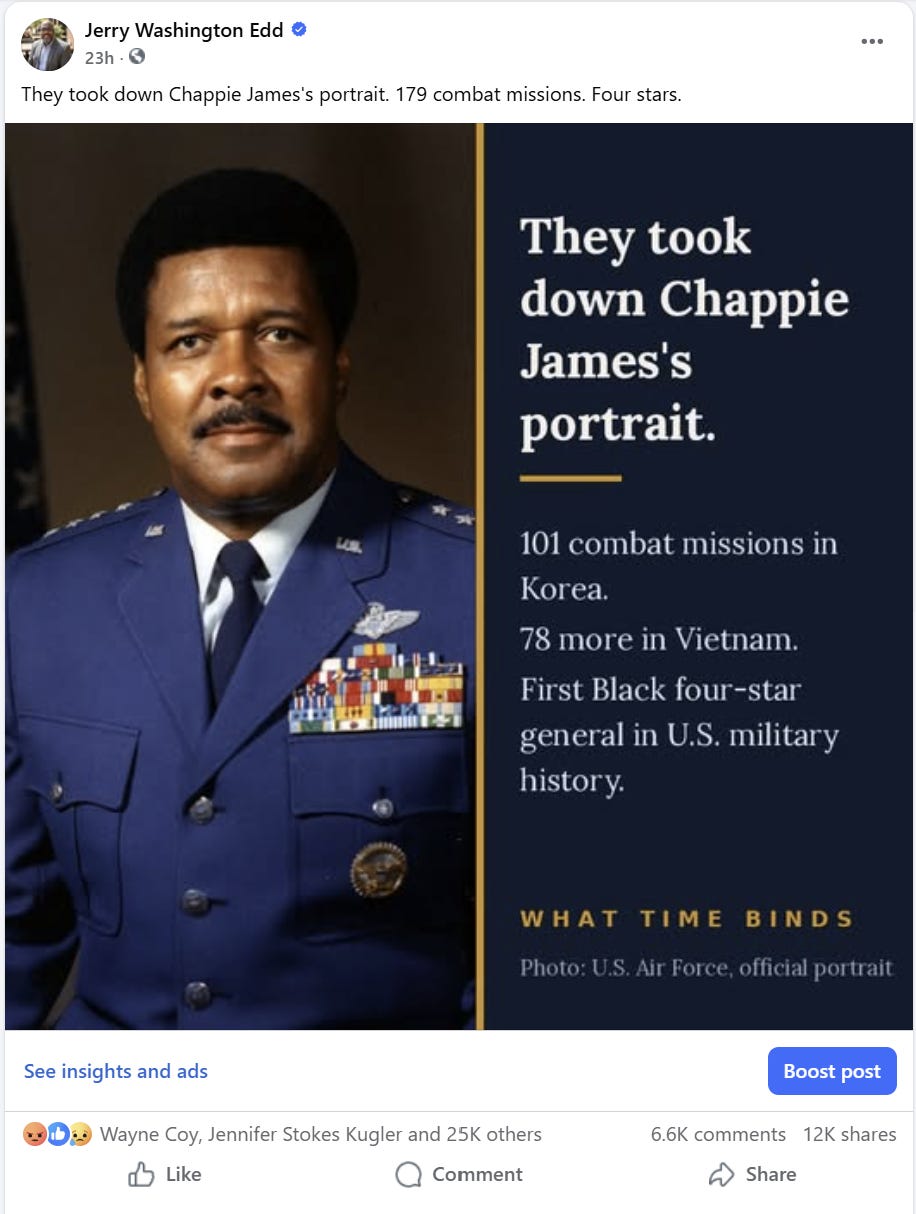
Wednesday night, I read Clint Smith’s new piece in The Atlantic, “The Betrayal of Black Patriots.” I took notes. I built a simple image: General Daniel “Chappie” James Jr. in his dress uniform, four stars on each shoulder, next to three facts: 101 combat missions in Korea. 78 more in Vietnam. First Black four-star general in U.S. military history. I posted it with one line about his portrait coming down at the Pentagon, and I went to bed.
I woke up to a fire that burned all day.
As of last night, the post sits at more than 25,000 reactions, 6,600 comments, and 12,000 shares. I spent twenty years hearing people ask why Facebook collects our data. Thursday I watched the answer scroll past in real time. One image of a Black general produced a complete behavioral inventory of how Americans process a contested fact: who verifies, who denies, who testifies, who deflects, who grieves, who asks the machine to settle it. Facebook doesn’t need to survey us. We file the reports ourselves, time-stamped, under our own names.
I have a different use for the same data.
Coding the thread
Reading 6,600 comments felt like being back in my dissertation, coding interview transcripts at the kitchen table. Qualitative researchers call the method thematic analysis: read everything, tag recurring patterns, name the themes, test them against the data (Braun & Clarke, 2006). I didn’t plan to code my own comment section, but it insisted.
Four themes carried the thread.
Theme one: the witnesses showed up
The most remarkable pattern was the men and women who knew him.
Rich Walling served under James at the 33rd Tactical Fighter Wing at Eglin in 1968. Leo Morrison was at Ubon Air Base the day of the MiG shootdowns. Scott Batz was the avionics mechanic on James’s F-106, tail number 59165, when James commanded Air Defense Command in 1976. Victor Von Stuben’s father shot pool with him in Libya in 1970. David Stroffolino’s grandfather served as his executive officer there. Dianne Thorp’s first-grade daughter shared a hospital floor with the general at the Air Force Academy; he visited the child’s room, more than once, to keep her company. John Kirksey has an autographed photo James gave his grandfather. Detria Mitchell’s great-aunt was his Tuskegee classmate. Dwayne Brown did his first book report on him. William Bonney holds a typewritten letter from James granting his father permission to marry his mother (I’d love to read that letter).
Nobody organized this. Several dozen primary sources show up in the comment thread and corroborated a man’s standing, unprompted, in public, over twelve hours. Archives spend decades assembling what that thread assembled in a day. This is the part Facebook’s data models can’t price: testimony.
Theme two: the cover-story machine
The second pattern ran in the opposite direction. The same physical fact, one painting removed from one wall, drew a rotating set of explanations from commenters who had read none of the reporting. It didn’t happen. It was relocated. It was relocated due to renovations. It was taken down for cleaning and preservation. It was actually a rusted T-33 airframe in Cape Cod in 2018. Portraits rotate all the time. They were painting the wall.
I counted six variants by midnight. By the time this is published, there will be more.
None of them match what the Pentagon’s own spokesman said. Acting press secretary Joel Valdez told the Atlantic that the Air Force “added” a James portrait to a “different location” in the “past two to three weeks,” after reporters started asking. That statement confirms the removal in the act of minimizing it. Every cover story in my thread had to route around the Pentagon’s own words, and every one of them did.
Political scientists Brendan Nyhan and Jason Reifler documented this mechanism fifteen years ago in a peer-reviewed study, “When Corrections Fail: The Persistence of Political Misperceptions” (Political Behavior, 2010). In their experiments, factual corrections frequently failed to change the minds of ideologically committed subjects. In several cases the correction backfired: subjects generated counterarguments and held the misperception more firmly than before. My thread ran the experiment at scale, free of charge. Each refutation produced a new variant tuned to survive the last one. The correction arrived every time. It just didn’t land.
One commenter gave the game away without meaning to. Defending the administration’s anti-DEI purge, he wrote that James “most likely got his stars by merit, because we didn’t have the stupidity of DEI, in the military, back then.” Read that twice. By his own logic, the Pentagon removed the portrait of a pre-DEI, merit-promoted, four-star combat pilot as part of a purge of DEI. The defense concedes the indictment.
Theme three: the word doing the sorting
Which brings me to “merit,” the word that worked harder than any commenter.
Defense Secretary Pete Hegseth wrote in his 2024 book that “Our strength is not in our diversity.” His Pentagon says every personnel change rests on merit and job performance. Senator Jack Reed testified that nearly 60 percent of the senior officers Hegseth has fired are female or Black, in a force where women and minorities make up under 20 percent of generals and admirals. The same Pentagon removed General Mark Milley’s portrait, scrubbed Jackie Robinson’s Army service page from the DOD website until public outrage forced it back, and reinstalled the 20-foot Robert E. Lee portrait at West Point, the one that shows an enslaved man guiding his horse.
In my thread, the word split cleanly along the line it was built to draw. One commenter wrote that “honoring him just because of his skin color belittled his accomplishments.” Another asserted the portrait “was up purely because he was black.” For these readers, a Black general’s recognition is suspect by default and the suspicion requires no evidence; the skin does the arguing. Adam Serwer named this pattern in the Atlantic when Hegseth claimed Black troops would be promoted on race alone: confession by accusation. The people who insist that recognition tracks color are describing their own sorting rule and then attributing it to everyone else.
James answered the question in 1975, when people asked whether his fourth star was a bicentennial gift: “They didn’t give me anything... You got to earn them.”
Theme four: asking the machine
A fourth pattern is newer, and it belongs in this newsletter’s beat. At least five commenters tried to settle the dispute by quoting an AI assistant. One pasted a Copilot summary claiming no portrait came down, only the Cape Cod T-33 in 2018. Another reported that Brave’s AI said no while Chrome’s said yes, and admitted the contradiction confused him. A third quoted Google’s answer about an aircraft at Otis. One simply wrote: “lets ai it then.”
The machines were stale. Their training data predates the July 2026 Atlantic issue, so they reached for the nearest matching event in their memory and presented it with full confidence. The commenters then deployed that confidence as adjudication. Watch this pattern closely, because it will grow: yesterday’s training data, delivered in tomorrow’s authoritative tone, recirculated as proof that today’s news didn’t happen. (I wrote a book about this in 2023: Simulated Realities.)
This week’s picks
1. Clint Smith, “The Betrayal of Black Patriots.” The Atlantic, July 2026. The source. Smith interviewed two dozen current and retired Black service members across the armed forces. Colonel Gerald Curry, who retired rather than oversee the removal of books from Air Force libraries. Brigadier General Jimmy McMillian, who mentored Black officers for thirty years and now watches the pipeline he built get dismantled. The portrait removal appears in the fourth paragraph, and the Pentagon’s own press secretary confirms it inside the piece while trying to minimize it. Read it before you read anything else on this list.
theatlantic.com/magazine/2026/07/black-military-patriots-hegseth/687306
2. Nyhan, B., & Reifler, J. (2010). “When Corrections Fail: The Persistence of Political Misperceptions.” Political Behavior, 32(2), 303–330. The empirical anchor. In controlled experiments, factual corrections frequently failed to change the minds of ideologically committed subjects. In several conditions the correction backfired: subjects generated counterarguments and held the misperception more firmly than before. Fifteen years later, my comment thread ran the replication at scale. Eight cover stories, each one tuned to survive the refutation of the last, all routing around the Pentagon’s own confirming statement. The corrections arrived every time. They didn’t land. Nyhan and Reifler explain why, and the explanation has nothing to do with intelligence and everything to do with what a fact threatens.
link.springer.com/article/10.1007/s11109-010-9112-2
3. Shari Dunn, “Being Black in Pete Hegseth’s Military.” sharidunn.substack.com, June 11, 2026. The family ledger. Dunn opens with her Uncle Daniel Staples, who came home from World War II and waited on the boat until every white soldier had disembarked, then was ordered to walk around the hero’s arch instead of through it. She takes Smith’s reporting and runs it backward through her own family’s record, showing what the desegregated military meant to Black families when the private sector offered nothing comparable. Her piece published the same day my thread caught fire. Different doors, same building.

4. Garrett Graff, “The Mythology of Pete Hegseth.” Doomsday Scenario, April 2, 2026. The year-long record. Graff, a historian and Pulitzer finalist, has documented the remaking of military leadership since early 2025, and his April piece assembles the full pattern: the firings, the blocked promotions, the scrubbed pages. The arithmetic he forces you to sit with is this. The Joint Chiefs of Staff today are all white and all male. The force they lead is 20 percent female and 43 percent people of color. That gap is a policy outcome, and Graff names the policy.
https://www.doomsdayscenario.co/p/the-mythology-of-pete-hegseth
5. Adam Serwer, “Pete Hegseth Is Trying to Resegregate the Military.” The Atlantic, April 2026. Paired with NBC News reporting on the removal of panels honoring Black WWII soldiers at an American cemetery in the Netherlands. The pattern named, at home and abroad. Serwer supplies the sharpest three words in this whole story. When Hegseth claimed Black troops would be promoted on race alone under General CQ Brown, Serwer called it confession by accusation: the people who insist recognition tracks color are describing their own sorting rule, then attributing it to everyone else. The NBC piece extends the purge past our borders, where Dutch families who tend American graves protested the removal of panels honoring Black soldiers buried in their soil. A commenter in my own thread, Rens Metaal, supplied that link unprompted. The thread sourced itself.
Landing back on the thread
One more comment stayed with me. Derek Lamson wrote: “Save your notes, people, save your receipts. It may well come down to us to be the ones to have the records.”
That sentence is this newsletter’s whole reason for existing. Alfred Korzybski called our species the time-binding class of life: we survive by passing the record forward, generation to generation, so the next group starts where the last one stood. That’s where this Substack gets its name: What Time Binds. A portrait on a Pentagon wall is time-binding. So is a typewritten letter from a general giving an airman permission to marry. So is a comment thread where the men who serviced his aircraft type his tail number from memory, fifty years on.
Facebook saved Thursday’s thread because engagement predicts revenue. Derek asked us to save it for a different reason.
The general said his piece in 1967, in the days after Dr. King was killed, to a room of Air Force officers. The words are carved on his tombstone at Arlington now:
“This is my country, and I believe in her. And I’ll serve her, and I’ll contribute to her welfare whenever and however I can. If she has any ills, I’ll stand by her until in God’s given time, through her wisdom and her consideration for the welfare of the entire nation, she will put them right.”
They took the painting off the wall. The record is ours to keep and to pass forward.
Also cited: Braun, V., & Clarke, V. (2006). Using thematic analysis in psychology. Qualitative Research in Psychology, 3(2), 77–101.
—
Jerry W. Washington, Ed.D., is a retired Marine Corps Master Sergeant (23 years, Combat Engineer), USC Rossier doctoral graduate, and Instructor at UCI Division of Continuing Education. He writes about meaning under pressure at What Time Binds.
You know Theme 3 got me fired up, right?! And honestly not surprised, the word "merit" doing that kind of work in a comment thread is the same thing I have watched happen inside institutions for years. No definition needed, no accountability required; the sorting just happens, quietly, under a term that sounds neutral enough that nobody has to defend it. And the people who feel it most are rarely the ones in the room when the standard gets set. What is powerful and kind of wild about this piece is that it made all of that visible in real time, timestamped, under people's real names, across four distinct patterns that are worth unpacking carefully. The cover story machine named in Theme 2 and the merit sorting in Theme 3 are not two separate things. They are the same move running on two tracks, one rewrites the fact, the other rewrites the person, and the standard that was never examined stays exactly where it was. And then Theme 4 with the AI piece, that one deserves its own conversation, sheesh!