

The Friday Binding · October 2, 2026
On Wednesday, an assistant secretary at the Pentagon signed a one-page letter to Sen. Elissa Slotkin of Michigan. In the third paragraph he cited a federal law that dates to 1865.
That law makes it a crime for a federal officer to bring “troops or armed men” to any place where an election is held. The letter says the Department of War operates “in strict compliance” with it.
The letter is the newest page in a record that runs back to February. My Sunday post about the “final battle” ad drew 71 comments. My readers asked about money, about the networks, and about November. This Binding takes the November question, because I can answer that one with what is on the record.
Here is the question the five picks below share: thirty-two days out, who has put it in writing that armed federal agents will stay away from your polling place, and which page binds them?
Four of these pages come from the executive branch, which answers to the President. One comes from Congress, and it is the oldest. I read each one with the two-level reading from Monday’s chapter: what the page says, set beside what it binds anyone to do.
A promise about November is only as strong as its verb, and only one of these pages carries a verb with a penalty attached.
Every Monday I take one word an institution bent and show the page it bent on.
Every Wednesday the What Do You Mean? Field Guide pins down one word from the news, and every Friday the Binding ties the week’s pages together.
Most days I also post the record on my Facebook page, where readers argue it out in the comments and the best threads become the next essay. The biggest of those threads I code comment by comment into Coded Threads: a workbook and a short memo that sort every comment by the argument it makes, count how often each argument shows up, and get checked by a second coder. It is built for teachers, researchers, reporters and organizers who need to know how real people argue about a public word, so a lesson, a study or a story can start from the evidence.
Coded Threads becomes the paid tier when What Time Binds reaches 500 subscribers. Subscribe and the Monday, Wednesday and Friday pieces arrive in your inbox, free.
This week’s picks
1. Assistant Secretary of War Mark Ditlevson, letter to Sen. Elissa Slotkin, September 30, 2026.
Slotkin wrote to Secretary Pete Hegseth and Gen. Dan Caine on Aug. 18. She asked both men to confirm in writing that the military will stay out of the midterms.
Caine, the chairman of the Joint Chiefs, answered on Aug. 28: “The Joint Force has no plans to send Federal military personnel or Federalized members of the National Guard to polling places during the 2026 elections.” He added a sentence you should save somewhere: “I have neither received nor anticipate receiving any unlawful order concerning the role of the Joint Force in the upcoming November 2026 midterm elections.”
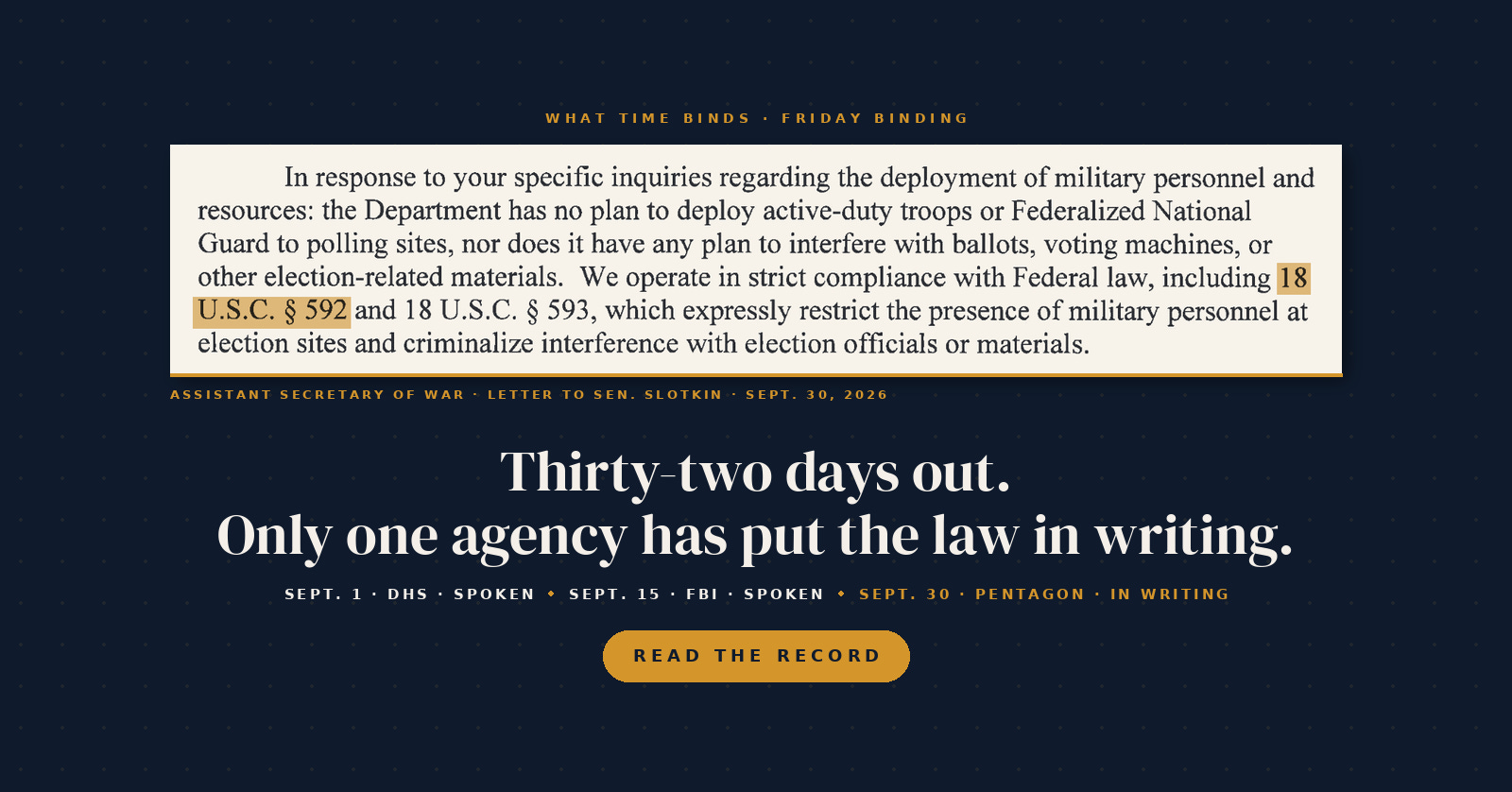
The department’s answer came 43 days after her letter. Mark Ditlevson signed it as Assistant Secretary of War for Homeland Defense and Americas Security Affairs. The core sentence: “the Department has no plan to deploy active-duty troops or Federalized National Guard to polling sites, nor does it have any plan to interfere with ballots, voting machines, or other election-related materials.”
The next sentence matters even more. “We operate in strict compliance with Federal law, including 18 U.S.C. § 592 and 18 U.S.C. § 593, which expressly restrict the presence of military personnel at election sites and criminalize interference with election officials or materials.”
Then the letter looks ahead, to the day another agency asks the Pentagon for help. Any such support “will be in strict compliance with the law and will not interfere with the voting process or create the perception of military involvement in the administration of elections.”
Read the letter before you read the press release about it. Slotkin’s office ended its headline with “Hegseth Silence Continues.” That holds in one narrow sense: the Secretary did not sign it. The letter itself says more than Secretary Mark Esper said when Slotkin put a similar question to him in 2020. Asked in writing whether he would refuse an order to send active-duty troops to polling places, Esper answered: “The U.S. military has acted, and will continue to act, in accordance with the Constitution and the law.” Slotkin said then that a question this serious deserved a response “in a declarative way.” This week’s letter is declarative, and it names the statute.
A correction from me. On Monday, in a Substack Note and in a comment under the “final battle” post, I quoted her office’s Sept. 2 statement that Hegseth “has yet to respond.” On Wednesday the department responded. This letter is the newer record, and it goes on the page beside the old one.
See for yourself. Open the letter. Find the third paragraph. Count the sections of law it names.
2. Pete Hegseth, “Countering Foreign Threats to 2026 Elections.” Secretary of War memorandum, signed September 22, released September 28, 2026.
This is the page the Secretary did sign. It runs one page and goes to four offices: U.S. Cyber Command, the National Security Agency, the Defense Intelligence Agency and the National Geospatial-Intelligence Agency.
Every directive in it carries the word foreign. Cyber Command is to “use its existing authorities, capabilities, and competencies in coordination with the Department of Homeland Security, to counter potential cyber threats from foreign actors.” The department “will do its part in supporting this whole of government effort.” The memo names one partner, Homeland Security. The words “state,” “local” and “county” never appear.
This is old and lawful work. The NSA and Cyber Command first stood up an election security group in 2018, then called the Russia Small Group, and brought it back for 2024.
The rest of the release reads heavier than the memo. It says the memo directs the department “to mobilize a comprehensive, whole-of-government defense of our election infrastructure from foreign adversaries.” Spokesman Sean Parnell goes even further: “By working in lockstep with federal, state, and local partners, U.S. Cyber Command and our defense intelligence teams will defend the integrity of America’s voting systems.”
State and local officials run America’s voting systems. The memo the Secretary signed does not mention them. The release added them.
Read the memo for what it orders and the release for what it claims. The order points outward, at foreign actors, and nothing in it reaches a polling place. That is how it should read. The answer to the question Slotkin asked, about troops at the polls, came from a different desk: the office that handles homeland defense, in pick one.
3. Homeland Security, on three dates: February 25, June 2 and September 1, 2026.
Homeland Security runs ICE. Its agents carry guns and work inside the country, which puts this department closer to the polling-place question than any office in the Pentagon. Its record comes in three dates.
February 25. Heather Honey, the Homeland Security official in charge of election integrity, spoke on a call with state election officials. NPR reported her words: “There will be no ICE presence at polling locations.” And: “Any suggestion that ICE is going to be present at polling places is simply disinformation.”
June 2. Primary day in California. At 8:15 a.m., ICE vehicles pulled into the parking lot of the vote center at the Rancho Simi Recreation and Park District Activity Center in Simi Valley. The Ventura County Star reported that the agents stayed about 30 minutes and did not enter the voting area. Simi Valley police said they had no advance notice. Homeland Security said: “For operational security reasons, we are not going to confirm the locations of our officers.” Nothing in the record says why they were there, and I will not guess.
September 1. Secretary Markwayne Mullin, at a news conference in New York: “ICE isn’t there to patrol the polling places. We’re there to enforce specific threats.” Then: “The only reason why we would be at polling places is if there is a threat to that polling place or we’re serving a warrant on someone that we have been actively tracking down.”
In 188 days the department’s promise moved from “no presence” to “only if.” Both came from the same department, six months apart. The second carries two exceptions the first did not.
Slotkin put the same question to Mullin in writing on Sept. 2. As of Oct. 1, her office says he has not answered.
See for yourself. Write the three dates on one line. Put the department’s words beside each date. Then read the line left to right.
4. FBI Director Kash Patel, testimony to the Senate Judiciary Committee, September 15, 2026.
The FBI also puts armed agents to work inside the country. Slotkin wrote to Patel, and to Attorney General Todd Blanche above him, on Sept. 2. Her office says neither has answered.
Patel did speak to the question in public, before that committee on Sept. 15. Sen. Richard Blumenthal of Connecticut asked him to commit that FBI agents would stay away from the polls in November. Talking Points Memo and Democracy Docket both reported this answer: “I don’t know that we can’t legally do it.”
He said more in the same hearing, and it belongs on this page too. “The FBI will follow the law. If there’s a reason to go there, because there’s been a violation of law, we will, otherwise we won’t.” Asked by Sen. Amy Klobuchar of Minnesota whether he knew the Justice Department’s policy limiting FBI work at polling places on Election Day: “We will always follow the law and the guidelines.” And to Blumenthal: “I’m telling you we’re going to house our agents and intel analysts in our field offices for election security.”
At least one headline compressed this into a director who won’t commit to obeying the law. Read his words whole. He committed to the law and told the Senate where his people will sit.
He also told the Senate he is not sure what the law forbids. Keep that sentence in your mind. A promise to follow the law is only as strong as the reading of the law behind it. The law has a plain reading, and it is the fifth page.
5. Congress, 18 U.S.C. § 592, “Troops at polls.” First passed in 1865.
Read with Hayne Yoon, “Preventing Voter Intimidation by Federal Agents at the Polls,” Brennan Center for Justice, July 28, 2026, and Amy Sherman, “What could stop Trump from sending ICE to polls?” PolitiFact, September 28, 2026.
Read this one last. It is a single sentence, and it binds every official in the first four picks:
“Whoever, being an officer of the Army or Navy, or other person in the civil, military, or naval service of the United States, orders, brings, keeps, or has under his authority or control any troops or armed men at any place where a general or special election is held, unless such force be necessary to repel armed enemies of the United States, shall be fined under this title or imprisoned not more than five years, or both; and be disqualified from holding any office of honor, profit, or trust under the United States.”
Congress first passed it in 1865, “amid the Civil War on a bipartisan basis,” in the Brennan Center’s account. Look at who it covers: an officer of the Army or Navy, or any “other person in the civil, military, or naval service.” Look at what it covers: “troops or armed men.” The Brennan Center reads that to mean the law “bans federal law enforcement agents, not just troops.” PolitiFact reports that Jonathan Diaz, a lawyer at the Campaign Legal Center, reads “armed men” the same way, ICE included.
The original law carried a second exception. Federal force could come to the polls to keep the peace. In 1909 Congress struck that exception, the Brennan Center writes, “at least in part because it feared that federal authorities could point to any kind of disturbance as a pretext to deploy troops.”
Now set the two side by side. Congress, 1909, writing “keeping peace at the polls” out of the law. Secretary Mullin, 2026: “if there is a threat to that polling place.” I am not a lawyer, and I will not tell you those two lines mean the same thing. I will tell you Congress weighed that kind of exception once, 117 years ago, and took it out.
I voted absentee for all twenty-three years I served in the Marine Corps, from stateside posts and from overseas, on the federal postcard. The Secretary’s own video on Sept. 25 pointed troops to that same postcard at FVAP.gov. The Marine Corps taught me that the law is not a suggestion and that an election is personal: the vote is yours. I voted in the 2008 election while I was stationed on Okinawa, Japan. No one stopped me then, and no one should stop me now.
A ballot from a Marine overseas and a voter walking into a community center in Simi Valley are protected by the same kind of thing: a page, written by Congress, with a penalty attached.
The small install: find the shall
It works on any assurance an official gives you, and it takes less time than reading the press release.
Find the sentence. Skip the headline and the release. Open the page itself and find the one sentence that answers the question you care about.
Circle the verb. “Haven’t thought of it.” “Has no plan.” “Will.” “Shall.” Each makes a different kind of promise.
Ask what would change it. A thought can change overnight. A plan changes with one decision. A commitment in a letter changes with the next letter. A “shall” in federal law changes only by a new act of Congress.
Landing
Five pages, and the verbs on them tell you how much power each one holds.
The Pentagon wrote “has no plan” about troops at the polls and “will not” about the help it gives other agencies, and it named § 592. The Secretary signed an order that says “foreign” in every directive. Homeland Security said “will be no” in February and “only if” in September. The FBI director said “will follow the law” and “I don’t know that we can’t.” Congress wrote “shall” and has kept the ban on the record since 1865.
Every agency here answers to one man. TIME asked the President on Sept. 28 whether he plans to send ICE agents to polling places in the midterms. His answer: “Haven’t thought of it.”
TIME asked him a second question: would he rule out declaring a state of emergency before the midterms, short of widespread violence in the streets? “I don’t rule anything out or in. We’ll see. You mean the Insurrection Act? No, I’ve never used it. I could use it. A lot of people think I should use it sometimes.”
Does that law open a door the 1865 page closes? Two Lawfare editors, Loren Voss and Natalie K. Orpett, argued on Sept. 30 that it does not. A specific statute like the troops-at-polls ban, they write, “will not be controlled by a general statute, such as the authority given under the Insurrection Act, unless Congress indicates that result.” They also put the other side on the page: a 1968 opinion from the Justice Department’s own lawyers “concluded § 592 did not restrict the president’s authority under the Insurrection Act.” And they say plainly that “courts have yet to weigh in on how the two laws interact.”
No court has settled it. That is the record as it stands, and you should know both sides of it.
The page with the penalties is the oldest one, and the Pentagon’s own letter points to it.
That leaves one plain ask, and the record supports it. On Sept. 2, Slotkin sent the Pentagon’s question to the Justice Department, Homeland Security and the FBI. All three command or oversee armed agents who work inside the country. Each can answer the way the Pentagon did: on paper, signed, with § 592 named. It only costs them one page.
Your polling place is run by your county, under your state’s law. Read the page before you read the release about it. Then hand the page to someone who will vote in person.
Your ballot is a page too. Read every race and every measure before you mark it. vote411.org
A question for your reply
What does your county’s own page say about who may be present at a polling place?
Find your county election office’s rule on it. Look on the office’s website or call and ask. Then reply to this email, or leave it in the comments, with the one sentence, your county and your state. I will bind what you send before Election Day.
One more
Before you settle on this reading, hold a claim that pushes against it.
Stephen Richer and Gina Goldenberg, “ICE at the Polls: Not the Hottest Election Threat,” Democracy Project, September 10, 2026.
Richer is the former Republican recorder of Maricopa County, Arizona, the office that handles voter registration and early voting there. He and Goldenberg argue that “the highly decentralized nature of our elections, plus the massive growth of early voting, combined with a strong legal framework, would make widespread ICE interference a heavy lift for the federal government.” Then they name the danger they do see: “Ironically, it’s possible that the real voting deterrent might be the perceived inevitability of ICE at the voting locations.”
I include this because a piece like this one could become that deterrent. Five pages about armed agents could leave a reader afraid to vote in person on Nov. 3.
So read the record in the order it protects you. A law has stood since 1865. The Pentagon put it in writing this week. Your county runs your polling place, and many states let you vote early. The fear only works if you stay home.
Author’s note. The comments are the appendix: tell me where the record is wrong and I will show the page or fix the line. Paid subscriptions open at 500 readers, and the paid product is Coded Threads, the codebooks built from these comment sections. A pledge now is a vote for that.
You refuse to know. The record remembers. I refuse to forget. — JWW
Sources, in order of appearance. “Chapter 1: Two Levels,” What Time Binds, September 28, 2026 · Sen. Elissa Slotkin to Secretary Hegseth, August 18, 2026 · Gen. Dan Caine to Sen. Slotkin, August 28, 2026 · Assistant Secretary of War Mark Ditlevson to Sen. Slotkin, September 30, 2026 · Office of Sen. Slotkin, release, October 1, 2026 · The Hill on Secretary Esper’s written answers, October 2020 · Secretary of War, “Countering Foreign Threats to 2026 Elections,” signed September 22, 2026 · The Record on the NSA and Cyber Command election security group · Department of War release, September 28, 2026 · NPR, “ICE won’t be at polling places this year, a Trump DHS official promises,” February 25, 2026 · Ventura County Star, “ICE presence outside Simi Valley vote center raises alarms,” June 3, 2026 · The Epoch Times on Secretary Mullin’s September 1 news conference · Office of Sen. Slotkin, release, September 2, 2026 · Talking Points Memo, Nicole LaFond, September 15, 2026 · Democracy Docket on Director Patel’s testimony, September 15, 2026 · 18 U.S.C. § 592 (Cornell Legal Information Institute) · Hayne Yoon, Brennan Center for Justice, July 28, 2026 · Amy Sherman, PolitiFact, September 28, 2026 · Federal Voting Assistance Program · The Secretary’s September 25 voting video, as quoted by Joe.My.God. · TIME, interview transcript, published October 1, 2026 · Loren Voss and Natalie K. Orpett, “The Insurrection Act Is No Exception to the Troops-at-Polls Ban,” Lawfare, September 30, 2026 · Stephen Richer and Gina Goldenberg, Democracy Project, September 10, 2026
This piece was written with AI assistance under the disclosure framework at what-time-binds.com. The analytical frame, the sources, and every position taken are mine and verified.
Jerry W. Washington, Ed.D., is a Marine Corps veteran of twenty-three years, a combat engineer by trade, an instructor at UC Irvine’s Division of Continuing Education, and the writer of What Time Binds, a record of how institutions bend words and how the page holds them to account.
I advise school districts, community colleges, and workforce teams on AI readiness: what the words mean before the tools arrive. Hit reply if you would like to talk.