

Read the next paragraph once, at the speed you read your feed. Then stop.
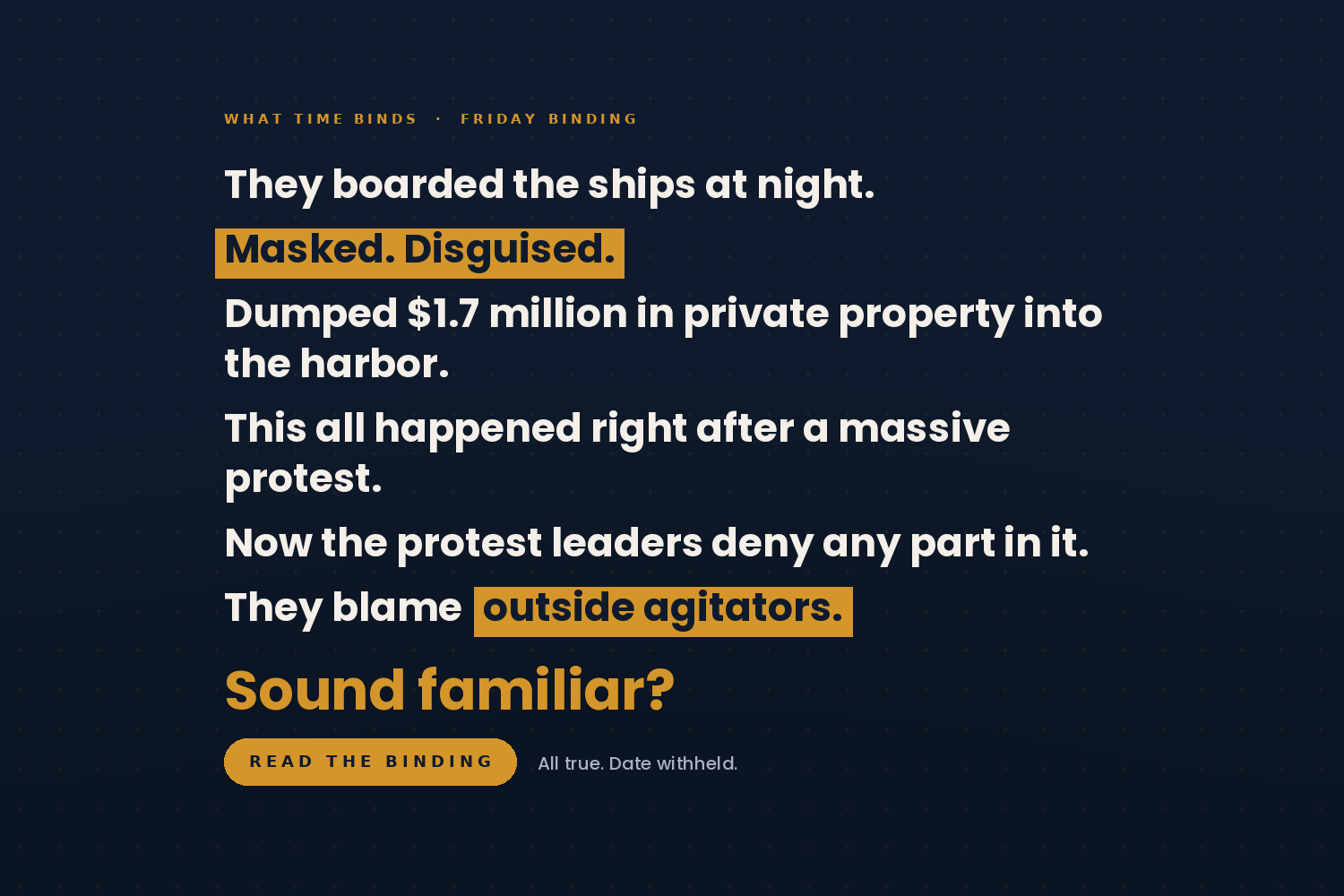
They boarded the ships at night. Masked and disguised, they broke into the cargo and dumped about $1.7 million worth into the harbor. Private property, all of it. This all happened right after a massive protest. Now the protest leaders deny any part in it. They blame outside agitators. Sound familiar?
Stop there.
What did you call them?
Rioters! Vandals! Criminals! Domestic terrorists! Maybe a name you have been saving for the other side for a few years now. Or maybe you felt a small warmth, because you guessed whose side they were on and you liked the side. Either way, you had a verdict before you had a date.
If you came here from the card on Facebook, you may have left your word in the comments already. Hold on to it. A verdict before a date is the lesson, and you just watched it happen in your own chest.
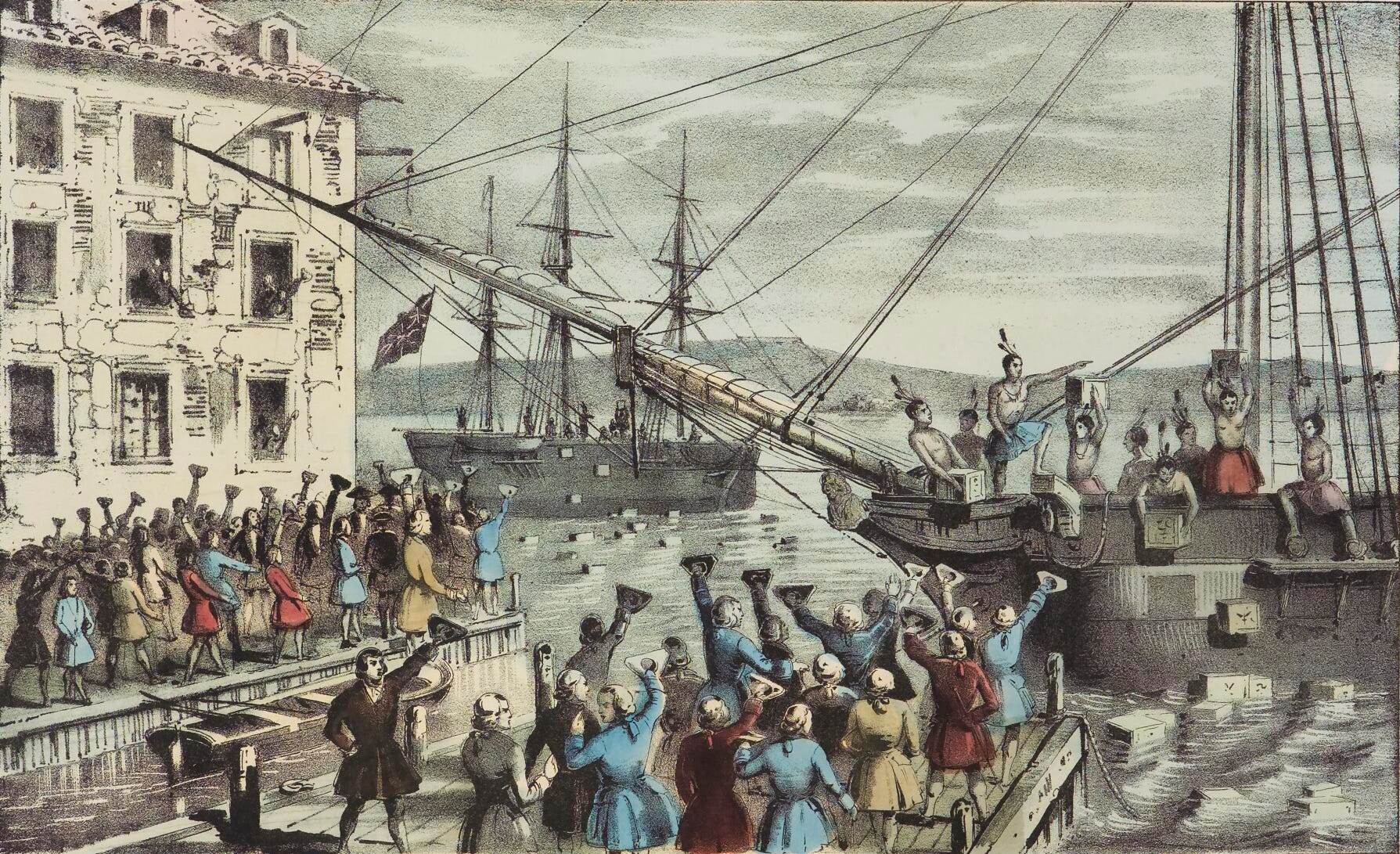
The date was December 16, 1773. The city was Boston. The property belonged to the East India Company, and the cargo was tea. Most of us learned to call those men patriots and the night a party.
Every fact in that first paragraph holds up. The ships, the night, and the protest are in the standard record: thousands packed the Old South Meeting House that day. The $1.7 million is the Census Bureau’s estimate of that cargo in today’s money. The soot they used for masks, the disguises, and the blame on outsiders come from the historian Alfred F. Young. “Outside agitators” is today’s phrase for what those leaders said. I changed the vocabulary and the tense. Nothing else.
The second half
The name “Tea Party” didn’t exist yet.
The historian Alfred F. Young put it plainly: “For more than 50 years, if it was mentioned at all in print, it was usually as ‘the destruction of the tea.’” Revolutionary Spaces, which runs the Old South Meeting House where the crowd gathered that day, says it took “almost a century for this event to transform from an embarrassing act of property destruction to a celebrated national origin story.”
The men who knew the event best did not cheer it. On February 2, 1774, Benjamin Franklin wrote from London to the Massachusetts House Committee of Correspondence that he could not justify, “in a Dispute about Publick Rights,” a decision “to destroy private Property.” He called it “an Act of violent Injustice on our part” and urged the colony to compensate the company.
That June, George Washington wrote to his friend George William Fairfax that the cause of Boston “is and ever will be considerd as the cause of America.” Then he added ten words inside a parenthesis:
“(not that we approve their cond[uc]t in destroyg the Tea)”
And the Boston leaders who would later be honored for that night did what leaders under pressure still do. In Young’s account, they “cited the Indian disguises worn by some in the boarding parties in order to deny responsibility for the affair and claim it was the work of outsiders.”
Hold on to that last word. It comes back.
What just happened to you
The reflex went off twice.
The first time, my words set it off. I wrote that paragraph in the vocabulary of your feed, and your body answered the vocabulary before your mind asked for a date. The second time, the name did it. “Tea Party” arrived decades after the event, and it put a holiday where a verdict should have gone.
Neither verdict came from the facts.
Franklin and Washington supported the cause. They had every reason to cheer, and they did something harder. They held the cause in one hand and the conduct in the other and judged each on its own terms. Washington did it in a parenthesis.
What you think of the men on those ships is yours to decide. So is whether any crowd from the last few years belongs beside them. That judgment rests on shape: what was destroyed, who was hurt, which law was broken, what remedy was offered. Three weeks ago I asked whether a comparison shares only the word or also the shape. This week the question runs the other direction.
Did the word decide before the shape arrived?
Why I care about half a second
I remember chatting with a good friend on a work trip to Iwakuni, Japan. Had to be 2006 or 2007. It was winter, cold and crisp out. He was with me in Iraq in 2003. When the ambush hit, he was in the vehicle ahead of mine. We were talking about the reactions our bodies still had to the smells and sounds of that day. Then we got to words and how a word can set off a similar feeling.
Muscles first. The meaning later, if at all.
I have been in enough stressful situations in life, in and out of the Marines, where reading the moment wrong cost something real. You learn to notice how your body feels. You learn what fear feels like, what discipline feels like, and the difference between the reaction that saves you and the one that wouldn’t. Either way, you would never know. If it didn’t happen, it didn’t happen. If it did, you are no longer alive.
The reaction to words is different. The body is firing, and there is nothing physical to react to. It feels physical. It isn’t.
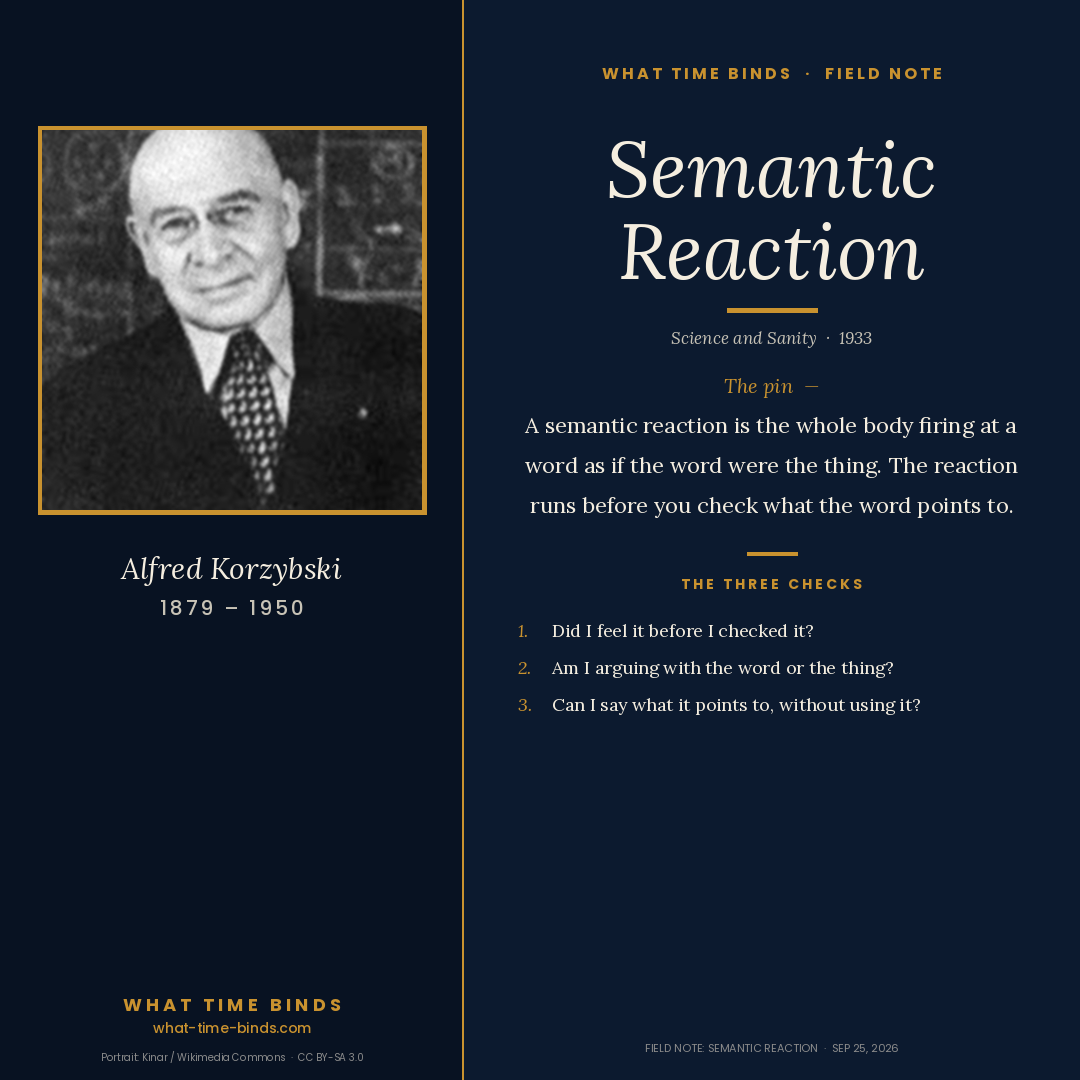
In 1933, a Polish-American scholar named Alfred Korzybski gave that reaction a name in Science and Sanity. He called it the semantic reaction: the whole organism answering a word as if the word were the thing. His other coinage, time-binding, is where this newsletter found its name. I have spent twenty years reading the people who named it before and after him. Five of them did something braver than name it. They set it off in their readers on purpose, then showed readers what had happened.
Five writers who did it on purpose
1. Horace Miner, “Body Ritual among the Nacirema,” American Anthropologist, June 1956.
Miner described a people “living in the territory between the Canadian Cree, the Yaqui and Tarahumare of Mexico, and the Carib and Arawak of the Antilles.” Every household keeps a shrine with a charm-box built into the wall. Specialists called holy-mouth-men perform painful rites on the mouth. “Were it not for the rituals of the mouth, they believe that their teeth would fall out, their gums bleed, their jaws shrink, their friends desert them, and their lovers reject them.” You read it and decide these people are superstitious and a little sad. Then you spell Nacirema backward. The shrine is your bathroom. The charm-box is your medicine cabinet. The holy-mouth-men are your dentist.
The technique: rename the familiar, and the reader judges it as foreign. I used it on you at the top of this Binding. I took it from him.
2. Jonathan Swift, “A Modest Proposal,” Dublin, 1729.
Swift wrote in the calm voice of a policy adviser solving a budget problem, and his proposal was to sell the infants of the Irish poor as food. “A young healthy child well nursed, is, at a year old, a most delicious nourishing and wholesome food, whether stewed, roasted, baked, or boiled.” Every word in that sentence belongs to the kitchen or the ledger. Your stomach turns anyway, because your body found the thing the vocabulary was built to hide. Then Swift hands you the target in one clause: this food “will be somewhat dear, and therefore very proper for landlords, who, as they have already devoured most of the parents, seem to have the best title to the children.”
The technique: keep the voice calm and let the reader’s horror aim itself. That is why my opening paragraph reads flat. Heat from a writer tells you what to feel. Flat facts make you find out what you already feel.
3. Shirley Jackson, “The Lottery,” The New Yorker, June 26, 1948.
A village gathers on a clear summer morning. Boys fill their pockets with stones. The men talk about planting and rain. The word “lottery” carries you through all of it, because in everyday English a lottery is a prize. The meaning arrives in the last paragraph, and it is the stones. Jackson documented the reaction herself, in a lecture later published as “Biography of a Story”: “Of the three-hundred-odd letters that I received that summer I can count only thirteen that spoke kindly to me.” Some readers, she recalled, wanted to know “where these lotteries were held, and whether they could go there and watch.”
The technique: let a warm word carry the reader past the point where they would have stopped. The warning I take from her: some readers never reach the last paragraph, and some reach it and keep the first word anyway. That is why the date in my opening came in the second paragraph, not the last.
4. Martin Luther King Jr., “Letter from Birmingham Jail,” April 16, 1963.
Four days earlier, eight white Birmingham clergymen published “A Call for Unity.” It called the demonstrations “unwise and untimely,” said they were “directed and led in part by outsiders,” and warned that these were not days “when extreme measures are justified.” King opened his reply “My Dear Fellow Clergymen” and then took their words one at a time. On outsiders: “I am in Birmingham because injustice is here.” On timing: “For years now I have heard the word ‘Wait!’ It rings in the ear of every Negro with piercing familiarity. This ‘Wait’ has almost always meant ‘Never.’” On extremism, he took the label and turned it around: “So the question is not whether we will be extremists, but what kind of extremists we will be.”
The technique: quote the word someone fired at you, slow it down, and pin it in public. Of the five, King shows the repair. He argued with the clergymen’s words and addressed the men as colleagues.
Read the Letter · Read “A Call for Unity”
5. Steve Rathje, Jay J. Van Bavel, and Sander van der Linden, “Out-group animosity drives engagement on social media,” Proceedings of the National Academy of Sciences, June 2021.
The researchers studied about 2.7 million Facebook and Twitter posts from news outlets and members of Congress. Each additional word referring to the political other side raised the odds that a post was shared by an average of 67 percent. In the published summary of the study, that effect ran almost five times stronger than negative emotional language and almost seven times stronger than moral-emotional language.
The technique: this one is the measurement, and it explains the business the other four were writing against. Miner, Swift, Jackson, and King set off the reflex and left the reader a way back to the facts: a name spelled backward, a clause about landlords, a pile of stones, a word pinned in public. The feed sets off the same reflex because a word about the other side raises the odds of a share by two-thirds. Then it scrolls on with bias intact.
Did I have the right to do this to you?
I went back and forth for weeks on whether to open this way. A piece that sets off your reflex on purpose is doing what your feed does to you all day. Here is my point. Every writer above did it to readers, and every one of them left a door back to the facts. So you got the date in the second paragraph, the founders’ own letters in the next section, and the name of the reflex after that. If I got the balance wrong, tell me. That is what the reply button is for.
The instrument
The instrument is the name that arrives before the facts. Sometimes a writer supplies it, the way I did in the first paragraph. Sometimes a century supplies it, the way “Tea Party” did. Sometimes the people in charge supply it, the way “outsiders” did in Boston in 1773 and again in Birmingham in 1963.
Includes: any verdict you reached before you could name the date, the place, the people, and the act.
Excludes: a verdict you reached after checking, even when it matches the one the word handed you. The reflex is sometimes right. The trouble is the order.
Example: you, in the first paragraph of this Binding.
Non-example: Washington, in his parenthesis.
A name is a verdict someone reached before you arrived. Every Monday, Wednesday, and Friday, I take one word an institution bent and show the page(s) it bent on. Subscribe, and the next one is in your inbox, free.
Repair protocol: when a word fires you before the facts arrive
Name your word first. Before you read on, say the word you just used for them. You cannot check a reaction you have not noticed.
Find the date, the place, and the people. If you cannot name all three, you are holding a label, and a label is not a verdict yet.
Split the cause from the conduct. Washington supported Boston’s cause and still judged the destruction of the tea. You can do both in one sentence.
Ask who named it, and when. Names often arrive after the event, from whoever won the argument about it.
Swap the words and read it again. Describe it in the other side’s vocabulary. If your verdict flips with the words, the words were deciding.
Say what it points to without the word. If you cannot describe the act without the label, the label is doing your thinking.
Save the card below. It carries the three questions I run on myself.
One word, two places
Go back to the ships one more time.
When the tea went into the harbor, Boston’s leaders reached for “outsiders.” One hundred ninety years later, eight clergymen in Birmingham reached for the same word to explain a movement arriving in their city. King answered in eight words: “I am in Birmingham because injustice is here.” The word did the same work in both places. It pointed the listener away from the thing.
You will hear it this fall. Run the checks when you do.
And keep Washington’s ten words. He wrote them in Williamsburg in June 1774, a year before the Continental Congress named him commander in chief of an army raised for the very cause he was defending in the same sentence. The friendly name we gave the men on those ships arrived long after him. What he left us is the parenthesis.
“(not that we approve their cond[uc]t in destroyg the Tea)”
A question for your reply
Reply with the word you used for the men on the ships, before you knew who they were. One word. If you want, add the word you use now.
I will read every one. If this lands and I hear from enough of you, next Friday I will show you what the room called them. That Binding is up to you.
I also want to write a series on the thinkers who studied the body’s reaction to words. One thinker per piece, each one read against something happening now. If you want that series, tell me in the same reply.
Read the page, then pass it on
The lesson fits in one line: the word arrives first, so check before you decide.
Every quote in this Binding links to the page it came from. Franklin’s letter and Washington’s letter sit on Founders Online, the National Archives’ free site for the founders’ papers. Read them yourself. Taking my word for what the founders said would be the same reflex with a new name on it.
Then pass them forward. The next time someone in your feed hangs a label on a crowd before anyone knows the date, you do not have to win the argument. Send the letter. A primary source travels farther than a verdict, and it teaches the person who receives it to ask for the page. That is how a record gets kept: one reader handing the next reader the document instead of the word.
Your ballot arrives soon, and every measure on it carries a title somebody wrote. Read past the name to the thing. Every race. Every measure. vote411.org
You refuse to know. The record remembers. I refuse to forget. — JWW
Sources, in order of appearance. East India Company cargo, chest count, and the Old South Meeting House crowd: Boston Tea Party (Wikipedia, citing the East India Company’s reported loss of £9,659) · Cargo value in today’s dollars: U.S. Census Bureau, “Looking Back 250 Years: The 1773 Boston Tea Party,” December 2023 · Disguises, soot, and the “outsiders” denial: Alfred F. Young, “The People and the Patriots,” Boston Review, November 1, 2011, and The Shoemaker and the Tea Party (Beacon Press, 1999) · Revolutionary Spaces, “Impassioned Destruction” · Benjamin Franklin to the Massachusetts House Committee of Correspondence, February 2, 1774 (Founders Online) · George Washington to George William Fairfax, June 10–15, 1774 (Founders Online) · “The Name They Keep Reaching For,” What Time Binds, September 4, 2026 · Mount Vernon, “Appointment as Commander in Chief” · Horace Miner, “Body Ritual among the Nacirema,” American Anthropologist 58, no. 3 (1956): 503–507 · Jonathan Swift, A Modest Proposal (1729), Project Gutenberg · Shirley Jackson, “The Lottery,” The New Yorker, June 26, 1948; reader mail from “Biography of a Story,” in Come Along with Me (1968), as quoted in the story’s reference record · “A Call for Unity,” April 12, 1963 · Martin Luther King Jr., “Letter from Birmingham Jail,” April 16, 1963 · Rathje, Van Bavel, and van der Linden, “Out-group animosity drives engagement on social media,” PNAS 118 (2021), with the comparative figures from the study’s press summary (Phys.org, June 2021) · Alfred Korzybski, Science and Sanity (1933) · Alfred Korzybski, Manhood of Humanity (1921), Project Gutenberg · Print: Nathaniel Currier, The Destruction of Tea at Boston Harbor (1846), public domain, via Wikimedia Commons.

This piece was written with AI assistance under the disclosure framework at what-time-binds.com. The analytical frame, the sources, and every position taken are mine and verified.
Jerry W. Washington, Ed.D., is a Marine Corps veteran of twenty-three years, a combat engineer by trade, an instructor at UC Irvine’s Division of Continuing Education, and the writer of What Time Binds, a record of how institutions bend words and how the page holds them to account.
I advise school districts, community colleges, and workforce teams on AI readiness: what the words mean before the tools arrive. Hit reply if you would like to talk or check out my practice site here: jerrywwashington.com