

In 2003, when I first went to war, information moved like it had weight. You waited for it. You hunted for it. A radio crackled, a runner showed up, a dusty map got unfolded on a hood.
By 2016, information moved like light.
I watched that change from the logistics and combat side—the unglamorous backbone of a fight and the tip of the spear.
In the early years, a convoy’s world was paper manifests, hand-scribbled notes, and the kind of “good enough” situational awareness that could still get you killed. Over time, the tools became sharper. GPS got better. Tracking systems got more precise. Sensors multiplied. Networks thickened. The war zone started to look, in flashes, like a modern city with a nervous system.
And then I’d see the same old human pattern repeat: a shiny new tool dropped into a unit that still ran on old assumptions. People clung to familiar scripts (dominance, blame, “don’t look weak,” protect your turf) while operating equipment that could coordinate thousands of people across miles in minutes.
That mismatch is hard to describe to civilians because it’s specific to war. We were surrounded by cutting-edge hardware while watching decision-making revert to the emotional equivalent of a fistfight in a parking lot.
One moment from my later deployments still sticks with me. I sketched out an idea for a mobile sport science lab—wearables and sensors that could track Marines’ physical strain in real time, prevent injuries, and improve training. It was the Engineer in me speaking: measure it, model it, optimize it. I sent the concept to my brother, expecting the kind of excitement that usually follows a clever technical fix.
He wrote back with a warning and a nickname: the Sports Missile.
My brother isn't the type to mock an idea. He was naming the risk. “Who owns the data?” “What happens when this gets used to punish people instead of protect them?” “What does it do inside a culture already addicted to toughness, status, and metrics?” He saw, instantly, that the tool would amplify whatever values were already in the room. If the room valued care, it would become a safety net. If the room valued control, it could become a leash.
That exchange was a small version of the larger story we’re living now.
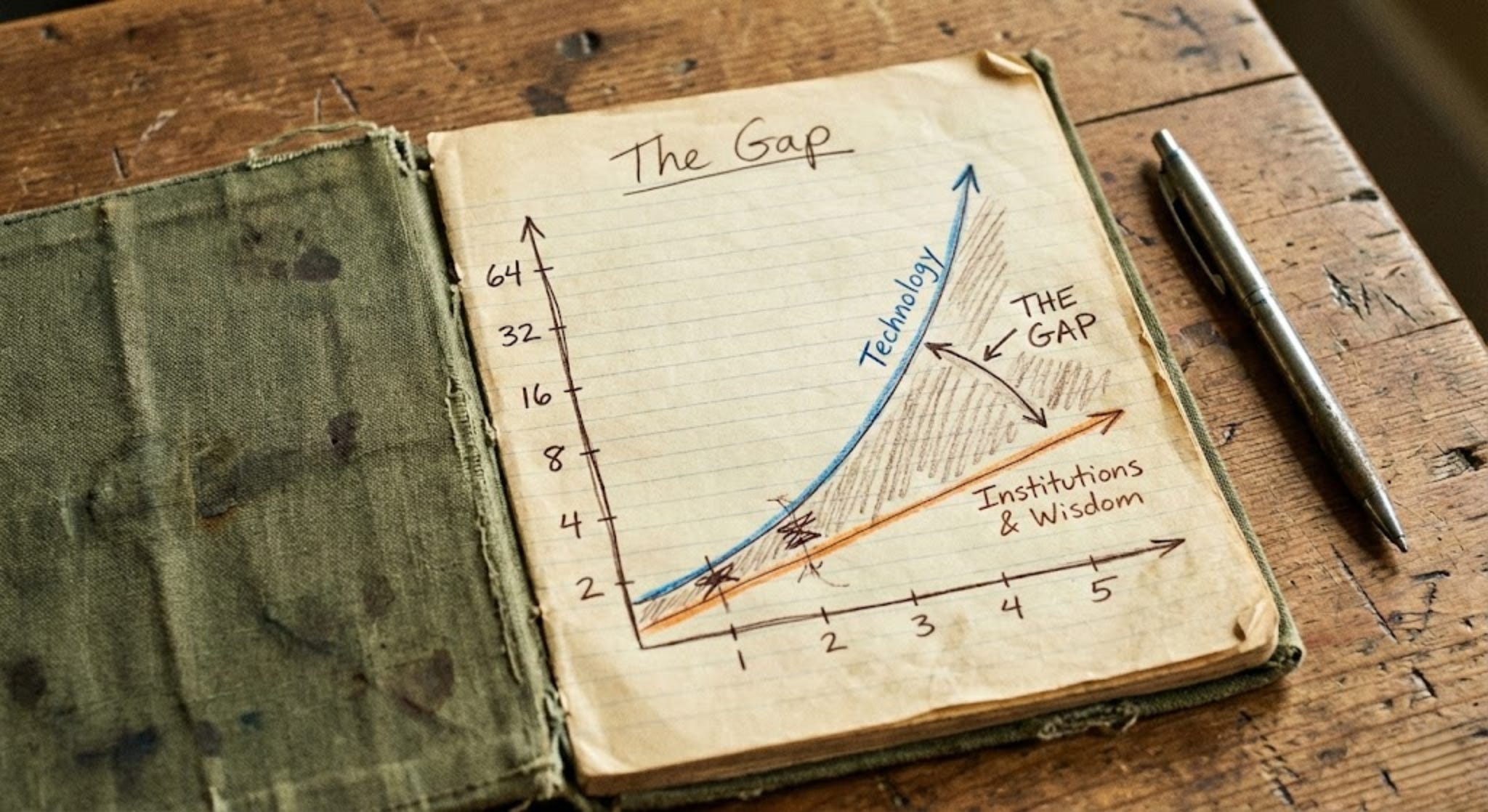
We have civilization-scale power—AI systems that can predict behavior, platforms that can shape mass emotion, markets that move at the speed of code. But a lot of our cognitive and institutional “maps” were drawn for a slower, smaller world. We’re navigating today’s terrain with yesterday’s instincts. The result is predictable: polarization, brittle governance, scarcity thinking, symbolic warfare. We shouldn’t be surprised when a society built for short-term competition struggles to manage long-term risk.
This is where I’ve landed after two decades of service, teaching, and research: the problem isn’t that humans are stupid. The problem is that we’re often loyal to outdated maps—mental models and institutional habits that once made sense, but now steer us into conflict with reality.
Some maps become emotionally non-negotiable. They stop being tools and start being identities. That’s when they turn into ghost maps: old routes we follow even after the roads have moved.
So what do we do?
I call the counterforce Binding Time. It’s a practice I learned about in 2003, and not a slogan. It starts with a simple premise: humans can pass improved maps forward. We can hand the next generation more than trauma, grievance, and broken systems. We can transmit better tools for seeing clearly and acting responsibly.
That requires both sides of me (us). The Engineer builds diagnostics: where are the incentives broken, where are the feedback loops toxic, where is the governance architecture too short-sighted to protect the future. The Gardener pays attention to conditions: are people resourced enough to think beyond survival, do they have the attention to learn, do they trust each other enough to cooperate.
Binding Time looks like choosing, on purpose, to update our maps together. Three starting moves are within reach of all
people:
Name the map. When you feel certain—furious, righteous, unshakable—ask what model is driving that certainty.
Test it against the terrain. What evidence would change your mind? If the answer is “nothing,” you’re not navigating—you’re defending.
Pass forward what works. Teach a younger person how you verify claims, how you recover from being wrong, how you disagree without dehumanizing.
In a war zone, the stakes were immediate. In civilian life, the stakes are generational. We are building the world our grandchildren will have to live inside. If our power keeps rising while our wisdom stays flat, we’ll keep firing missiles we don’t fully understand.
Binding Time is how we grow up: by making our maps worthy of the terrain—and worthy of those who come next.