

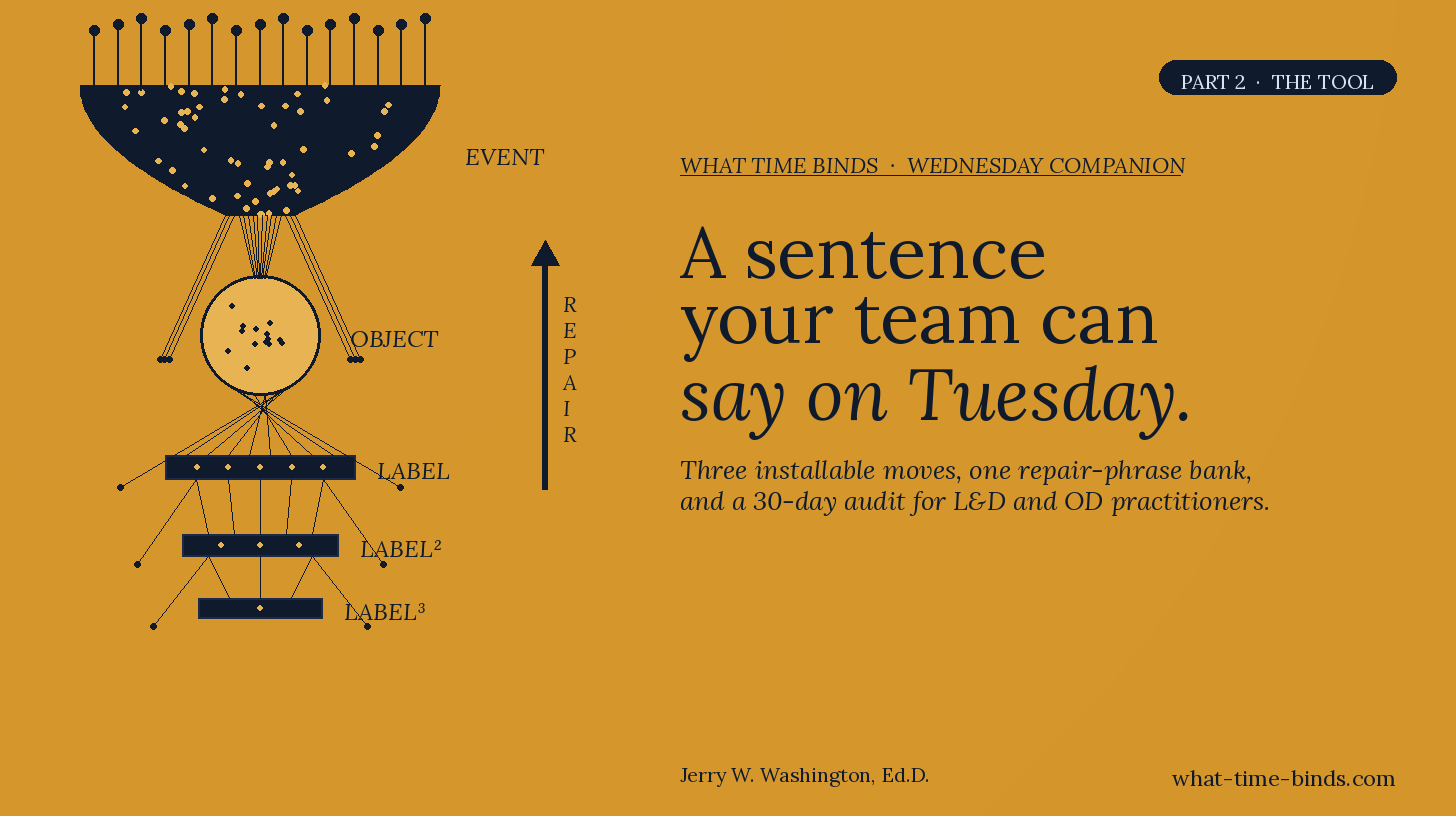
Monday, I walked you through a century of philosophy, cognitive science, and L&D research, all pointing at the same grammatical bug: the “is” of identity, the verb that quietly freezes a person’s behavior into the person’s supposed essence. Korzybski named it. Wittgenstein demolished it. Butler performed it. Bourdieu called it symbolic violence. And yet, no one handed a team a sentence to say out loud on a Tuesday at 2 p.m. to catch it, pause, and repair it.
Today, I want to hand you that sentence. Three of them, actually. Plus a 30-day audit and one uncomfortable meeting exercise.
The MRCI sequence, in 90 seconds
Drift → Suppression → Repair Activation → Outcome.
Drift names the moment a shared referent quietly migrates. “He’s just not strategic” drifts from observable behavior to a fixed attribute of the person. “Gen Z doesn’t want to work hard” drifts from a limited sample to a bounded kind.
Suppression names what happens next. The social cost of challenging the drift runs high enough that the team keeps moving, and the drifted meaning calcifies into a decision. Without psychological safety, suppression wins by default.
Repair Activation is the sentence-level move. Not a confrontation. A grammatically-specific request that makes the drift audible.
Outcome is the calibrated decision the team makes with the label removed and the event restored. Textio, Bohnet, and the Stanford work on gendered evaluation language all converge: when language shifts from dispositional to evidentiary, rating disparities shrink, and decision quality improves.
The 30-day install
Move 1 — Audit one artifact. Pull last quarter’s performance reviews, your competency rubric, or one leadership development module. Mark every sentence that attributes a stable essence (“she is strategic,” “he lacks executive presence”) versus every sentence that describes a specific event (“in the March pitch she restructured the agenda twice”). Count the ratio. It will shock you. It shocked me.
Move 2 — Run one meeting in approximate E-Prime. Not forever. Not perfectly. Just once, as an exercise, ideally a calibration, a peer review, or a team debrief. Ban every is, are, was, were, being, been for ninety minutes. Watch what it surfaces. Bourland’s 1965 argument was that the constraint forces precision. A hundred writing teachers since have confirmed it. Teams report the same effect and usually ask to do it again.
Move 3 — Install one repair phrase. One. The whole team. Said out loud when drift shows up. The phrase doesn’t have to sound clever. It has to get repeated until it becomes infrastructure, until the team reaches for it without deciding to.
The repair-phrase bank
Three phrases, calibrated to three situations. Pick one and practice it for two weeks before adding another.
For talent calibrations and performance reviews: “Can we translate that down to what we actually saw?” Neutralizes dispositional language. Forces the speaker back to observable behavior. Works especially well when the drift comes from a senior voice, the phrase doesn’t challenge their authority, it requests evidence.
For strategy and decision meetings: “Is that a pattern or a property?” Separates “this has happened three times” (pattern — actionable, repairable) from “he’s just like that” (property — closed, essentialist). Pattern language keeps the person changeable. Property language freezes them.
For culture and team-dynamics conversations: “Can we name the behavior instead of the person?” The Wittgenstein move. “Sarah interrupts in meetings” travels differently than “Sarah is difficult.” The first describes something a camera caught. The second places Sarah into a category that will outlive this conversation.
Optional fourth, for the philosophically-inclined team: “Is that an ‘is’ of identity or an ‘is’ of predication?” I’ve watched this one land in rooms where at least one person has read Korzybski. It makes the grammar audible. Some teams love it. Others find it too cute. Calibrate to your room.
An extension from the field
Monday’s essay had been live for about three hours when María Tomás-Keegan, my BoldTimers co-founder and a coach who works with professionals navigating late-career transitions, wrote back with a magnet word I had missed.
“Good one. I was thinking about the word ‘too.’ It holds such judgment. Too young, too old, too aggressive, too shy. Too many ‘too’s in our world.”
She’s right, and the linguistics backs her up. “Too” belongs to a different grammatical family than is, technically an excessivizer, an intensifier that scales beyond an expected or desired maximum. Where the “is” of identity freezes a behavior into an essence, “too” smuggles in an unnamed reference point. “Too aggressive” requires a yardstick (too aggressive compared to what?) that the speaker almost never surfaces.
So a fifth phrase for the bank, credited to María:
For any evaluation conversation where a “too-” shows up: “Too, compared to what?”
A small sentence. It makes the hidden yardstick audible. And if nobody in the room can answer it, the evaluation probably isn’t evaluating what it thinks it’s evaluating.
“Too” deserves its own essay and will get one, probably a What Do You Mean? entry in May, maybe co-authored with María if she’s willing. For now, add it to the bank and keep moving.
The handoff artifact
Every meeting that uses a repair phrase should produce one line in a running doc:
Date / Decision / Evidence / Language corrected.
Example: 4/19 · Promotion hold on Marcus · March pitch restructured by Jim; April QBR handed to skip-level · Corrected from “not strategic enough” to “has not yet led a strategic planning cycle end-to-end.”
This is the decision log future-you inherits. It’s also what HR needs when someone asks why the promotion didn’t happen.
Why this behaves like infrastructure
What makes this infrastructure rather than a skill or a mindset is that it installs at the team level, gets repeated, becomes audible, and compounds. It behaves the way Korzybski hoped the structural differential would behave, as a training device that produces a cortical delay, turning a reflex into a choice. The difference: MRCI runs on a Slack thread and a Monday standup, not a semantics seminar in 1937.
One invitation
If you run a team that does any talent evaluation in the next thirty days, try Move 1. Just the audit. Send me the ratio, anonymized, no identifying content. I’m building a reference dataset for the next iteration of the framework, and your artifact helps the field.
Monday, I said the grammar you use to describe your colleagues writes your culture in real time.
Today, I’m handing you the pen.
Edit it.
Jerry W. Washington, Ed.D., is an L&D and OD researcher whose framework MRCI (Meaning Repair as Cognitive Infrastructure) derives from a PRISMA-ScR scoping review of 131 academic sources. He writes at what-time-binds.com*.*
I’d be delighted to coauthor “too”!